Get Full Government Meeting Transcripts, Videos, & Alerts Forever!
Get email alerts on the Food Waste Recovery topic
No spam. Unsubscribe anytime.
Local nonprofit describes food‑rescue work; city staff outlines limited compost pilot options
Summary
Rooted In founder Selena Darrow urged more education and donation-based food waste recovery in Greater Green Bay; city staff said curbside organics collection is not yet feasible and recommended a city‑operations pilot at the Wildlife Sanctuary.
Selena Darrow, founder and executive director of the nonprofit Rooted In, outlined the organization’s food‑recovery and meal programs and urged the Sustainability Commission to pursue education and donation strategies to reduce local food waste. City staff later reported that a full curbside organics collection pilot is not feasible now and said the most practical near‑term test would be composting for city operations at the Brown County Wildlife Sanctuary.
Darrow told the commission she launched Rooted In two years ago and that the group both recovers surplus food for meals and distributes recovered foods to partner pantries. “The mission we have today is the mission from iHeart. It's to build a community table that nourishes and uplifts, and we bring access to local nutritious foods as a tool to transform health and well‑being,” she said. She described three programs: a monthly “Nourishment for All” meal program that she said produces “approximately 400 individually packaged meals” for pantry partners, a recipe database for households, and a “Glean team” that recovers garden, orchard and on‑farm surplus. Darrow said Rooted In recovered about 7,000 pounds of perishable food at the NFL draft and has recovered “over 25,000 pounds of recovered food in less than 2 years.”
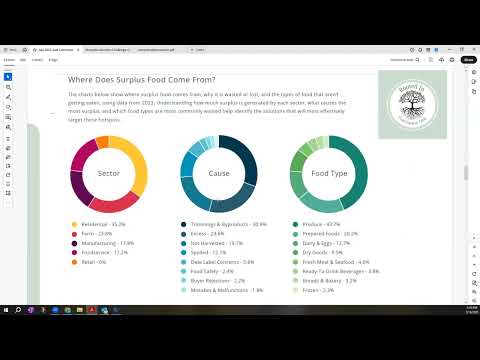
Darrow and several commissioners highlighted education and donation as low‑cost first steps. She described uncertainty over federal SNAP and Medicaid changes and said food recovery will help meet local need if federal supports change. She also described national and state research showing households commonly waste the equivalent of about $100 in groceries per month and noted inconsistent date‑labeling on food as an obstacle, citing California’s pending work on labeling consistency as a possible model.
Later in the meeting, city staff provided an update on a feasibility review of food‑waste composting pilots. Melissa (city staff) said staff had consulted the Wisconsin DNR and other municipalities and concluded that launching a curbside, public organics collection pilot this year was not realistic because of funding and operational constraints. “We felt like it would be a good idea to look internally and to look at pilots for our own operations from a staff perspective, not a public facing pilot,” she said. Staff recommended exploring composting options for city‑operated sites and identified the Brown County Wildlife Sanctuary as the most practical near‑term location because of existing composting activity and on‑site use for finished compost.
Staff described technical requirements and barriers: successful programs generally require capital for tamper‑proof or tumbling composters, operational staff or nonprofit partners to manage turning and monitoring, and safeguards against vermin where food or meat is present. Staff said Bay Beach Amusement Park has food waste dominated by items such as partially eaten hot dogs and buns and that some edible leftovers from events are being donated already; staff therefore judged Bay Beach a poor fit for an organics diversion pilot. The Wildlife Sanctuary, by contrast, already uses tumblers for a 4K program and has greenhouse needs for finished compost, making it a practical testing location. Staff also noted that residential curbside collection models in other cities usually start with nonprofit partners and outside grant funding before scaling to municipal programs.
Commissioners and staff asked for follow‑up: several asked staff to return with more detail on capital costs, operational champions and possible grant sources; others encouraged collaboration with local nonprofits already active in food recovery. Darrow offered to share successful materials used by Feed Milwaukee and to present further detail about Milwaukee’s USDA‑funded feed project, which she described as a model. Commissioners also discussed education campaigns and targeted workshops for schools and restaurants as inexpensive first steps.
The commission did not take formal action on a public curbside composting program at the meeting; staff said they would continue conversations with the parks director, the wildlife sanctuary and interested community partners and would return with more specific recommendations and cost estimates.
Ending: Commissioners thanked Darrow for the presentation and asked staff to report next steps for an internal pilot. Darrow and staff agreed to share resources and follow up on potential partnerships and grant opportunities.