
County board removes proposed 30% cap on park models and camping cabins; adopts other campground amendments
Get AI-powered insights, summaries, and transcripts
Subscribe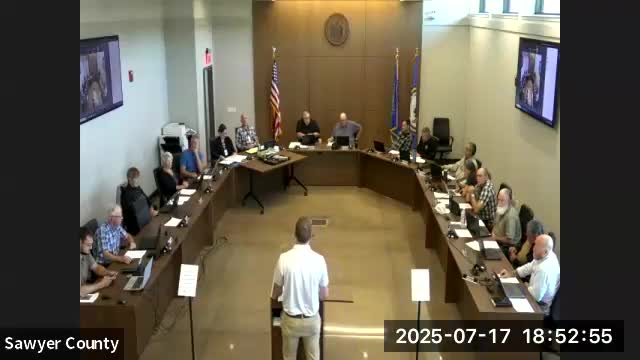
Summary
After public comment and committee debate, the Sawyer County Board voted 8-6 to remove a proposed 30% cap on park models and camping cabins in licensed campgrounds while approving other changes that revise size, height and utility rules for camping cabins.
The Sawyer County Board of Supervisors voted 8-6 to approve changes to the county campground ordinance but removed a proposed 30% cap on the combined number of park models and camping cabins at licensed campgrounds.
The amendment — brought forward as “option F” by the zoning committee — would have changed several rules for licensed campgrounds, including raising the maximum camping-cabin size from 300 square feet to 400 square feet, increasing maximum height to 16 feet (with no lofts allowed), allowing concrete slabs underneath camping cabins, and removing the existing prohibition on gas, water and sewer in camping cabins. The zoning administrator said the proposal would continue to require camping cabins to hook to code-compliant sewer systems and rely on state standards for wastewater sizing.
Why it matters: the changes would allow camping cabins with utilities and larger footprints and would adopt technical state definitions; opponents and supporters said the package could reshape how campgrounds in Sawyer County operate and how much space is reserved for transient campers versus more permanent, higher-revenue units.
Public commenters who identified as campground owners warned the 30% limit would constrain business and local tourism development. “We're defining park models from travel trailers from fifth wheels and so on and so forth,” said Adam Bodenshott, identifying himself as a Hayward-area campground industry business owner, arguing park models “fall under the RVIA code” and should not be singled out for a numeric cap. Camper-business owner Steve Bodenchat said park models “are from 75 to $95,000” and described the market as “glamping” customers who stimulate local spending.
Zoning administrator Jay Kozlowski reviewed how the amendment reached the board and the ordinance changes. Kozlowski said the draft uses state definitions in ATCP 79 and noted the package removes the prior prohibition on gas, water and sewer in camping cabins while allowing slabs (but not foundations) and increasing cabin size to 400 square feet. He explained a slab in his research was a 4-inch concrete slab distinct from foundations with frost footings.
County legal counsel Rebecca (last name not provided) advised the board on options: “Pursuant to 5,969, you have the option to enact the ordinance as you have it in front of you, you may make amendments to it or you may deny the ordinance… or you may refer it back to the zoning committee with directions.” Kozlowski and counsel told the board that because the 30% limit never took effect after the 2016 process, existing campgrounds that were already permitted would likely not be retroactively constrained by a newly adopted cap; the 30% provision would mostly affect new conditional use permits and expansions.
Supporters of a percentage limit argued a cap protects space for transient campers and prevents full conversion to park-model housing. Board member Kaye Wilson said she favored the cap, saying it preserves space for transient tent campers and pull-behind trailers. Opponents described the percentage as an arbitrary business restriction; several board members questioned the origin and justification of “30%” and said the towns’ earlier responses to drafts were mixed.
After discussion, County Supervisor (Miss) Cecil moved to approve the amendment but remove the 30% limitation; the motion was seconded by Supervisor Carian (record shows “motion by Miss Cecil, second by Mister Carian”). A roll-call vote produced an 8-6 result in favor of the motion to remove the 30% cap; the chair announced, “Motion carries.” The board therefore advanced the ordinance amendments with the 30% language omitted.
What remains unresolved: Kozlowski said the zoning committee and towns had considered multiple draft options over months and that the 30% language had been reintroduced during the committee process after mixed town responses. He also flagged local concerns raised in public comments and committee hearings about impervious surfaces, septic capacity and groundwater pressure if cabins with full utilities become common. Several public commenters urged the county to pursue groundwater mapping before broad utility changes; others urged local study of park-model impacts.
The board did not adopt a separate timetable for implementation in floor discussion; legal counsel said the board may adopt, amend, deny, or refer the ordinance back to zoning committee. Kozlowski said the ordinance changes under consideration would apply only to licensed, conditional-use campgrounds; existing permitted campgrounds would likely be unaffected unless a specific conditional-use permit had expressly included a 30% condition.
The board discussion and vote occurred after public comment from multiple campground operators and property owners and a zoning-department presentation that cited ATCP 79 and state wastewater (DSPS/SPS) standards.