
Centennial planning commission recommends denial of rezoning for 6021 S. Liverpool after residents raise traffic and grading concerns
Get AI-powered insights, summaries, and transcripts
Sign Up Free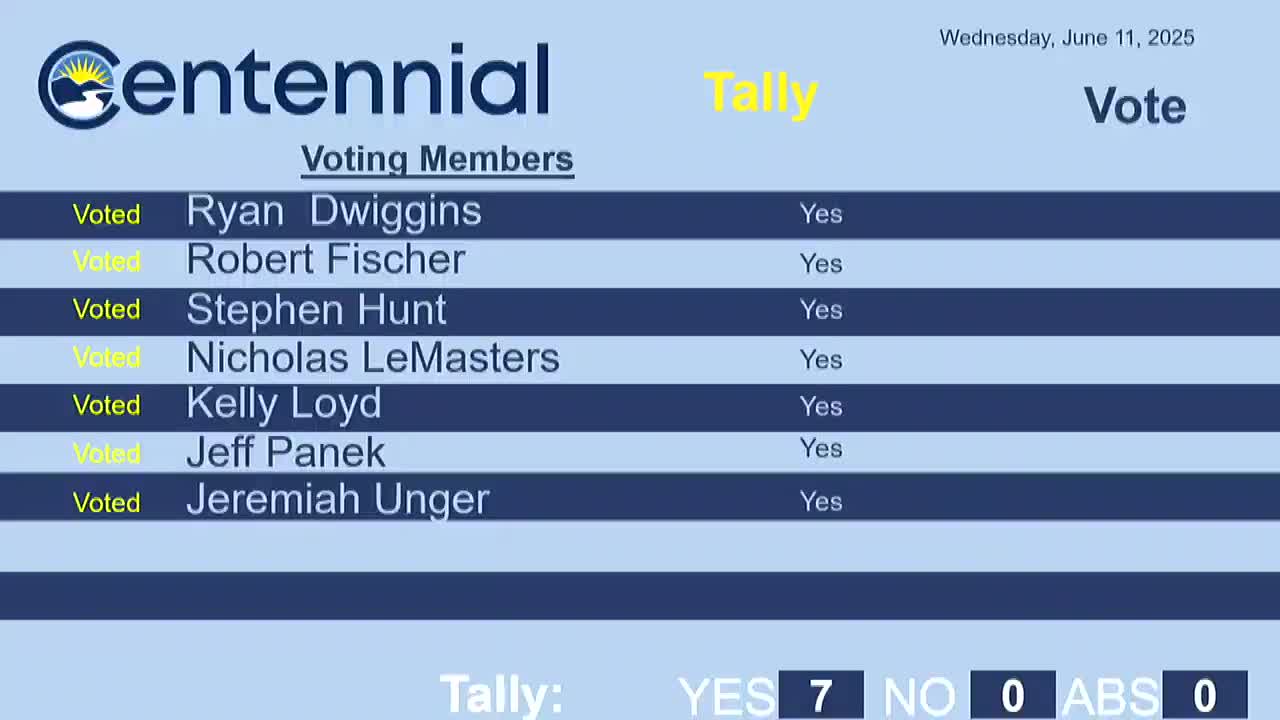
Summary
The Planning and Zoning Commission voted 4–3 on June 11 to recommend denial of Ordinance 2025‑o‑07, a request to rezone 6021 South Liverpool Street from Business Park (BP 35) to General Commercial (CG).
The Planning and Zoning Commission voted 4–3 on June 11 to recommend denial of Ordinance 2025‑o‑07, a request to rezone 6021 South Liverpool Street from Business Park (BP 35) to General Commercial (CG). The site, an 11.6‑acre parcel that includes Peakview Assisted Living, was proposed to be subdivided with 3.34 acres along East Smoky Hill Road considered for the rezoning and future commercial development.
City planner Stephanie Roren told commissioners, "My name is Stephanie Roren. I am a planner here at the City of Centennial. And tonight, for your recommendation, is a rezoning project located at 6021 South Liverpool Street." The staff report concluded the request met the written rezoning criteria in LDC section 12‑14‑604(e) and recommended approval to city council, subject to later site‑plan review.
But long public testimony and questions from commissioners focused on traffic, the steep grade change along Smoky Hill, and how a proposed fill/retaining wall and new site grade would affect Peakview residents and adjacent neighborhoods. Spectrum Retirement Communities, which owns Peakview and is the applicant for commercial pads, explained its history in the area. Mike Longfellow of Spectrum said Spectrum "has developed more than 50 communities in 12 states," and Todd Hager of Galloway and Company described the applicant's intent to maintain higher landscaping standards during site plan review.
Traffic consultants and city traffic staff said a traffic impact study (TIS) was provided for concept‑level review. Traffic engineer Brian Horan summarized the TIS methodology and told commissioners that a nearby neighborhood access on Kirk Street "operates at level of service F in existing conditions. It is difficult to make the left out of that neighborhood," and said any future site plan would be designed to direct traffic away from that constrained intersection. City traffic staff also noted Smoky Hill at Piccadilly carries roughly 27,000–45,000 vehicles per day depending on the segment and that existing crash data did not place the intersection in the highest safety concern categories.
Dozens of residents from Greenfield, Hillside and nearby streets used the public‑comment period to oppose the rezoning. Speakers cited left‑turn difficulty from Kirk onto Smoky Hill, the potential for additional cut‑through traffic in residential streets, noise and light pollution from a higher lighting zone, and the visual and privacy impacts of a large retaining wall. Fred Eamon, who lives on Orchard Place and said his home is "right at the corner of Kirk and Smoky Hill," warned the change could "impact our traffic exponentially." Several residents asked that the applicant meet directly with the neighborhood before the proposal moved forward.
Commissioner Unger moved to recommend denial on the basis that the request did not meet LDC criterion 9 (that proposed amenities and uses "tend to enhance the quality of life in the area by creating a comfortable and aesthetically enjoyable environment"). Commissioner Masters seconded. The commission chair called the roll and the motion passed 4–3, a recommendation that will be forwarded to city council for the final public hearing on June 17, 2025.
What remains clear from the record is that the rezoning request shifts the parcel from BP 35 — a district with limited retail and a 35‑foot height limit — to CG, which permits broader commercial retail, restaurants and up to 50 feet in height; it also reduces the required landscape surface ratio from 25% to 15% and moves the property from lighting zone 2 to lighting zone 3. Staff and applicants emphasized that detailed design, traffic access and grading plans would be reviewed at the site‑plan phase should council approve the rezoning.
The commission's recommendation does not itself change zoning; the matter is scheduled for a city council public hearing on June 17, 2025. If council approves a rezoning, any future development will return to staff and the commission for site‑plan and infrastructure reviews, including traffic, stormwater and retaining‑wall engineering.
Ending note: The packet at the public hearing included staff's analysis, the applicant's concept plan and a TIS; staff said referral agencies (including Southeast Metro Stormwater Authority and East Cherry Creek Valley water/sewer) provided no objections to the rezoning itself but noted that agency approvals will be required for subsequent site plans.