Get Full Government Meeting Transcripts, Videos, & Alerts Forever!
Get email alerts on the Land Use topic
No spam. Unsubscribe anytime.
City staff recommends moratorium on enforcing group‑living occupancy rules while state law and local standards are clarified
Summary
Staff advised council to adopt a temporary moratorium on enforcing numerical occupancy limits in the city code for group-living facilities so staff can rewrite local definitions and explore health-and-safety standards; the moratorium is slated for public hearing and possible vote at the next regular meeting.
City staff recommended a temporary moratorium on enforcing portions of the municipal code that regulate group‑living occupancy counts so the city can align local rules with a recent state law and, in parallel, evaluate local health-and-safety standards.
The item stems from House Bill 24-107 (referenced during the workshop as the statute that bars local governments from limiting how many people may live together based on familial relationship). Mike framed the issue: the state law “does not allow us to regulate group homes based on a quantity of people,” and the city’s current code contains multiple categories and numerical thresholds that are no longer compatible with that statute.
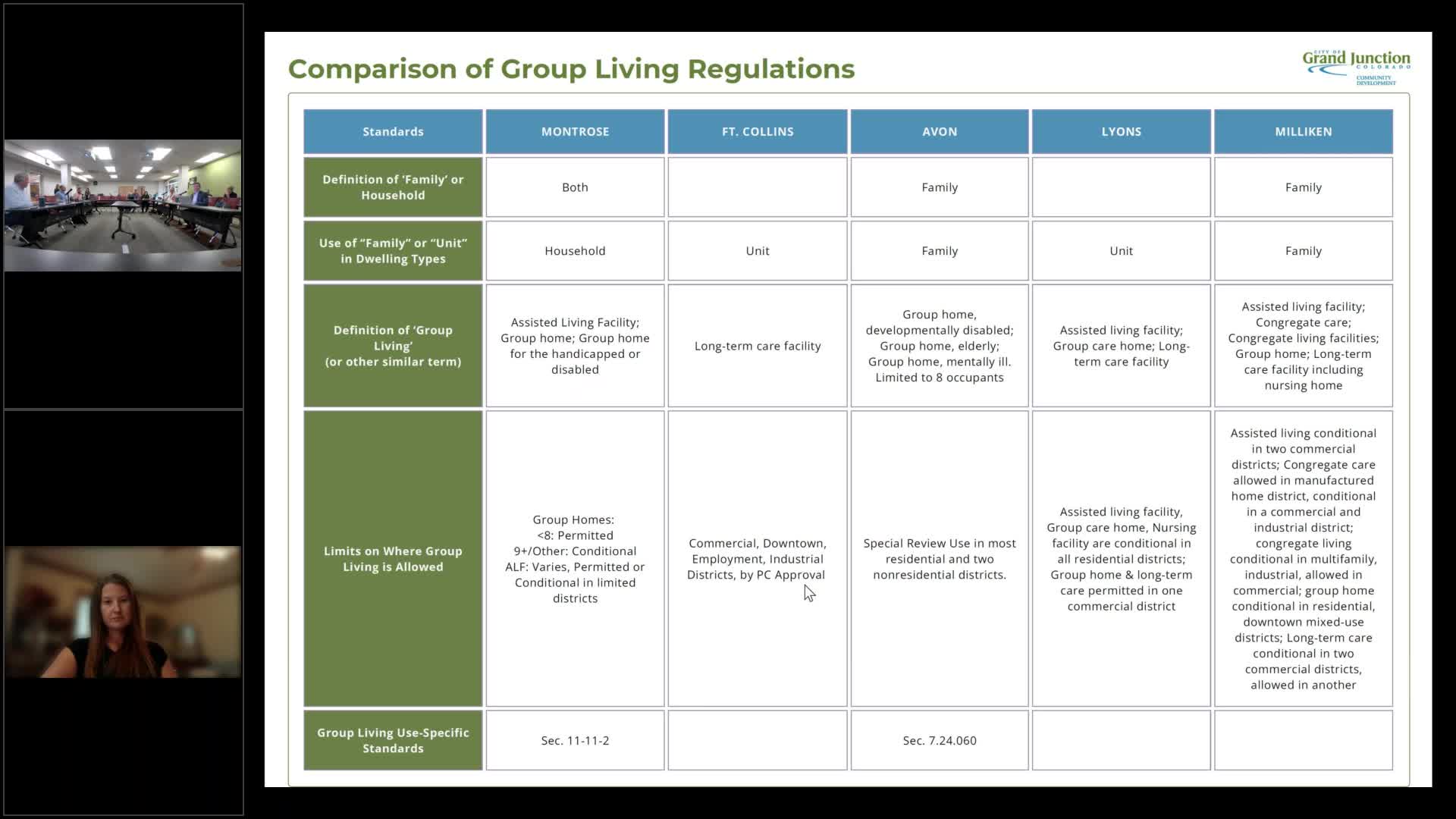
Nikki, identified as a planning manager, summarized how other Colorado jurisdictions have responded: some (Montrose and others) allow eight or fewer residents by right and require conditional use review for properties with nine or more; others eliminated some group-living categories or treated certain facilities as nonresidential. Nikki said the statutory reference linked the “eight or fewer” threshold to language in state zoning law that treats group homes serving specialized populations as residential when they house not more than eight persons.
John, the city attorney, cautioned that adopting an alternative approach does not remove legal risk but described two parallel paths staff is pursuing: (1) bring a short moratorium on enforcement so the city can pause actions that are facially inconsistent with the state statute while staff completes a code rewrite; and (2) have building and fire officials develop demonstrable health-and-safety standards (for example, International Building Code or fire code metrics) that would legally support occupancy limits. “Well, short answer is no,” John said in response to a question about whether the new information reduced litigation risk; he later recommended the moratorium as the prudent first step.
Council direction: Council did not adopt new regulations in the workshop. Members generally supported placing the moratorium on the agenda for a public hearing and possible vote at the next regular meeting so the city has time to evaluate code changes, consult building and fire officials about measurable safety standards, and monitor related legislative developments. Staff plans to return with draft moratorium language and with analysis of what a code rewrite would entail.
Discussion versus decision: The workshop provided policy direction; an ordinance or resolution will follow at a public hearing. Staff emphasized that the moratorium would be limited to the portions of local code that rely on numeric household/occupancy counts and not a ban on group living per se. Staff also flagged possible ripple effects — reclassifying some uses as nonresidential, adjusting reporting requirements, and determining nonconforming-status rules for existing facilities — that will require careful code drafting and legal review.