Get Full Government Meeting Transcripts, Videos, & Alerts Forever!
Get email alerts on the Affordable Housing topic
No spam. Unsubscribe anytime.
Council assigns private-activity bond allocation to fund 144-unit Ascent affordable housing on Salt Flats
Summary
City council approved assigning carryforward and 2025 private-activity bond (PAB) volume cap to the Colorado Housing and Finance Authority for the Ascent at Salt Flats project, unlocking low-income housing tax credit equity for a 144‑unit development that targets 30–70% AMI.
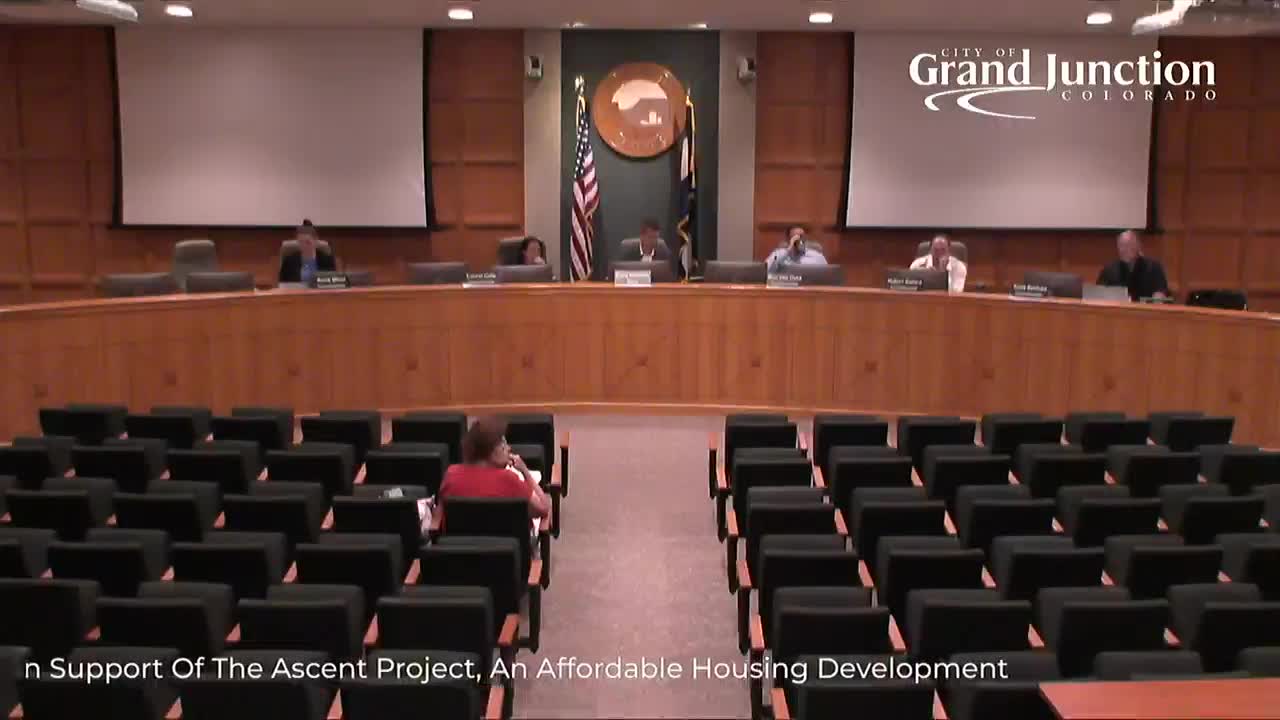
Grand Junction City Council on July 7 voted to assign the city’s available private-activity bond (PAB) volume cap to the Colorado Housing and Finance Authority to support Ascent at Salt Flats, a proposed 144‑unit affordable rental development. The council authorized delegating carried-forward 2023–24 PABs and the city’s 2025 allocation to CHFA so the developer can access low-income housing tax credit equity and other financing tools. The action matters because PAB allocation allows projects to combine tax credit equity without competing in the annual statewide competitive round, potentially accelerating delivery of deeply affordable units. City housing staff said the city carried forward about $8.28 million in PAB authority from 2023–24 and that the 2025 allocation is about $4.46 million — roughly $12.7 million of local PAB authority when combined — and that assigning it to CHFA will help secure roughly $17.2 million in LIHTC equity for this phase. Ashley Chambers, the city staff member leading the PAB process, said the Salt Flats is a 21.78‑acre, city‑owned site acquired with CHFA Prop 123 funds and infrastructure grants; the Salt Flats master plan currently envisions about 467 total units when fully built and a goal that roughly 70% of units on the site meet affordability definitions. Tyler Elick, chief development officer for Brookwell (the project developer), said Ascent at Salt Flats would sit on about 4.35 acres, total 144 units and include studios through four‑bedroom units. He said the complex would average roughly 58% of Area Median Income (AMI) and range from 30% to 70% AMI, and that the design intentionally includes unit sizes (studios and larger 3–4 bedroom units) that the local affordable housing stock currently lacks. Elick described the financing effect: “This assignment will unlock about $17.2 million of equity that is necessary to make the project feasible,” and said the combination of tax credit equity and debt/soft funding will be essential to move forward. Council members and staff also placed the move in the context of the city’s Proposition 123 commitments. Chambers said the city has a target of 374 units tied to prior commitments; with projects already in process and the Ascent proposal, staff estimates the city could approach roughly 430–435 units by 2026, depending on final unit counts and income‑averaging rules. Council approved the resolutions assigning PAB authority to CHFA by voice vote, 7–0. The council’s approval delegates to CHFA the ability to issue the bonds and support the project’s LIHTC financing pathway. What’s next: the developer will proceed with CHFA financing steps and LIHTC syndication now that the PAB authority has been assigned. City staff said other Salt Flats phases and partners will continue to be advanced through the development, permitting and financing processes.