
Gov. Maura Healey launches statewide anti-hunger task force after federal SNAP cuts
Get AI-powered insights, summaries, and transcripts
Subscribe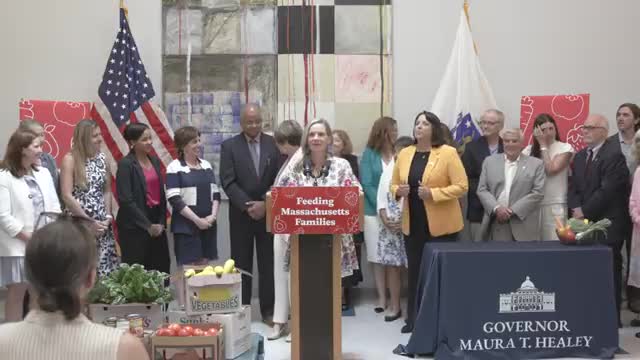
Summary
Gov. Maura Healey announced the formation of a statewide anti-hunger task force at the Mystic Community Market in Medford, directing it to produce a six-month plan to address increased food insecurity following recent federal cuts to nutrition programs.
Gov. Maura Healey announced the formation of a statewide anti-hunger task force on a visit to the Mystic Community Market in Medford, directing the group to deliver a plan within six months to address increased food insecurity tied to recent federal cuts to nutrition programs.
The task force will convene state agencies, local governments, nonprofits and philanthropic partners to host listening sessions, form working groups focused on specific populations and develop both immediate gap-filling steps and longer-term solutions, Healey said. "That's what this is, a hunger fighting strike force, so to speak," she said.
Why this matters: speakers at the event said the recent federal action will reduce food support nationwide and could affect roughly 1,000,000 people in Massachusetts who use SNAP. Healey described the federal package as a large reduction in food assistance and said the state must act to prevent heightened hunger among children, seniors, veterans, people with disabilities and other vulnerable groups. "These cuts are cruel. I think they're destructive," Healey said at the market.
Administration and nonprofit leaders framed the announcement as an urgent coordination effort rather than a single funding fix. Catherine D'Amato, president and CEO of the Greater Boston Food Bank, said the administration is "taking action" and that the state must maximize existing resources while continuing to press for federal support. "It's a wake up call for us to be coordinated in our action across the state," D'Amato said, summarizing findings from the food bank's recent statewide hunger study.
Local operators described current strain on food-distribution infrastructure. Debbie Amaral, who runs the Mystic Community Market and serves on the Greater Boston Food Bank board, said the market has expanded rapidly since its ribbon-cutting in 2020 and now distributes millions of pounds of food and thousands of bags monthly. "We serve about 2,600,000 pounds of food," Amaral said at the event, adding the market serves more than 12,300 individuals a month and distributes more than 15,000 bags per month (figures provided by Amaral at the announcement).
Erin Maclaire, identified at the event as president and CEO of Project Bread, called hunger a systemic problem and urged state-level leadership. "Hunger is not an individual failing. It's a systemic one," she said, and praised the administration's plan to assemble a cross-sector team. Project Bread and the Make Hunger History Coalition have mobilized stakeholders statewide, Maclaire said, and she noted the group hears daily from households that rely on programs such as SNAP, WIC and school meals.
Speakers also cited program-scale figures discussed at the event: Healey said SNAP injects about $3,000,000,000 annually into the Massachusetts economy; the governor and presenters said roughly 900,000 children receive free school meals and that Summer Eats is estimated to provide some 2,000,000 meals in July (estimates cited at the announcement). The governor said the federal actions that prompted the announcement include an enacted bill she described as cutting roughly $200,000,000,000 nationally from food support programs; event speakers warned that reduced eligibility or benefits would also reduce federal funding streams tied to school meal eligibility and other programs.
The task force will be staffed across the Office of the Governor and multiple state agencies and is expected to report short-term recommendations within six months and a longer-term blueprint afterward, Healey said. The event featured officials and staff named by the administration as participants or partners, including Lieutenant Governor Kim Driscoll; Kiami Mahania, secretary of health and human services; Rebecca Tepper, secretary of energy and environmental affairs; Lauren Jones, secretary of labor and workforce development; Robert Limson, secretary of aging and independence; and other agency officials and nonprofit leaders.
Speakers urged public engagement. Healey told attendees and listeners to "reach out, find out what your local food pantry needs" and encouraged donations and volunteering. The Greater Boston Food Bank and other local providers emphasized that philanthropy and state action alone cannot replace federal programs.
Next steps: the governor said the task force will host listening sessions to identify where hunger risk is rising fastest, develop working groups focused on specific populations and produce a six-month plan for immediate interventions and a longer-term strategy building a more resilient statewide food system.
Votes or formal legislative actions: none were taken at the event; the announcement constituted an executive direction to form the task force and coordinate state and nonprofit response.