
Planning staff seeks broad text amendments to remove "family" from zoning code; moratorium on enforcing group-living rules to go to council
Get AI-powered insights, summaries, and transcripts
Subscribe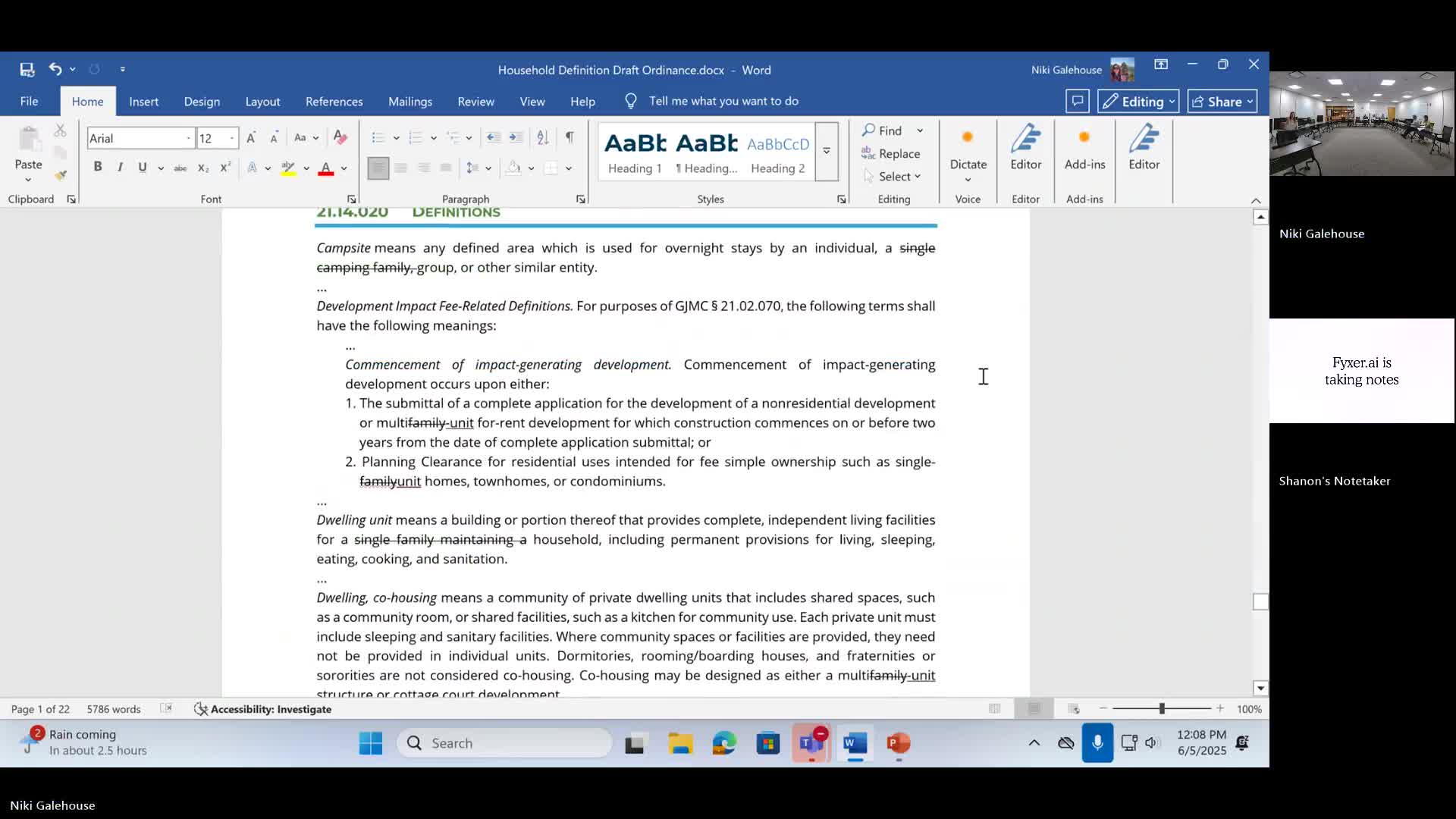
Summary
City planning staff reviewed proposed text amendments that replace or remove "family" from multiple zoning definitions, said most changes are terminological, cited state law language, and told the commission a temporary moratorium on enforcing group‑living rules will go directly to city council for first and second reading.
Planning staff told the Grand Junction Planning Commission on Tuesday that they will present a multi-page zoning text amendment that removes the word “family” from many code definitions and replaces it with “household” or deletes it where redundant, and that the city will seek a moratorium on enforcing its group‑living rules while state law issues are resolved.
The change affects definitions across the zoning code, staff said, including the definitions of “household,” “dwelling unit,” and shifts from terms such as “single‑family” and “multifamily” to “single‑unit” and “multi‑unit.” "Most of the actual significant changes are in the definitions. So I'm gonna start there," Planning staff said during the presentation.
Staff said the amendments are largely terminological: the package runs 22 pages but "it's only, like, 30 words that are changing," and the revisions were drafted to align local language with state law. The staff cited a state measure in the discussion and read a statutory phrase into the proposed household definition that would allow occupancy limits only to the extent allowed by applicable health and safety codes or other state or federal law: "the number of occupants shall not exceed the maximum allowed by health and safety codes if and when any are found under adopted and or by any applicable state or federal law or regulation and or by applicable affordable housing standard, if any," the staff presentation read, referencing the statute by the phrase used in the meeting: "House Bill 20 four‑ten oh 7" and the broader "state law."
Staff also said they will recommend a temporary moratorium on enforcing the city's group‑living regulations while the precise effect of the state law on managed or supervised group living situations is clarified. "For the meantime, we are gonna pursue the moratorium on enforcement of our group living regulation," the presenter said, and added that the moratorium ordinance "does not need to come before planning commission. It'll go straight to council for first and second reading." The moratorium, as described by staff, would pause enforcement of the local group‑living rules while staff and elected officials consider how to integrate changes required by state law.
Commissioners asked clarifying questions about how specific housing types will be classified after the edits. One commissioner asked whether “duplex” will mean any building with more than one unit; staff clarified the local distinction: a duplex is two units on the same lot, while "single unit attached" covers two or more attached units that are separately platted. Commissioners also queried how the code treats managed living and sober‑living homes; staff said the code currently distinguishes "group living" by the provision of services and that some types of sober living may or may not be considered group living depending on whether services are provided on site.
No formal action or vote was taken by the planning commission on the text amendment or the moratorium during the meeting. Staff said the text package will move forward in the city's public hearing process and that the moratorium will go directly to city council for consideration at first and second reading.
The commission was given the staff report and draft language in advance; staff told commissioners they plan to bring the full code edits for the regular hearing process and to answer detailed questions at that public review stage.
Clarifying details from the presentation: the draft text edits run roughly 22 pages, staff said the substantive edits affect a small number of words (staff described "about 30 words" changing), the household definition would be revised to remove relationship‑based language and limits on unrelated persons and to add the state‑law occupancy caveat, and the proposed moratorium would suspend enforcement of the city’s group‑living regulations while the city processes the code changes and interprets the state law.
Next steps: staff said it will publish the text amendment package for public hearing and submit the moratorium ordinance to city council for first and second reading. The planning commission’s role at this workshop was informational; staff told the commission the moratorium ordinance itself will not require planning commission review before council consideration.