
CalHFA board approves $2.4 million permanent loan increase for Marina Village
Get AI-powered insights, summaries, and transcripts
Subscribe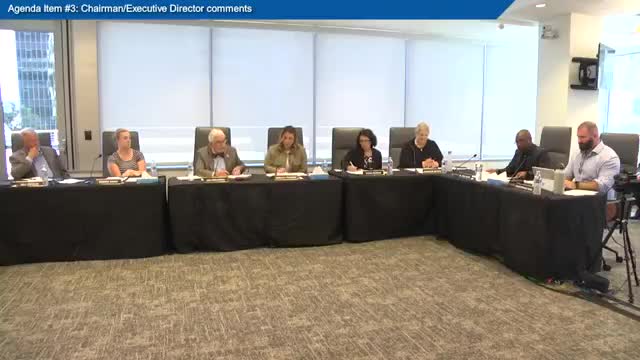
Summary
The California Housing Finance Agency board voted to approve a $2.4 million (10%) permanent loan increase for Marina Village, a 160-unit mixed-income project in Suisun City, citing COVID-era cost and interest-rate increases; the board discussed effects on developer fee timing and repayment of agency subsidy (MIP).
The California Housing Finance Agency board on a voice roll call approved Resolution 25-21 to increase the agency's permanent loan for Marina Village by $2,400,000, a roughly 10% increase to the project's permanent financing. The motion to approve was made by Director Russell and seconded by Director Sotelo; the roll call showed the motion passed with board members voting in favor.
The board heard details from Stephen McFadden, CalHFA's director of multifamily programs, who said Marina Village is a 160-unit family project in Suisun City, Solano County, developed by Solano Affordable Housing Foundation and originally financed under CalHFA's 2021 Mixed Income Program. "This is a permanent loan increase request that exceeds 7% of the original commitment amount," McFadden said, explaining the item required board approval. He said projects that started construction in 2021'22 faced COVID-related delays, higher construction costs and rising interest rates, and that the agency is seeing more conversions request increases at permanent financing.
McFadden described specific factors at Marina Village: the construction lender (JPMorgan Chase) faced higher variable interest costs during construction; vandalism led to theft of backordered electrical switchgear; and the tax credit investor is R4 Capital. He said, "To help cover these costs, the developer is requesting a $2,400,000 increase to our permanent loan, which is a 10% increase." CalHFA said it has locked the conversion interest rate and the new hybrid rate will be 4.24%.
CalHFA underwriting found the project remains within the agency's debt service coverage and loan-to-value limits, in part because higher AMI levels allow higher rents than originally modeled. McFadden said the CalHFA Mixed Income Program unpaid balance at refinance remains zero under the proposed structure.
Board members focused several questions on developer fee treatment and the Mixed Income Program (MIP) repayment timeline. Director Sotelo asked whether increasing the deferred developer fee would delay repayment to the MIP; CalHFA staff and Kevin Brown, the agency's housing finance officer, explained that the developer fee at board approval rose from about $7.2 million to $11.3 million, and that the revised cash flow will defer some MIP receipts for a short period but, as under the original approval, the agency expects full repayment over the long term. Brown said the deferred developer fee will be repaid under the revised structure and "we still end up at maturity with 0 MIP outstanding." He added that payments toward the MIP start later in the cash flow and extend through later years of the model (staff referenced payoff patterns beginning around the mid- to late-teens of the model and continuing toward maturity).
Directors and staff emphasized the broader market trend: McFadden said 71% of recent conversions required loan increases and 14 additional loan conversions were scheduled in the next six months, reflecting industry-wide construction and financing pressures. Several board members said they supported the loan increase to protect CalHFA's on-going investments and to enable occupied affordable units to reach permanent financing.
The board then voted to approve Resolution 25-21. No public commenters spoke on the item at the meeting.
CalHFA staff noted ancillary concessions in the transaction: additional equity proceeds, an increased deferred developer fee, the addition of a fully subordinate development-deficit loan, and an insurance claim for vandalism damages. The staff recommendation to the board was to approve the loan increase based on the updated underwriting and appraisal.
The approval will allow the conversion to proceed with the newly sized permanent loan and the locked hybrid interest rate; staff indicated similar conversion requests will come before the board as other projects from that 2021 construction period reach permanent conversion.