Lifetime Citizen Portal Access — AI Briefings, Alerts & Unlimited Follows
Committee advances Waste No More ordinance to full council after weeks of negotiation over exemptions for small restaurants and events
Loading...
Summary
Task force members and the mayor’s office remain at odds over construction & demolition thresholds, restaurant exemptions and event exemptions; committee voted to move the item to full council for floor debate and possible amendments.
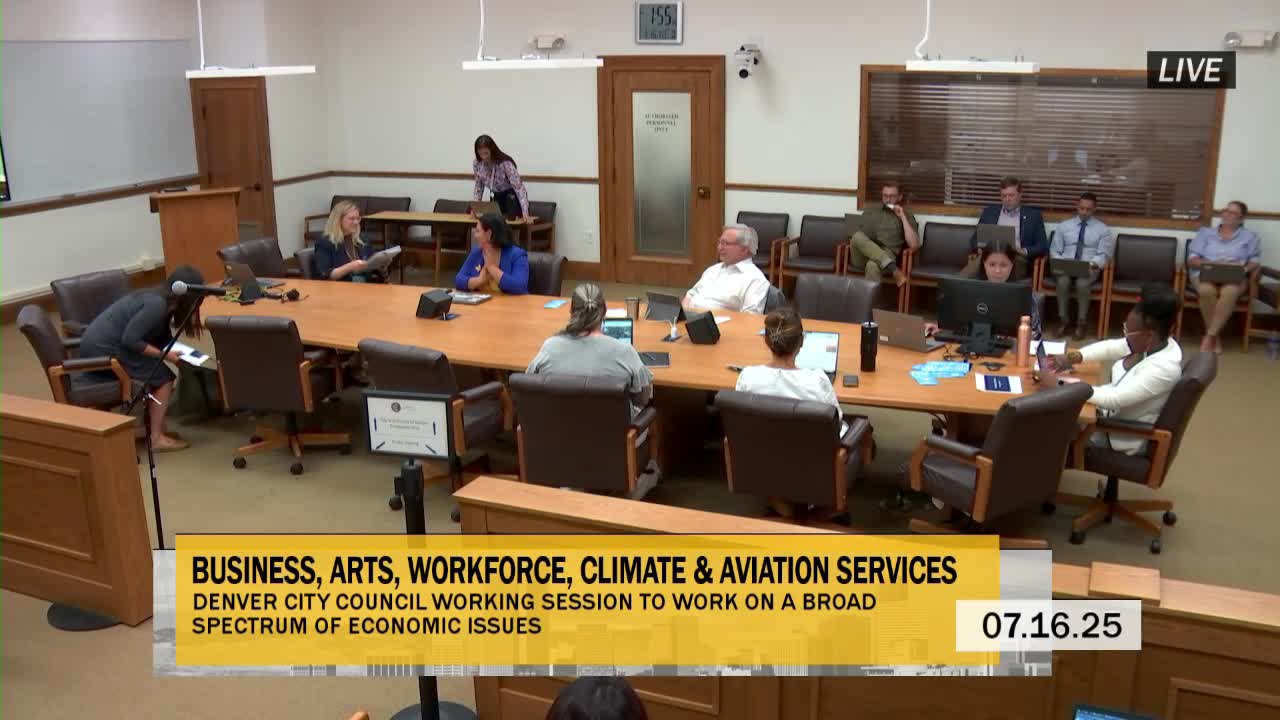
Denver’s Business, Arts, Workforce, Climate and Aviation Services Committee voted to move the Waste No More ordinance out of committee and to the full council after extended testimony from task force advocates and mayor’s office staff over several outstanding exemptions and implementation details.
Task force members from Green Latinos Colorado presented a redline of recommended changes and urged narrower exemptions for construction and demolition activities, smaller thresholds for special-event exemptions, and tighter limits on a proposed restaurant exemption. Brian Loma, hazardous materials and waste diversion advocate for Green Latinos Colorado, summarized the task force’s approach and said the redlines remove “sweeping permanent exemptions” and add phased thresholds and reporting requirements.
The mayor’s office, represented by Tim Hoffman, director of policy, and Jonathan Wachtel, deputy executive director of the Climate Action, Sustainability and Resiliency Agency, said the administration supports an ambitious, citywide diversion program but argued the mayor’s proposal includes exemptions meant to protect the smallest restaurants and community events. Hoffman said the mayor’s team believes chosen thresholds (including a revenue threshold and an employee-count test) better target the need for relief to the smallest operators, and that the plan would be transformational for how the city handles composting and recycling.
Key points of disagreement - Small-restaurant exemption: The administration proposed an exemption for retail food establishments with less than $2,000,000 in revenue in the prior year and fewer than 25 employees; task force members said that approach could create a loophole for new restaurants and advocated phased, volume-based thresholds and time-limited exemptions. The task force proposed a phased approach and a 60-gallon weekly threshold as the de minimis volume at which private haul pickup becomes practical. - Event exemptions: The task force sought to tighten special-event exemptions (proposing a reduction from a 350-attendee threshold to 300 and clarifying how aggregate attendance is calculated); the mayor’s office supported broader exemptions for smaller, community-based events to avoid imposing costs on grassroots organizers. - Construction & demolition (CND): The task force proposed reducing square-footage exemptions in a phased manner and retaining rulemaking authority for the community planning manager to adjust thresholds.
Reporting and compliance: Task force members proposed reporting every three years for the first decade, and updates to training, language-access requirements and contamination controls; the administration said the ordinance’s rulemaking structure already contemplates reporting and that the first report would occur three years after implementation with subsequent reporting every three to five years at the discretion of the executive director.
Council members’ concerns: Several councilmembers said they share the task force’s urgency and the voters’ 2022 mandate — 70.8% approval of the ballot measure — while also expressing concerns about outreach and the risk to small restaurants that lack representation in trade associations. Councilmember Shantel M. Lewis (committee chair) said the committee had reached an impasse and recommended the item be moved to the full council for debate; Council President Amanda Sandoval and several members supported moving the measure forward for floor debate.
Committee action: Council President Amanda Sandoval moved to advance the ordinance out of committee; Councilman Fenn seconded the motion. The transcript records the motion and a committee action to move the item to the full council; no roll-call tally was recorded in the provided transcript.
What happens next: With the committee’s recommendation, the measure will be considered on the council floor where members can propose amendments. Both sides said they expect further negotiations before final council action. Task force members emphasized phased implementation, volume-based exemptions for small producers and strengthened reporting; administration staff emphasized targeted relief for the smallest restaurants and a rulemaking pathway to monitor capacity and adjust exemptions over time.