Get Full Government Meeting Transcripts, Videos, & Alerts Forever!
Get email alerts on the Civil Service Hiring topic
No spam. Unsubscribe anytime.
Civil Service Commission briefs Denver council on new Denver-specific entry test, recruitment progress and diversity gaps
Summary
The Civil Service Commission told the Denver City Council Safety, Housing, Education and Homelessness Committee on Tuesday that a Denver-specific entry-level written exam and other process changes have increased applicant throughput and reduced test non-completions while the commission monitors possible adverse impact and low Indigenous representation.
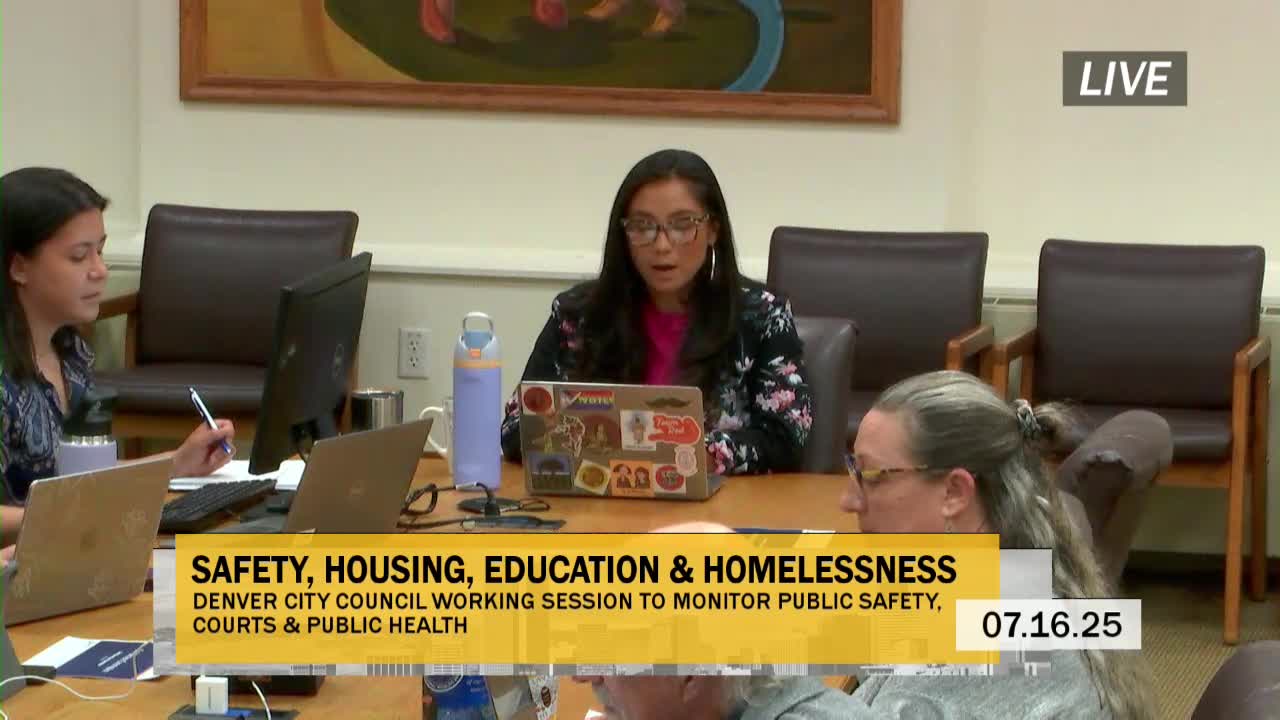
The Civil Service Commission told the Denver City Council Safety, Housing, Education and Homelessness Committee on Tuesday that it has implemented a Denver-specific entry-level written exam through the National Testing Network and is seeing increased test completions and improved tracking across hiring steps, while continuing to monitor possible adverse impact and persistent gaps in Indigenous representation.
Gracie Bettis, executive director of the Civil Service Commission, told the committee that “we implemented a new Denver specific written exam, entry level written test, through the National Testing Network as of 01/01/2025.” She said the commission pulled year-to-date data in June and found higher applicant completion rates for the police written test compared with 2024 and fewer candidates leaving the process before taking the test.
The commission reported that it is about 6% shy of matching total police test completions from all of 2024, and that the number of candidates who registered but did not take the police entry test fell from 1,031 in 2024 to 752 year-to-date in 2025 — roughly a 27% reduction in non-completions by the commission’s calculation. The commission also raised the minimum passing score for the written elements from 65% to 80% in March to “raise the quality of candidates,” Bettis said, and has been monitoring the effect on demographic groups.
Bettis said the vendor recommended lowering the overall passing score back to 65% or, as an intermediate step, lowering the writing-element passing score to 75% to address possible adverse impact. She said the commission is instead pursuing multiple other remediation steps before changing cut scores, including asking the vendor to (1) review which questions candidates most commonly miss and consider rephrasing them, (2) develop a Denver-specific practice test, and (3) prepare a candidate handout describing test components and strategies.
“We want to educate,” Bettis said, explaining the commission’s view that some failures reflect unfamiliarity with test formats rather than candidate unsuitability. She added that the vendor is developing a custom practice test because available practice materials did not match Denver’s revised exam.
The commission also described changes to later stages of hiring. Greg Moore, vice chairman of the Civil Service Commission, said the commission updated its job analysis and refined its medical/psychological screening and job suitability assessments to better differentiate candidate suitability. Bettis said that, for police applicants, the commission now can track timelines between hiring steps in Workday and reported an average of about 125 days from application to commission deliberation and endorsement for the eligible register; she identified polygraph and background-investigation capacity as past bottlenecks.
Bettis summarized recruit-class projections: if the current academy class of 59 stays through the July 28 start date, the commission expects about 108 recruits by that academy’s start; with an additional academy later in the year she said the city would reach about 160 recruits across the year as processing continues.
The commission also reported it received an audit of its entry-level hiring process from the Office of the Auditor that included 14 recommendations; four policy-related recommendations have been addressed, Bettis said, with six more planned to be addressed by Oct. 31 and the remainder by Dec. 31.
Council members pressed for more detail about how process changes affect applicants and community representation. Councilmember Chris Hines asked whether candidates drop out of Denver’s process because it takes longer than other agencies; Bettis said the commission now surveys candidates about their experience and is tracking attrition points, and that the commission lost at least one applicant earlier in the year who took an offer from a neighboring agency because Denver’s process was slower.
Councilmember Stacy Gilmore and others raised concerns about writing skills and whether the written test functions as a barrier for candidates who might otherwise be strong officers. Bettis said the commission and vendor monitor quarterly and have already produced candidate handouts and will make a practice test available to reduce barriers. Commissioner Greg Moore and other commissioners described outreach, mentoring and recruitment strategies to improve yield and diversity in the pipeline.
Councilmembers also raised Indigenous representation in the applicant pool. Bettis acknowledged that American Indian and Alaska Native candidates make up a very small share of applicants and asked council members to share community contacts for targeted recruitment. “We can certainly partner with the department,” Bettis said.
Committee members asked why police entry testing is shorter and unproctored while the firefighter written test remains longer and proctored; Bettis said the vendor produced the police reading-and-writing exam rapidly and that the vendor is still developing the firefighter version, which includes a mechanical component that takes longer to build. She said proctoring requirements previously made the police test difficult for many candidates to take at home (for example, strict webcam/proctor rules), which reduced yield, and that post-implementation data for the new unproctored police format are being monitored closely.
Throughout the discussion commissioners emphasized maintaining screening steps rather than removing them, with one commissioner saying the commission “kept every step” but improved and automated tracking to both preserve standards and increase throughput. Bettis closed by asking for candid feedback from council members and stakeholders: “Our intent at Civil Service Commission is to add value to the entire process.”
The committee had three consent items that were not pulled; the chair said those “will move forward to the full body” but did not provide item details during the briefing.
Why it matters: The Civil Service Commission oversees steps that determine who becomes a sworn officer or firefighter in Denver. Changes to test format, cut scores, candidate supports and timeline tracking affect the size, composition and readiness of recruit classes and are key inputs as the council considers public-safety budgets, staffing and community-police relations.
Looking ahead: The commission said it will continue post-implementation monitoring for adverse impact, provide a practice test and candidate handouts, work with departments on recruitment, and implement remaining audit recommendations by the dates stated to the committee.