Get Full Government Meeting Transcripts, Videos, & Alerts Forever!
Get email alerts on the Sidewalks Infrastructure topic
No spam. Unsubscribe anytime.
Committee approves two integrated construction contracts to accelerate Denver sidewalk program
Summary
The committee approved two integrated‑construction contracts — CEMA Construction ($50M capacity) and Melinder White ($25M capacity) — to deliver sidewalk enterprise projects citywide, part of a multi‑year program sized at roughly $97.5 million in budgeted work over three years.
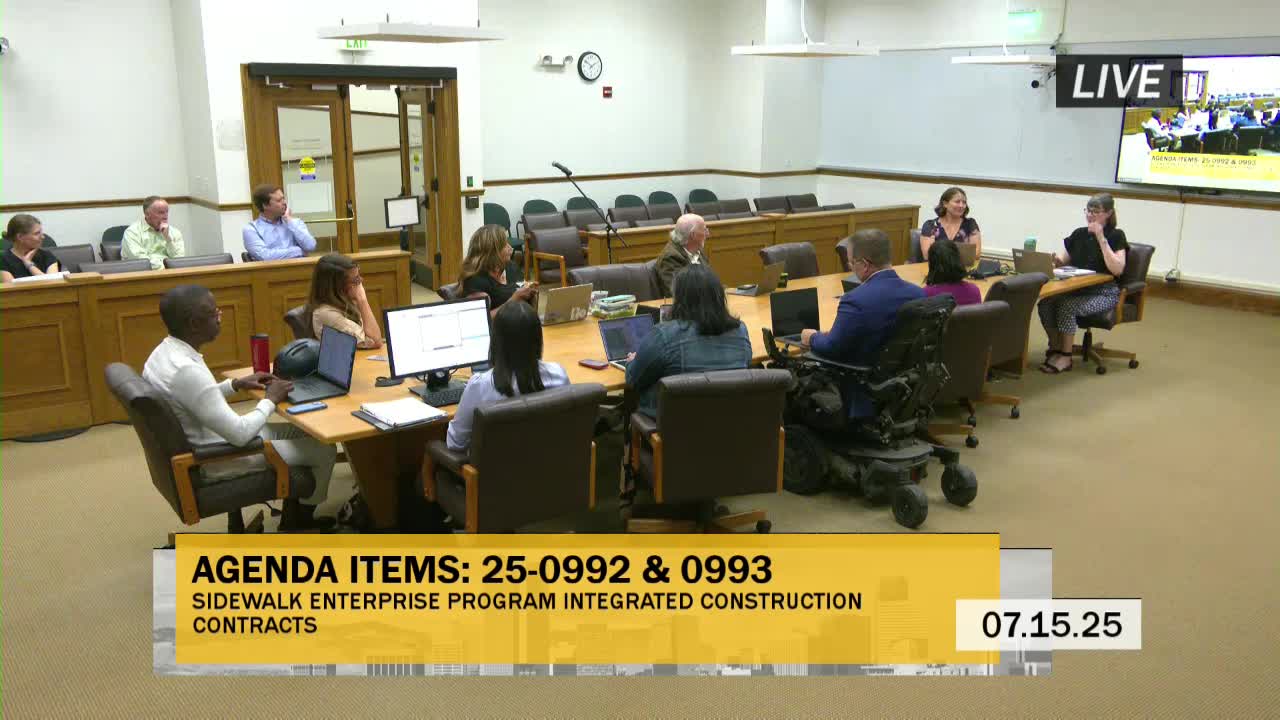
The Land Use, Transportation and Infrastructure Committee approved two integrated construction contracts July 15 intended to speed delivery of Denver’s Sidewalk Enterprise projects, authorizing contract capacity of $75 million for construction and enabling work on gaps and ADA repairs across the city. The committee approved both items (agenda numbers 250992 and 250993) as a block motion moved by Councilmember Paul Cashman and seconded by Councilmember Jamie Torres; the motion passed by acclamation.
Geneva Hooten, program director for the Sidewalk Enterprise, and Elena McWhorter, legislative liaison, described the contracts as part of an overall $97.5 million three‑year program budget for sidewalk work. The two construction teams selected are CEMA Construction with $50 million in capacity and Melinder White with $25 million in capacity, both on three‑year contracts with a 22% MWBE participation goal. HNTB was described as the on‑call consultant already under contract for design, program management and other services; the HNTB portion is roughly $15 million of the three‑year program, leaving approximately $75 million intended for construction.
“We will be implementing the sidewalk program using these two contracts,” Hooten said, explaining that integrated construction (IC) contracts are intended to reduce procurement timelines, provide constructability input during design and allow the city to move more quickly from design into construction. Hooten said the IC mechanism also provides staff augmentation and creates subcontracting opportunities for minority and women‑owned businesses.
Staff described a project pipeline that includes gap projects and spot repairs already in design; examples named for early work included East 40th Avenue, Sheridan Boulevard, Tower Road and West Evans. The department anticipates issuing notices to proceed in September and beginning construction later in the year. Budget figures presented at the committee: fiscal 2025 budget roughly $28.9 million, FY2026 forecast $33.8 million and a three‑year revenue forecast of about $108 million; staff said the city holds 10% of forecast revenue as unbudgeted contingency, producing an annual budgeted program amount totaling $97.5 million over three years.
Committee members pressed staff on several topics. Councilmember Amanda Sandoval and others asked how the program will account for trees and “tree lawns” along corridors. Hooten said decisions about adding or preserving tree lawn will be part of trade‑off discussions in the forthcoming sidewalk implementation plan and follow a design review process with the city forester; she said right‑of‑way acquisition to enable tree lawns could be expensive and that tradeoffs would be discussed with the public. Councilmember Cashman, Councilmember Chris Hines and others urged attention to consistency of pedestrian experience and to flagstone sidewalks in historic neighborhoods; staff said flagstone presents sourcing, safety and accessibility challenges and will require a separate, targeted approach in those neighborhoods.
On equity goals, the contracts carry a 22% MWBE participation target. Steve Coggins, supporting Geneva Hooten, confirmed there is no separate Small Business Enterprise (SBE) goal included; “there was not a requirement for an SBE,” he said.
Staff also said collections for the sidewalk enterprise fee began late in 2024 and that the program is on track to meet the 2025 revenue forecast. Hooten explained that contract awards establish capacity; the city will only issue task orders where budget is available. She emphasized the importance of constructing early to avoid higher future costs: “If we are not constructing, we are not meeting the will of the voters,” Hooten said.
The committee approved the two contract awards to move to the full City Council. The contracts and the sidewalk implementation plan will return to City Council for final approvals and for subsequent project‑level notifications and task orders; staff committed to continued council touchpoints and neighborhood engagement as designs advance.
Clarifying details recorded in committee: selected teams CEMA Construction ($50M capacity) and Melinder White ($25M capacity), both three‑year contracts; 22% MWBE goal on combined $75M construction capacity (approx. $16.5M MWBE target); HNTB on‑call contract accounts for approximately $15M of program work; FY2025 budget ~$28.9M; FY2026 forecast ~$33.8M; three‑year revenue forecast ~$108M with 10% contingency unbudgeted, yielding $97.5M in budgeted program funds for three years.
The committee’s action was an approval to advance the contracts; final construction task orders and project delivery remain contingent on available budget, approved designs, public outreach and statutory procurement requirements.