Get Full Government Meeting Transcripts, Videos, & Alerts Forever!
Get email alerts on the Elections Ranked Choice topic
No spam. Unsubscribe anytime.
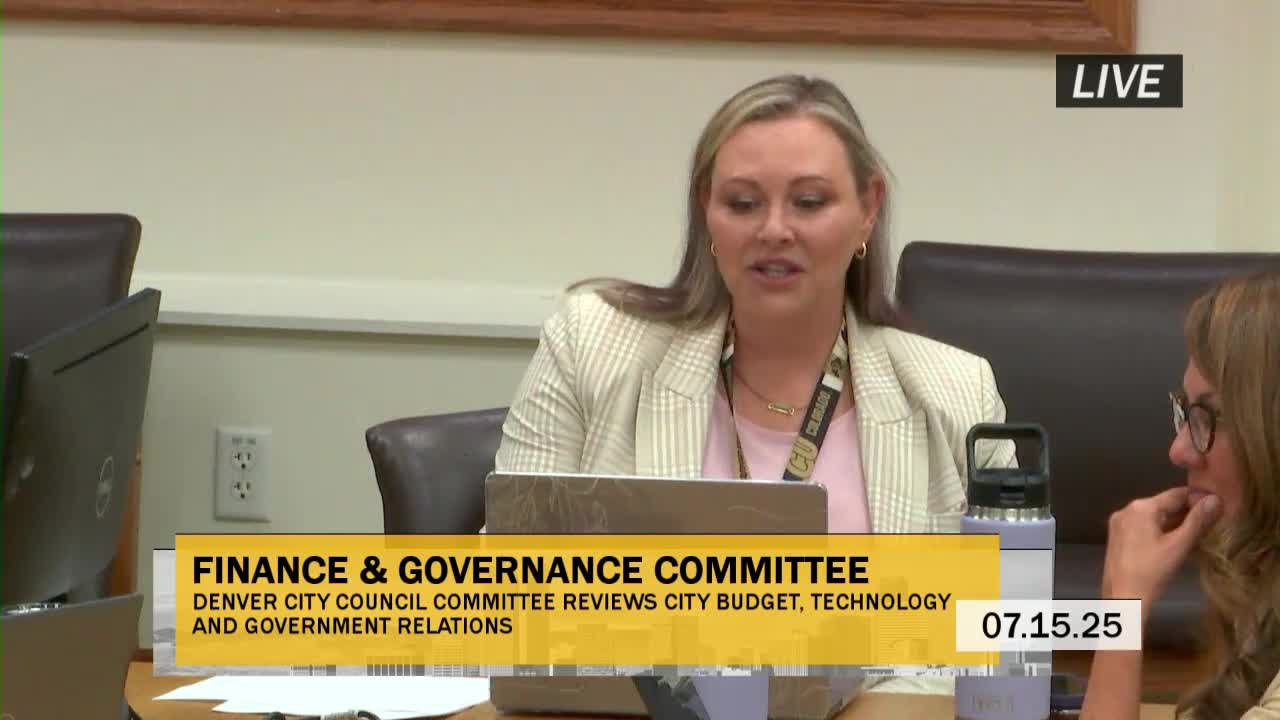
Committee advances charter amendment to let Denver voters decide on instant-runoff (ranked‑choice) voting
Summary
The Denver Finance and Governance Committee voted July 15 to send a charter amendment to the full City Council that would let Denver voters decide whether municipal elections should use instant‑runoff (ranked‑choice) voting, with a trigger clause delaying multiwinner at‑large conversion until audit software and procedures are certified.
The Denver Finance and Governance Committee on July 15 voted to advance a charter amendment that would let Denver voters decide whether municipal elections should use instant‑runoff (ranked‑choice) voting (IRV) instead of the current runoff system.
The proposal was moved by Councilmember Daryl Watson and seconded by Councilmember Kevin Lewis; the motion passed in committee and will go to the full City Council. The measure’s language includes a trigger clause: at‑large multiwinner races would convert to ranked methods only after the Denver Clerk and Recorder certifies that audit software and procedures meet state auditability standards.
Committee chair Amanda Sawyer, the councilmember representing District 5, introduced the item and said proponents believe the method yields winners with broader support and reduces the “spoiler” problem. Sarah Ferdy, a co‑sponsor, framed the change as grounded in academic literature and social choice theory and said ranked ballots encourage candidates to seek wider support: "candidates have a real incentive to reach as many voters as possible," Ferdy said. Supporters cited recent decisions by the Colorado secretary of state and national studies; the sponsors told the committee the secretary of state has issued the rule needed to allow risk‑limiting audits (RLAs) for single‑winner IRV races.
Backers at the hearing described expected benefits and logistical details. Ally Balnap, executive director of Colorado Common Cause, urged referral to the ballot and said the change would "create better access to participation for our Denver voters by eliminating the need for expensive low turnout runoff elections." Linda Templin of RCV for Colorado pointed to post‑implementation surveys in other cities, citing that "96% in New York City said this was easy." The clerk’s office estimated eliminating runoffs could save the city roughly $2,000,000 per election cycle, and the clerk’s staff told the committee they are capable of conducting RLAs for single‑winner races and are working on ballot design and audit procedures.
Opponents and some committee members raised concerns about ballot exhaustion, turnout and equity. Justin Wills, political and legislative advocate for the American Federation of State, County and Municipal Employees (AFSCME), told the committee his organization would take a neutral position and warned that voter education costs may be high and that RCV may not resolve turnout disparities among Black and Latino voters: "we'd like to submit a position of neutral today," Wills said. Councilmember Andrew Flynn pressed sponsors on exhaustion rates in other cities and warned that in some RCV contests a large share of ballots become non‑deciding in final rounds; sponsors replied that the same phenomenon occurs when voters skip runoffs by not turning out and that IRV counts lower‑rank choices rather than discarding initial ballots entirely.
The draft measure sets ranks up to six candidates in single‑winner races and contemplates a practical limit for at‑large multiwinner races based on auditability and software capability; sponsors explained that if auditability for multiwinner tallies is not certified in time, at‑large races would initially allow fewer ranks (for example, ranking up to two) until the technology and audit procedures are in place. Ben Schlag of the Clerk and Recorder’s office told the committee that “we are fully capable of doing a risk limiting audit for a single winner race.” Ballot design options and voter education plans were discussed; sponsors said funds saved by ending runoffs could be used to support bilingual voter education if legally allowable or otherwise via commitments from the clerk’s office.
Committee discussion clarified timeline and next steps. Sponsors proposed first reading at City Council on July 28 and second reading on August 4, with an intent to place the question on the November ballot; staff emphasized those dates were subject to calendar confirmation. The sponsors asked the committee to let the full council debate the measure and warned that 2026 would be a tight timeline for outreach and implementation for the 2027 municipal cycle.
Discussion versus action: the committee had extended debate and public comment and then took formal action to forward the measure to the full council. The motion to move the measure forward was carried in committee; committee members opposing referral said key implementation issues — especially auditability and how at‑large seats will be tallied — needed firmer resolution before sending a charter amendment to voters.
What’s next: the item will be scheduled for the full City Council. Sponsors and the clerk’s office said additional work on ballot design, audit procedures for multiwinner seats, and a robust voter education campaign will continue if the measure proceeds. Public‑facing voter education, bilingual outreach and coordination with community groups were described by backers as central to implementation if Denver voters approve the change.
Ending note: committee action advances a high‑stakes election change to the council floor but leaves open critical operational questions — principally the auditability of multiwinner tallies and the detailed voter education plan — that sponsors and city staff said they would continue to refine before citywide implementation or certification of at‑large procedures.