Get Full Government Meeting Transcripts, Videos, & Alerts Forever!
Get email alerts on the Landmarks topic
No spam. Unsubscribe anytime.
Council grants landmark designation to midcentury Macallan‑Coolidge house in Belcaro
Summary
The council approved designation of the Macallan‑Coolidge House (510 South Garfield Street), a 1956 Usonian‑style residence designed by Joseph Dion, recognizing its architecture and intact midcentury interior.
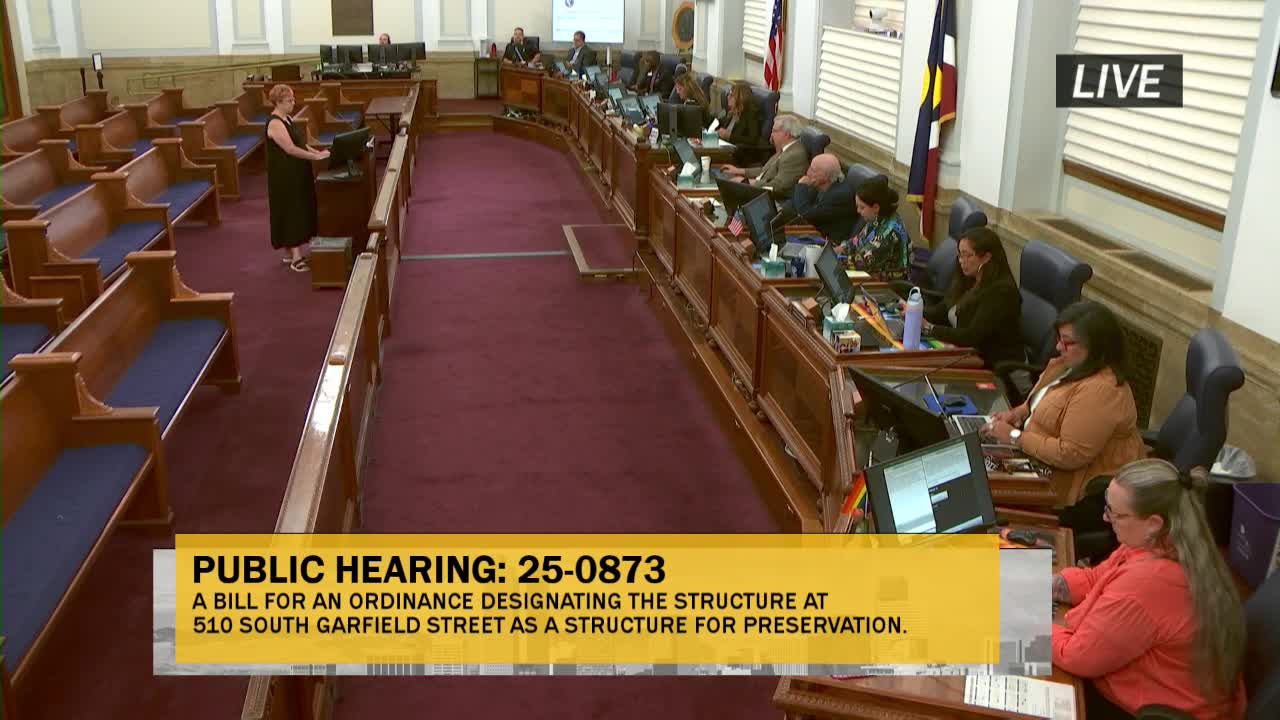
The Denver City Council voted July 14 to designate the Macallan‑Coolidge House at 510 South Garfield Street as a landmark. Council Bill 25‑0873, an owner‑supported designation, passed after a required public hearing and a recommendation from the Landmark Commission.
Abby Chrisman of Landmark Denver presented the staff report and said the house, built in 1956, is an intact example of Frank Lloyd Wright–inspired Usonian design and represents the work of local architect Joseph Dion. Chrisman told council the property meets three landmark criteria: its architectural style (Usonian/midcentury modern), association with a recognized architect (Dion), and its ability to illustrate changing domestic ideals of the mid‑20th century. She said the home retains original materials and workmanship and that its period of significance runs from 1956 to about 1970.
Thomas (Mark) Kulish, executor of the estate of Betty Kulish and a family member raised in the house, spoke in support, saying his parents preserved the home and that visitors consistently remark on the house’s unique, calming character.
One public speaker, Jesse Basson Harrison (representing several groups), stated support for the designation.
Council members praised the owner‑supported nomination and Landmark Denver’s research. The final roll call recorded 11 ayes; Council Bill 25‑0873 passed.
Why it matters: The designation recognizes the house as a rare surviving Denver residence by Joseph Dion and preserves an intact example of midcentury Usonian domestic architecture. The council and Landmark Denver said the property functions as a well‑preserved example of a postwar design approach that emphasized indoor‑outdoor connections, radiant slab heating, and modest, efficient living spaces.
What the designation does and next steps: The designation protects the property’s historic features under Denver’s landmark rules; owners will continue to be able to maintain and repair original materials, subject to the city’s review process for changes to designated properties. Landmark staff noted forthcoming updated guidelines for window replacements and noted available state residential tax credits that can assist with energy upgrades.
This article uses direct remarks from Landmark staff and the owner representative delivered during the council hearing.