
Finance committee advances $160M loan and $50M line for Downtown Development Authority
Get AI-powered insights, summaries, and transcripts
Subscribe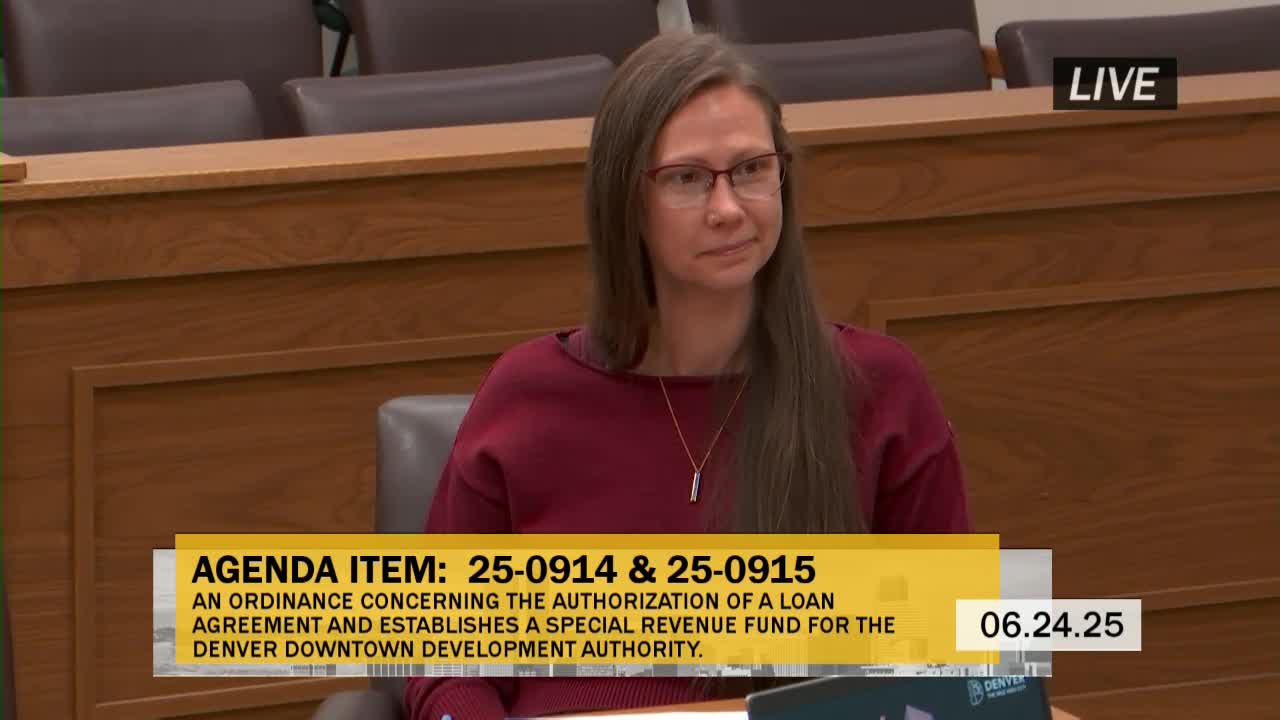
Summary
The Denver City Council Finance and Governance Committee on June 24 moved two DDDA financing measures to the full council that would authorize a $160 million fixed-rate loan and a $50 million revolving line of credit, with repayment pledged to tax increment finance (TIF) revenues only.
The Denver City Council Finance and Governance Committee on June 24 voted to send two related DDDA financing measures to the full council after a staff presentation from the Department of Finance. The measures would authorize a $160 million fixed-rate loan and a $50 million revolving line of credit to support the Denver Downtown Development Authority Investment Program and would establish a DDDA special revenue fund to cover administrative and legal costs.
The committee action moves the items to the floor for consideration; Council President Amanda Sandoval moved the block and Councilmember Daryl Watson seconded the motion, which committee members approved by informal consent. Donna Wilder and Hannah Stewart of the Department of Finance presented the program update and described the financing terms.
The measures implement voter authorization from November 2024 that permits the DDDA to issue up to $570 million of debt without raising taxes. Department staff said the DDDA application portal has received 44 applications requesting nearly $450 million in funding to date. Staff told the committee that the loan and line of credit are intended to be available now so projects can be obligated and funded as they clear the DDDA evaluation and inclusion processes.
Department of Finance staff summarized how the authority and finance tools work. The DDDA uses tax increment finance (TIF) — a portion of property and sales tax growth within the district — to repay projects. Hannah Stewart said, “The sole source of repayment for both of these components is property tax and sales tax TIF revenues generated within the existing DDDA boundaries. Only TIF revenues are pledged. The city is not obligated to use any non TIF funds for repayment.”
Staff described the two tools that would be issued as a direct placement with PNC Bank following a competitive process: a $160 million fixed-rate loan (indicative rate 4.83% in the RFP response, with an estimated annual payment of $16.9 million and maturity aligned to the DDDA statutory term) and a $50 million revolving line of credit (variable rate equal to 1-month SOFR plus 0.40 percentage points). Staff said the fixed loan would include a 1.25x debt service reserve fund ratio as a risk mitigation measure; the line of credit is designed as a short-term tool that expires 12/31/2025 and may be renewed annually up to five years. If the line cannot be repaid within the fiscal year, staff said it can be converted into a long-term obligation amortized through Feb. 2038 and would then count against the $570 million authorization.
Councilmembers asked about sizing, market risk and safeguards. Kevin Flynn asked why $160 million was chosen; staff replied that the amount preserves flexibility for an initial tranche while preserving capacity for future tranches if revenues support additional borrowing. Councilmembers also asked what would trigger conversion of the line of credit to long-term debt; staff said the trigger would be inability to repay within the fiscal year, at which point the balance could be converted at a fixed rate on parity with the loan. Chair Amanda Sawyer asked whether the general fund could be compelled to repay the line; staff reiterated that only DDDA TIF revenues are pledged.
The committee heard brief remarks from Council President Amanda Sandoval, who serves on the DDDA board, thanking staff for their work and noting an expected increase in project activity once funds are available. Stewart told the committee the timeline, if advanced, would bring the ordinance to Mayor and Council on July 1, first reading July 14, second reading July 21 and close on Aug. 7.
Next steps identified by staff include appointments to the DDDA board (facilitated by the mayor’s offices of boards and commissions) and the inclusion and contract approvals for initial projects as they come through the DDDA application and evaluation process.
The committee moved items 914 and 915 in block to the full council (mover: Council President Amanda Sandoval; second: Councilmember Daryl Watson); the committee approved the motion by general consent and did not take a roll-call vote in committee.
The committee record shows the financing proposals are structured to rely exclusively on TIF revenues within the DDDA boundaries, and staff emphasized monitoring and monthly review of revenues and draws to manage repayment risk.