
Council rezones Shops at Northfield site for mixed-use development; requires 10% units at 60% AMI
Get AI-powered insights, summaries, and transcripts
Subscribe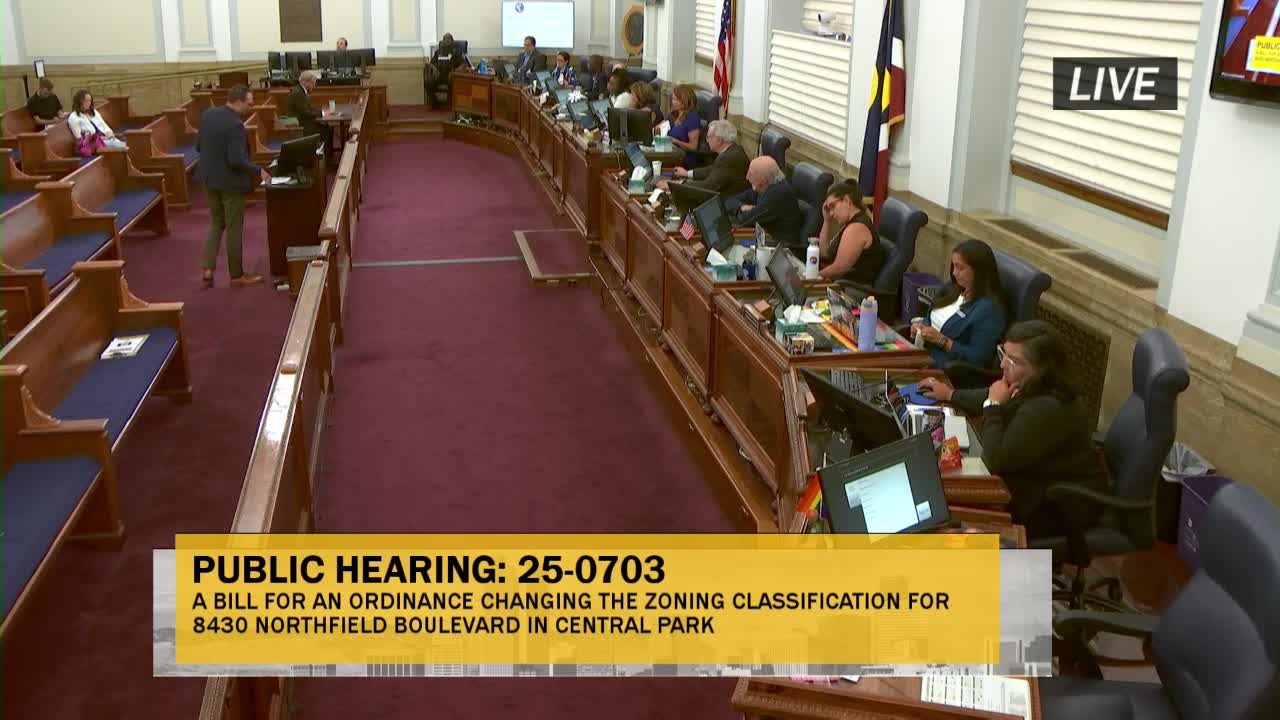
Summary
Denver City Council approved council bill 25-0703 to change zoning for a roughly 16‑acre portion of the Shops at Northfield to CMX-5/CMX-8, paving the way for up to eight‑story mixed‑use development and requiring a high‑impact development compliance plan with 10% of units income‑restricted at 60% AMI for 99 years.
Denver City Council on June 23 voted 13-0 to rezone about 16 acres at the Shops at Northfield, approving council bill 25-0703 to change former Chapter 59 CMU‑20 zoning to CMX‑5 and CMX‑8 urban center mixed‑use districts, which allow buildings up to five and eight stories respectively.
Why it matters: The rezoning aligns the site with Denver’s Blueprint Denver and Comprehensive Plan 2040 goals to concentrate housing near transit, encourages higher density in a regional center, and requires an on‑site high impact development compliance plan that commits 10% of new units as income‑restricted at 60% of area median income (AMI) for 99 years and 30% of total units to have at least two bedrooms.
What the council heard: Tony Lechuaga of Community Planning and Development (CPD) presented the application and the department’s recommendation for approval, citing plan consistency and prior master planning for Central Park. CPD noted the site is close to transit corridors and existing amenities, has high access to opportunity, and a low vulnerability to displacement by the metrics CPD reported.
Planning and affordable‑housing commitments: The developer and HOST agreed to a high impact development compliance plan that requires on‑site affordability rather than fee‑in‑lieu or off‑site mitigation. Liah Mitchell of HOST explained the proposal commits 10% of units at 60% AMI, and the developer voluntarily waived enhanced incentive height options (which could otherwise raise the maximum stories) in exchange for providing the affordability on site.
Public comment and outreach: CPD and the applicant described an extensive outreach effort beginning in late 2024 that included multiple Registered Neighborhood Organizations, the Central Park Master Community Association (which ultimately negotiated a financial participation agreement), local businesses, and transportation groups. Speakers from the community and applicant team — including residents, business owners and the site's owner/operator — generally supported the rezoning, citing the need for housing and potential retail revitalization. Several commenters noted traffic concerns; the applicant presented a traffic analysis and committed to Transportation Demand Management (TDM) measures, transit pass options and further coordination as the site development plan proceeds.
Process and next steps: Because the property sits inside an existing planned building group and a broader master plan for Central Park, CPD’s Development Review Committee determined large development review would be redundant; the project will proceed to planned building group amendment, pre‑application review and site development plans, with departmental referrals on infrastructure, traffic, open space and affordable‑housing details. The city indicated the site has an associated high impact development compliance plan and will require on‑site delivery of the agreed affordability and family‑sized units.
Vote and result: Planning Board recommended approval; the zoning change was adopted by City Council on a 13‑0 roll call. Councilmembers who spoke said the decision moves vacant, underused parking lots toward a denser, transit‑oriented, mixed‑use neighborhood and helps meet the city’s climate and housing goals, while requiring agreements to address neighborhood infrastructure costs and transportation mitigation.
What to watch: The applicant must amend the planned building group, complete required site development plan review and satisfy the high impact development compliance obligations, including delivery of income‑restricted units and family‑sized units on site, TDM measures and neighborhood infrastructure contributions negotiated with the Master Community Association.