Get Full Government Meeting Transcripts, Videos, & Alerts Forever!
Get email alerts on the Public Safety topic
No spam. Unsubscribe anytime.
City staff, fire authority and natural areas outline urban wildfire readiness and homeowner steps
Summary
Fort Collins staff and Poudre Fire Authority briefed council on wildfire risk and mitigation including home ignition-zone assessments, hazard-mitigation planning, fuel management in Natural Areas, and city restrictions on irrigation-ditch burning during red-flag days.
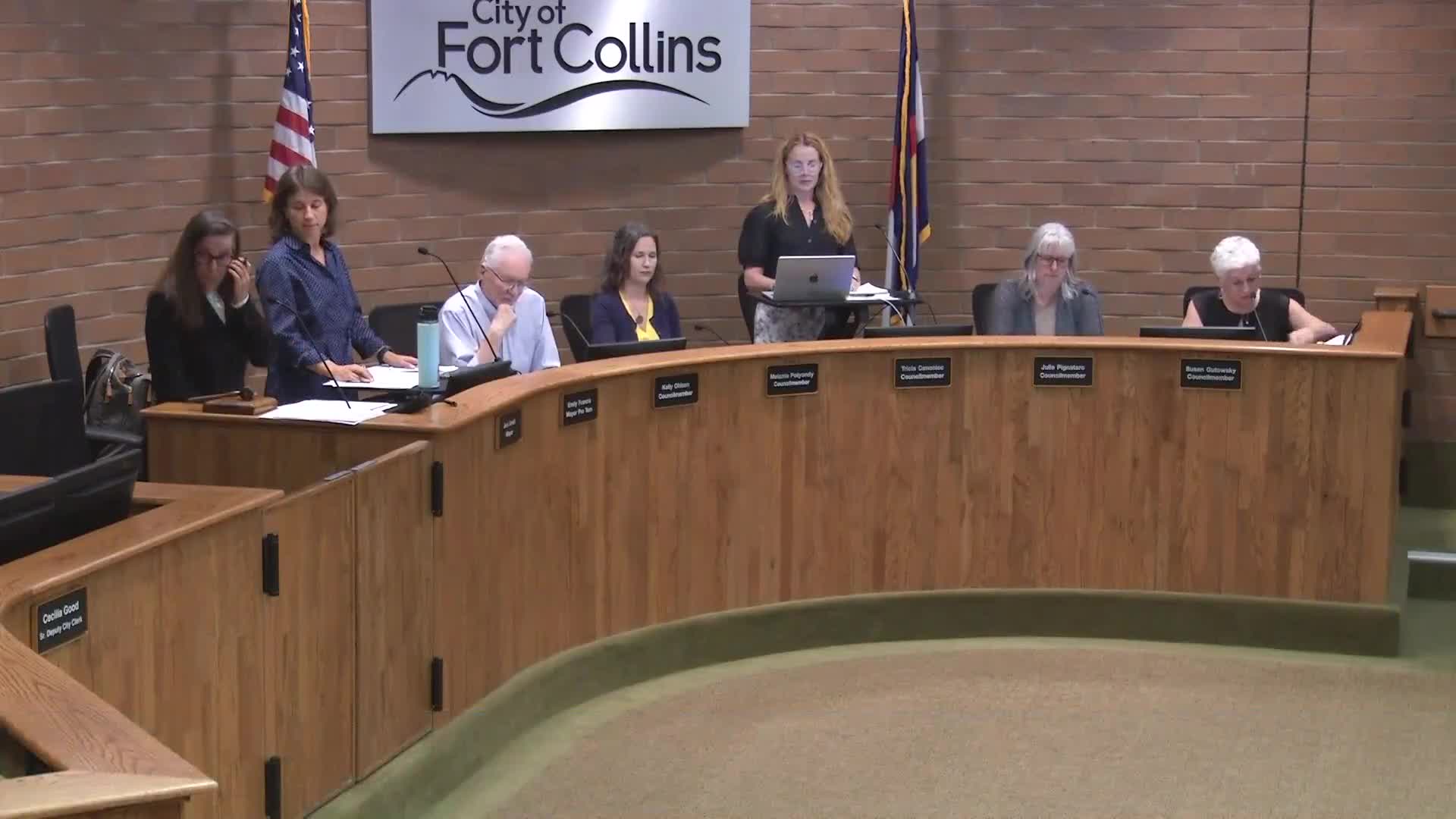
Fort Collins officials told City Council on July 15 that the city and regional partners are actively addressing wildfire risk in the wildland-urban interface through planning, education and targeted fuel-mitigation activities.
Dennis Day, program manager for emergency preparedness, said the city participates in a multi-jurisdictional hazard mitigation plan (the 2021 plan) and will begin a 2026 update this fall. He said Fort Collins is ranked as a medium wildfire hazard in the plan because of its wildland-urban interface areas but benefits from proactive mitigation and interagency planning.
Derek Bergston, representing Poudre Fire Authority operations while Chief Butler was deployed, described the community wildfire protection plan and a district map that categorizes areas by interface type. He said the Poudre Fire Authority covers roughly 230 square miles and that outreach and home assessments are a core part of preparedness. Bergston said residents can request a Home Ignition Zone assessment through the authority’s website (poudrefire.org), and that a typical visit takes about 45 minutes to an hour.
Katie Donahue, director of Natural Areas, described natural-areas fuel types near the city and explained that most city-owned natural acreage is open grass, shrubs and riparian vegetation rather than dense tree canopy. Donahue said natural-areas management focuses on reducing invasive grasses such as cheatgrass and promoting native species that retain moisture longer. She noted that mowing is used selectively and that mowing can sometimes lay green fuel down and dry it faster if clippings are not removed.
Council members asked about the five-foot mowing buffer next to natural areas and about burning irrigation ditches. Donahue said residents with concerns should contact Natural Areas staff for a site visit and discussion of local treatments. Bergston said the city’s updated ordinance now allows the city to prohibit burning of irrigation ditches within city limits on red-flag days; outside city limits the city cannot legally prohibit such burns. He explained that the city evaluates relative humidity, temperature and wind each morning to determine whether a red-flag day is in effect.
Staff and presenters noted other mitigation tools the city is developing or using, including targeted grazing, prescribed fire where feasible, weed control for cheatgrass, and participation in the Northern Colorado (NoCo) Fireshed Collaborative. They emphasized that the city manages for dominant, moderate conditions rather than extremes such as the Marshall Fire, which burned across typical fuel breaks.
Council members thanked staff and presenters, and several praised the free assessment services and public education programs. No formal action was required of council; the presentation was provided for information with staff available to follow up on specific resident concerns.