Get Full Government Meeting Transcripts, Videos, & Alerts Forever!
Get email alerts on the Public Comment topic
No spam. Unsubscribe anytime.
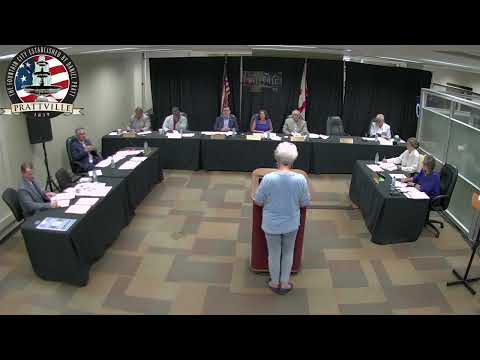
Prattville public commenters press council on immigration enforcement, incentives, transparency and election integrity
Summary
Public comment period featured speakers alleging unconstitutional immigration enforcement actions, criticizing economic incentives and transparency, and raising concerns about voter integrity and discrimination in demolitions; council and staff provided limited responses and pledged follow-ups on some items.
A broad set of concerns dominated the public comment period at the Prattville City Council meeting, with residents raising allegations about an immigration enforcement action at a local restaurant, criticizing the city’s use of economic incentives and delays in historical-marker deliveries, and urging greater transparency about the city’s 1¢ sales-tax allocations and election integrity.
Allison Brown opened the public comment period alleging that masked, armed individuals collaborating with the Prattville Police Department entered a local restaurant and removed patrons without a warrant; she framed the incident as a constitutional and human-rights concern. “They showed no warrant. They showed no warrant signed by a judge,” Brown said. The council did not provide a formal response during the public comment period; speakers urged follow-up and investigation through appropriate channels.
Adam Hunt, the former president of Prattville Pride, accused city staff and some community groups of blocking Pride use of a public pavilion and said he believed parks staff had allowed other groups to reserve space to prevent the Pride event. “You gave cleanup Alabama whatever they wanted because Ray Bowles supported them,” Hunt said, alleging favoritism; he also told the council community members were watching and would seek candidates who would listen.
Several speakers, including Dr. Jerry Simis and Jessica Hayes, criticized economic incentives and transparency. Dr. Simis provided a historical tally of incentives and said the city’s incentive practices require stronger benchmarks and clawbacks. “You need to be very selective in your picking these economic development projects because they need to pay high dividends, and they need to have measurable benchmarks,” he said. Jessica Hayes said she had difficulty locating documentation and that historical marker orders were only placed in May despite project funding years earlier; she asked for clarity about roughly $20,000 in city funds to the group overseeing markers.
Multiple residents pressed the city for clearer, public financial data on the 1¢ sales-tax buckets. Daniel Wood said he had emailed and called staff seeking actual receipts and expenditures rather than budgeted figures, and asked for an itemized accounting since the tax’s inception. Daniel Oakley, the city finance staff member, presented a detailed breakdown during the meeting and told residents where printed materials would be available and that some numbers were on the packet posted online.
Other comments raised concerns about demolitions and perceived uneven code enforcement in predominantly Black neighborhoods (Barbara Robinson), voter-signature irregularities on petitions (pastor Lucas, who described signatures he believes to be forged), and local school facility needs tied to new housing (Thea Langley and Shane Caston).
The mayor and staff answered some procedural questions (for example, the registrar mailing voter district cards was described as underway) and said budget and debt flowcharts were posted for public review. Several speakers said published materials arrived too late for community review and requested better pre-meeting public posting of financial documents.
No formal council action resulted from the public comments at the meeting; multiple speakers asked staff to follow up with documents or investigations and the council acknowledged those requests and, in several cases, said staff would supply additional information.