Get Full Government Meeting Transcripts, Videos, & Alerts Forever!
Get email alerts on the Wireless Infrastructure topic
No spam. Unsubscribe anytime.
Commission forwards wireless‑communications code update to council after debate over stealth, permitted vs. conditional use
Summary
The commission recommended the City Council consider an updated wireless communications ordinance; commissioners debated permitted vs. conditional use status, stealth treatments, pole height and setback metrics and ultimately approved a recommendation with changes by 4‑2.
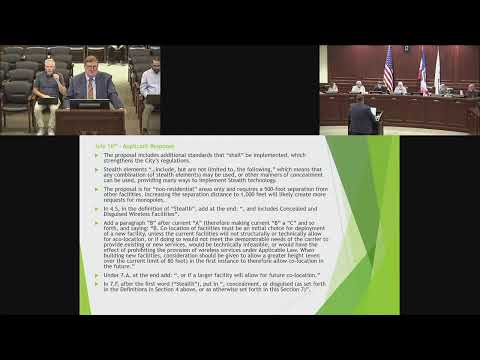
The Planning Commission recommended the City Council adopt an updated wireless‑communications ordinance after a lengthy discussion about where towers should be allowed, required stealth treatments and how to balance coverage needs with visual impacts. Staff outlined that the existing code allows monopoles in certain zones with a maximum height range and noted federal (FCC) standards that affect local regulation. The applicant (a wireless carrier and/or tower company) and consultant representatives explained that, because of the city’s residential growth and limited public/quasi‑public locations for collocation, taller facilities can reduce the total number of monopoles needed across the community. Commissioners debated several topics: whether non‑residential zones such as C‑1, C‑2 and TM should allow wireless monopoles as a permitted use (the applicant preferred permitted); staff and several commissioners favored maintaining conditional‑use review so the commission or staff can require context‑specific stealthing; whether painting a monopole is sufficient camouflage; appropriate maximum pole heights given Herriman’s topography; and how to measure required separation from residences (some commissioners favored a fixed larger buffer). The draft ordinance includes stealth‑option language (‘‘stealth elements include but are not limited to…’’) and requirements that co‑location be structurally accommodated. After discussion the commission voted 4–2 to forward the draft with specific edits: keep review as a conditional use (not automatically permitted in C‑1/C‑2/TM), adopt staff‑recommended standards with an emphasis on encouraging co‑location, set a recommended maximum pole height of 80 feet in the draft (applicant asked for higher; staff and commission discussed 80–100 ft), and require separation metrics tied to either the height of the pole or a minimum standard. Commissioners also deleted a proposed 500‑foot minimum from schools/playgrounds in one subsection and asked staff to clarify measurement (lot line vs. structure). The motion carried 4–2 and staff will refine language before sending the ordinance to council.