Get Full Government Meeting Transcripts, Videos, & Alerts Forever!
Get email alerts on the Land Use Subdivisions topic
No spam. Unsubscribe anytime.
Bradford County commissioners start rewrite of subdivision rules, stress road, drainage and inspection standards
Summary
At a July 17 workshop, county commissioners asked consultants to draft comprehensive plan and land‑development regulation changes focused on street construction, stormwater, inspections and maintenance funding tools including MSBUs; no formal policy was adopted.
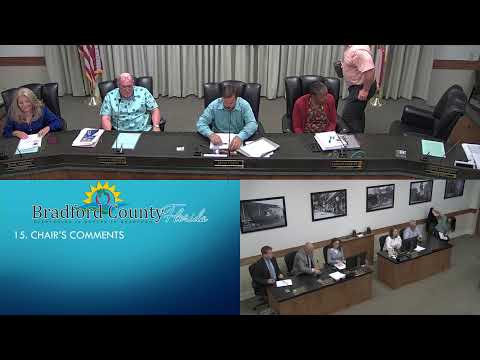
Bradford County commissioners on July 17 directed staff and a hired consultant to draft a near‑complete rewrite of subdivision rules and related comprehensive plan language aimed at preventing repeat problems from decades‑old, unfinished developments. Planning and grants director Brandon Stubbs of North Florida Professional Services told the board he would return with a draft in a few months.
The discussion focused on streets, drainage and long‑term maintenance. Commissioners described subdivisions where private roads and lack of stormwater infrastructure left homeowners to “fill in holes” after storms and asked the consultant to require standards that allow the county to accept streets only if they meet FDOT or equivalent specifications and have been inspected by county road staff. “What have you seen as your biggest issues and what things that y’all wanna make sure that y’all address?” Stubbs asked the board as he opened the workshop.
Commissioners and staff proposed several specific tools to reduce future county liability and recurring service calls: clearer plat requirements that show flood zones and minimum floor elevations, mandatory recorded drainage and utility easements, routine construction inspections tied to permit milestones, operation‑and‑maintenance agreements for stormwater facilities, and Municipal Service Benefit Units (MSBUs) to fund annual maintenance without using general taxpayer revenues. “If you set up MSBU for, like, streets and roads or stormwater, it goes into a bank account … and the county is the administrator of that funds,” Stubbs explained.
Board members also raised policy questions about large‑lot and rural divisions. The discussion confirmed that Bradford County’s current Land Development Regulations treat lots 10 acres or larger differently: such divisions are not considered traditional subdivisions and may allow private lime‑rock roads rather than paved public roads. Commissioners requested options for a “division of land” pathway that would require engineered road bases and stormwater permits while allowing private, non‑paved surfaces for large‑tract parcels.
Staff and commissioners asked the consultant to draft proposals that would: (1) require minimum floor elevations and grading plans where state statutes already apply to plats of 5+ acres or 25+ lots; (2) add explicit inspection steps and county sign‑offs before final plat approval; (3) require recorded easements for drainage and utilities; (4) identify whether MSBUs or similar assessments will be required to fund ongoing maintenance; and (5) offer a treated alternative for large‑tract (>10 acre) divisions that balances cost and public safety. No final ordinance or rule was adopted at the workshop; Stubbs said he will circulate a 90% draft for staff review and return for a formal hearing later.
Commissioners asked staff to inspect and document existing problem sites, specifically Riverbend, and to meet with realtors and contractors as part of outreach. Jason Dodds, public works director, and other county staff agreed to review draft construction standards and inspection language before the next public workshop. The board offered general consensus for the consultant to proceed with drafting but made no formal vote or change to adopted regulations at the meeting.