
Fargo staff review property-tax incentives and TIFs, urge measured use amid caps
Get AI-powered insights, summaries, and transcripts
Subscribe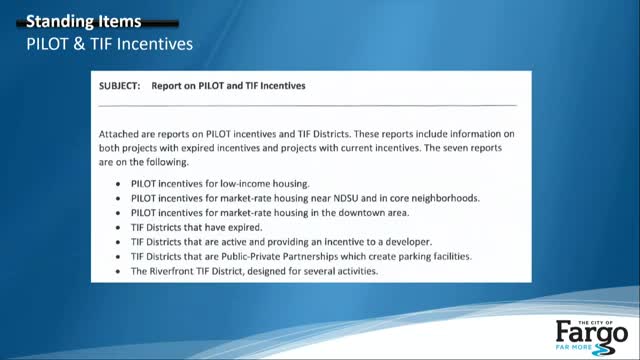
Summary
City staff reviewed downtown and neighborhood property-tax incentive programs, tax increment financing districts and public-private parking partnerships, saying incentives helped unlock development but raising questions about fiscal impacts under a 3% county cap on tax growth.
City of Fargo staff summarized the city’s portfolio of property-tax incentives and tax increment financing (TIF) districts and told the finance committee that the programs helped make housing and downtown projects feasible while creating long-term taxable value for local governments.
At a finance meeting, Jim (Staff member) reviewed low-income housing exemptions, neighborhood housing exemptions near NDSU, a downtown program that gave 10–15 year property-tax exemptions, multiple TIF districts and four public‑private parking ramps. “These are the different property tax incentives that the Economic Development Incentives Committee evaluates,” Jim said. He noted many incentives have already expired and that current pipeline projects will expand taxable value over time.
The presentation said 738 units currently receive property-tax exemption for restricted‑rent housing and forecast “another 3 to 4 applications coming in this fall.” Jim pointed to downtown incentives as a driver of growth, saying downtown assessed value rose from about $250 million to roughly $1 billion over the last two decades and that expired TIF districts have produced more than $130 million in incremental value in the past five years.
Commissioners pressed staff about how incentive caps at the county level could change the city’s calculus. Commissioner Strand asked whether the city or the county would see immediate revenue if school and city incentives made projects feasible while the county did not participate; Jim said local governments run a “but‑for” test to award incentives only when a project would not happen otherwise. “We only want to help projects that won't happen,” Jim said.
When Commissioner Peppcorn asked whether the city’s incentives reduce residential tax burdens, Jim replied that downtown growth had spread taxes across a broader base and likely kept taxes lower than they would have been absent development. Other commissioners emphasized the need to quantify city‑level fiscal impacts if county participation declines or if caps limit participation.
The committee discussed the new housing exemption as a candidate for elimination; staff noted consultants had suggested removing that particular exemption because those units might have been built without it. Commissioners also raised the need for more detailed fiscal analyses at the city level to evaluate future incentive approvals.
No formal action or vote was taken; staff presented background and answered questions and said they would provide more detail on individual proposals and fiscal impacts when projects come forward.
Fiscal and policy context: staff said some TIF and Renaissance‑zone style exemptions have phased out and that more projects are in the pipeline; the riverfront TIF renewal plan approved in 2021 is funding environmental cleanup and riverfront work. Jim told the committee that there will likely be more candidates for investment than available TIF revenue in future budgets and urged the commission to set priorities.