Get Full Government Meeting Transcripts, Videos, & Alerts Forever!
Get email alerts on the Education Finance topic
No spam. Unsubscribe anytime.
Forensic audit: No fraud found at Newburgh City School District but auditors flag transparency, controls gaps
Summary
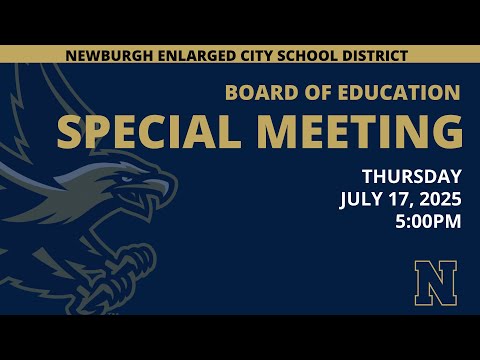
Special meeting, July 17, 2025 — Newburgh City School District board President John DeRay opened a special meeting Wednesday announcing the public presentation of a forensic audit commissioned earlier this year.
Special meeting, July 17, 2025 — Newburgh City School District board President John DeRay opened a special meeting Wednesday announcing the public presentation of a forensic audit commissioned earlier this year. Auditors from O'Connor Davies presented a report dated June 20 that found no evidence of fraud but described multiple weaknesses in financial controls and transparency.
The report, the auditors said, covered 13 categories including budgeting and financial reporting, capital projects (including Proposition 5), energy performance contracting, grants and procurement. "We didn't find any fraud within any of the areas that we looked at," said Keith Balham of O'Connor Davies. He added that "nobody was a whistleblower either to say, hey, there's fraud going on in this particular area either." The firm nevertheless recommended changes across six themes to improve oversight.
Why it matters: the auditors told the board that gaps in routine financial reporting, unclear budget-transfer explanations, uneven claims-auditor checklists, incomplete capital-project documentation and overly broad user access to the district's financial system increase the risk of errors, hinder accountability and limit the board's ability to make timely decisions.
Auditors said the engagement began after a February 5 RFP, the contract was signed March 15, and the fieldwork ran through the end of May. The engagement consumed roughly 400 professional hours across six staff, and the report notes the initial project budget was $316,000 with an actual cost of about $175,000. "We performed our field work through May and then did our analytical work and the report and issued our report dated, June 20," Balham said.
Key findings and examples - Budget transfers: For fiscal year 7/1/2023–6/30/2024 auditors identified about 210 budget transfers totaling roughly $56,100,000. Explanations on the transfer reports were often sparse; auditors recommended clearer narrative and an annual comparison of actual-to-actual and actual-to-budget figures to reduce midyear transfers. - Fund balance: The report notes the district's unassigned general fund balance exceeded the district's 4% benchmark as of 6/30/2024. Auditors urged regular fund-balance projections and clearer use of capital reserves to plan for known capital needs. - Treasurer and claims reports: Several treasury reports were timely and complete; one lacked a budget-status report. Claims-auditor checklists did not fully align with the claims-auditor job description, and testing found two procurement exceptions: an approximately $30,000 cumulative Amazon vendor spend that bypassed competitive bidding and a roughly $74,000 gym refinishing contract that also did not go out for competitive bid. - Grants: Auditors identified roughly $2,500,000 of potential grant carryovers. They recommended a consolidated grant status schedule showing each grant's budget, period, cumulative revenue and remaining spendable balance to prevent unspent funds from lapsing. - Capital projects and facilities oversight: Auditors reported limited facilities-committee activity during the 2023–24 fiscal year and cited inconsistent documentation tying invoices to specific fiscal years and projects. They advised regular facilities-committee meetings and a designated board liaison to provide frequent, project-specific updates to the board. - Procurement and system access controls: Auditors reviewed WinCap (the district general-ledger software) user access and found multiple users — including two contractors — with broad permissions to view and activate pay authorizations. "If they're posting anything, is that really a necessity? Can somebody in the business office post it instead?" Balham said, recommending tighter, time-limited contractor access and periodic review of user permissions. - Energy performance contract: The auditors noted the district's guaranteed annual energy savings figure (about $1,800,000) and that the contractor's annual report was due Feb. 28 but had not been received as of the auditors' fieldwork. The contract allows the vendor to repay the district if guaranteed savings are not met.
District response during the meeting District staff acknowledged some of the issues and provided context. The district confirmed there had been contractor support in the business office during vacancies and that user-access listings obtained by auditors represented system permissions as of April 24, 2025. District finance staff said payroll authorization remains a multi-step process beginning with HR and board-approved positions, and that payroll changes are routed back to HR for correction if errors are found.
Board members pressed auditors and administrators on specific items during a lengthy Q&A: whether recommendations were discussed with district leaders before publication (auditors said they were not), whether user-access logs showed activity (auditors said they reviewed access lists, not activity logs), and whether certain findings already were being addressed (district leaders said several corrective actions were underway and that many recommendations have been accepted or are in process).
Other numerical details and context noted in the report: auditors interviewed 35 people, reviewed more than 500 documents, and indicated the district held a capital reserve of over $30,000,000 at 6/30/2024. Auditors also explained that a $7.8 million capital-project deficit reflected timing and accounting for reimbursements (for example, Smart Schools Bond Act reimbursements) rather than clear overspending.
Next steps and recommendations The auditors gave a suite of recommendations grouped under governance (establish a calendar of financial reports and clearer board resolutions), fund management (regular fund-balance projections and clearer emergency-resolution language), operations and controls (regular user-permission reviews and improved procurement checklists), centralized grant oversight, and strengthened facilities reporting. At least some corrective actions were reported by the administration as already begun: the district said it has a populated director-of-grants role, a capital-project reporting cadence is being restored and IT/data-closet work was funded in May to address immediate infrastructure risks.
What the auditors did not conclude Auditors emphasized they found no evidence of fraud or criminal activity in the areas they examined. "We did not find that," Balham said during the meeting.
Ending Board members and administrators said they will use the report's recommendations to refine policies and reporting. Several trustees said they supported implementing the auditors' recommendations to increase transparency and improve internal controls; others urged careful follow-through to ensure changes are sustained.