
Topeka coalition launches One‑Stop pilot at Let’s Help as part of drive to end chronic homelessness by 2030
Get AI-powered insights, summaries, and transcripts
Subscribe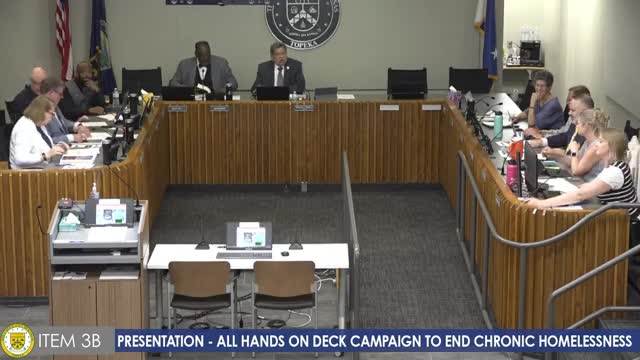
Summary
A multi‑sector coalition presented a housing-and-homelessness strategy and a One‑Stop pilot at Let’s Help that will run through Oct. 31 and aims to improve outreach, intake and referrals for unsheltered residents as part of a broader campaign to end chronic homelessness by 2030.
A coalition led by United Way and Compassion Strategies outlined Wednesday night a multi‑part plan to reduce chronic homelessness in Topeka and Shawnee County and said it launched a One‑Stop pilot at Let’s Help on the same day.
The presentation to the Topeka governing body described a three‑pronged approach — coordinated outreach, a One‑Stop homeless resource center and a housing continuum that includes permanent supportive tiny homes and other supportive housing — and stressed that outreach and trust building must come first.
The All Hands on Deck campaign, chaired by Brett Martin of United Way, said the One‑Stop pilot will operate at Let’s Help through Oct. 31 and provide mental‑health services, employment and financial services, life‑skills training, shelter and housing navigation, and basic needs such as showers and meals. Barry Fieker, project consultant with Compassion Strategies, said today’s pilot intake successes show the model can connect people who have been chronically unsheltered to services. “We had people that found out where we are, the gratitude that we saw there,” Fieker said. “We had an individual who has not been able to connect with services who was immediately able to get his intake done today and he’s on his way to moving through.”
Why it matters: campaign leaders said outreach must precede other investments; without reliable relationships with people experiencing homelessness, centers and shelters have limited impact. The coalition described the effort as a housing and homelessness solutions network that will use data improvement and case conferencing — components of the Built for Zero framework — to match services to individuals’ needs.
Details: campaign leaders said outreach teams are already deployed but require training, redeployment and better data. The mobile access partnership — a street‑based service model started during the COVID pandemic — has 17 partner agencies; Impact Avenues, which works with unsheltered children and families, has more than 40 partners. Carrie Higgins, city staff coordinating Impact Avenues, said the campaign will merge services at Let’s Help on Aug. 20 to expand the One‑Stop to children and families as well.
Operational questions: council members asked what the city or public can do to help extend the pilot past Oct. 31 if it proves effective. Fieker and other presenters said the pilot’s continuation depends on indoor showers, added staffing and meals, and transport for people who cannot reach the site (including those with large animals that cannot use Metro buses). Fieker said an architectural firm is evaluating shower installation options and that organizers are budgeting for a twice‑weekly shuttle to bring people to the site.
Costs and volunteers: presenters said partner agencies currently fund their own participation and that Let’s Help will need more resources for additional days of meals and utilities if the pilot expands. Organizers also described volunteer and donation channels — Let’s Help and Compassion Strategies’ public website and social media — for residents and groups who want to help.
Council response and next steps: council members praised the coalition’s groundwork and asked for details on sustaining the pilot through winter. No formal vote was taken Wednesday; presenters asked only for questions and community support. The pilot will continue through Oct. 31, and coalition leaders said they will return with further updates and needs as the evaluation proceeds.
Ending: coalition leaders emphasized the long‑term nature of the work and a stated goal to end chronic homelessness in Topeka and Shawnee County by 2030, while acknowledging multiple operational hurdles remain. Barry Fieker said, “Do we wanna do it? Yes, we do. Do we believe we can? Yeah. We think we can.”