Topeka planning staff, housing committee propose allowing duplexes by right in single‑family zones
Summary
Planning staff and the Housing Committee presented a proposal July 8 to permit duplexes by building permit in single‑family residential zones and to allow tri‑ and quadplexes via conditional‑use permits; no ordinance was sent forward and the committee will refine the plan after more neighborhood outreach.
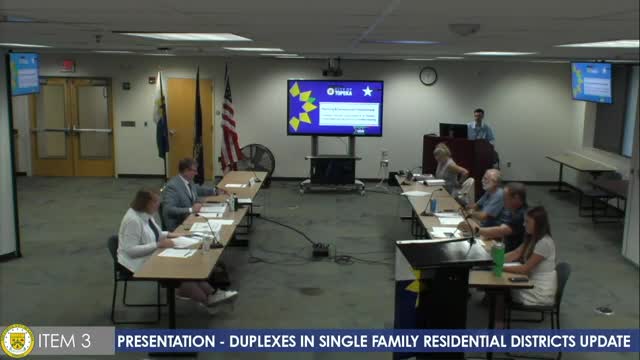
Topeka planning staff and members of the Planning Commission’s housing committee presented a proposal July 8 to allow duplexes in single‑family residential zones through an administrative building‑permit review and to allow triplexes and four‑plexes through conditional‑use permits.
The proposal, offered by Jim Kaup of the Planning Commission’s housing committee, is intended to increase “missing‑middle” housing — duplex through small apartment buildings — and respond to findings in Topeka’s 2020 housing market study that the committee and staff said showed a persistent shortage. “We are trying to provide more diversity in our housing stock to achieve a number of benefits for the community,” Kaup said. The committee’s presentation said 87% of Topeka’s residential zoning is single‑family and estimated demand of roughly 14,400 additional housing units over 20 years.
City staff described specific draft standards that would apply to duplexes built through administrative review, including a minimum lot width of 37 feet, required landscape in the front setback including at least one tree, alley access where available, and design standards to reduce blank facades or front‑street garage dominance. Conversions of existing single‑family houses to duplexes were included in the proposal and could be approved administratively if they met the standards; otherwise they could proceed through a conditional‑use permit, staff said.
Why it matters: committee members and staff framed the proposal as part of a broader, multi‑year effort to lower housing costs by allowing more housing types without the time and expense of rezoning. Staff said other Kansas cities and a number of states have recently taken similar steps to address housing shortages, and that local efforts are one part of a larger strategy to increase supply.
Committee discussion focused on preserving neighborhood character, public input, and parking. Councilmember Marcus and Councilwoman Hofer said they generally support increasing housing options but raised concerns about impacts in historic districts and on street parking. Councilmember Marcus suggested starting with duplexes before permitting higher‑density conversions, and he emphasized community review for conversions because conditional‑use review gives neighbors an opportunity to comment. “I think my only frustration to some degree is I am one of 10. I don't get to make all the rules…but I do think that without either some sort of carve‑out for historic districts or some promise that it still has to go through the conditional‑use permit process, that would be a hard sell to the rest of the council,” Marcus said.
Staff and committee members said they had presented to several neighborhood associations — College Hill, Historic North Topeka East and Highcrest — and had circulated an online survey. Staff reported the survey showed about 62% of respondents said duplexes should be allowed in some manner (administrative, conditional use or other), while 38% said duplexes should not be allowed. The committee acknowledged that some neighborhood meetings favored the idea while others, notably College Hill, opposed conversions of existing houses.
Next steps: the housing committee will continue work in August, incorporate committee and neighborhood feedback, and could forward a formal zoning text amendment to the Planning Commission for a public hearing and recommendation; staff said the governing body would likely see the item in September. No ordinance or text amendment was voted on at the July 8 meeting.
Details to watch: the draft standards presented would allow administrative approval if an application meets specified design, landscape and lot‑width standards; conversions that fail to meet those standards could be reviewed via conditional‑use permit, which triggers public notice and a Planning Commission hearing. Committee members directed staff to continue outreach and to return with refined language and examples for committee and council review.