Get Full Government Meeting Transcripts, Videos, & Alerts Forever!
Get email alerts on the Land Use Development Sewer Tif topic
No spam. Unsubscribe anytime.
Township officials tell Buckeye Valley board EPA sewer maps and TIF deals could drive annexation, affect schools
Summary
At a July Buckeye Valley Board of Education meeting, Concord Township leaders and a township representative warned that EPA '208' sewer planning, tax-increment financing agreements and city annexation could channel high-density development into parts of the district and change how tax revenue is distributed to local schools.
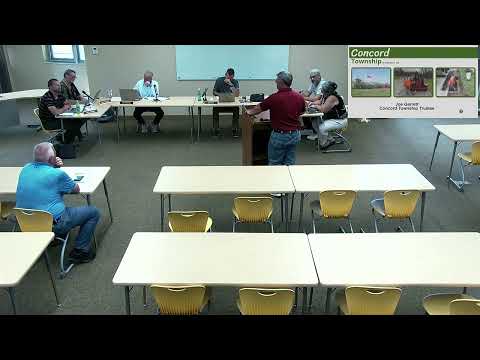
Joe Garrett, president of the Delaware County Township Association, told the Buckeye Valley Board of Education at its July meeting that recent and proposed development, changes to Tax Increment Financing (TIF) deals and an Environmental Protection Agency mapping effort known as a "208 plan" could affect where sewer service — and therefore annexation and higher-density development — occurs in the Buckeye Valley area.
Garrett said, "We currently in Concord have 4 communities that have been approved. … If all of those were to be built, it's 400 homes." He warned that developers and cities use sewer access and TIFs to shape how development proceeds and said townships must scrutinize TIF allocation details.
The township leader explained why that matters to local schools: many TIF structures use long-term schedules (Garrett described a "30 year" residential TIF) that redirect tax-increment revenue. "When you do a 30 year … we can put that on there. And what that does is take 75% of any increased value of funds," he said. Garrett cautioned that TIF agreements often are written so the developer and city receive funds first and that the school district may not receive the full benefit promised until after those payments are made.
Why it matters: Garrett framed the EPA 208 mapping and TIF language as mechanisms that can limit which entity may obtain EPA permitting for sewer service in particular areas, and thus which government can extend sewer lines and which jurisdictions can annex land. "They are drawing maps to give sewer districts to certain areas," he said. "Anything in there can only be sewered by this group, and so you have no choice." He urged the board to contact representatives and oppose any mapping that would restrict options for townships or transfer sewer permitting advantage to cities.
Troy Johnson, identified at the meeting as a township representative, reported one recent case in which an annexation was denied because the city lacked sewer capacity. "There was 350 acres that was gonna be annexed … it was denied by the city," he said, adding that the city currently cannot serve that northwest quadrant because of sewer capacity constraints and that estimated costs to extend service in that area could be about $45,000,000.
Garrett and Johnson also described other local developments and constraints that affect Buckeye Valley: - Concord Township has four approved developments that, if built to current standards, would total roughly 400 homes; Garrett said the township cap is now 1.5 homes per acre (down from earlier approvals at two per acre). - Garrett said some developers have requested residential TIFs to pay for infrastructure such as roads and sewer hookups; he said the township resisted requests to use TIF proceeds to subsidize some developer costs. - Garrett said the intake for an identified sewer line off Moore Road is very deep and expensive to connect because of rock conditions; he encouraged the board to talk with "Tiffany Nag, who's the director of the sewer department," about technical limits.
Garrett described the EPA 208 mapping work as especially consequential: "They really did come to us. We held a meeting with the EPA. … If you haven't seen those, you better. … It goes all the way out in Radnor." He said the maps can make a single sewer provider the only permitted option for an area, which he said effectively steers annexation and higher-density development toward cities that the maps favor.
Garrett flagged how TIF accounting and contract language can create the impression a taxing authority will receive a full distribution while the paperwork designates a developer or city to be paid first. "If they say, hey. We're gonna give you we're gonna pay for $5,000,000 of infrastructure. They get that 5,000,000 first," he said. "So you may not see any money. You'll get a 100% for years, you know, 25 to 30." He urged board members to review proposed TIF distributions and to verify the sequence of payments and the projected tax base in the auditor's records.
On other development topics, Garrett criticized past annexation procedures that he said lacked specific written commitments from cities about road or service takeovers and urged more rigorous review during hearings. He also described local landscaping and zoning requirements meant to raise development costs as a tool the township uses to slow certain projects.
Board response and next steps: Board members asked clarifying questions during the district update, and speakers asked the board to be vigilant and to contact their representatives about EPA mapping and potential annexations. No formal board action, motion or vote on the topics was recorded during the meeting; the discussion was presented as an informational district update.
Ending: County- and township-level leaders told the Buckeye Valley board they will follow developments related to sewer mapping, TIF negotiations and annexation. They urged the school board to review TIF contract language carefully and to coordinate with county and township officials if developers or cities pursue projects that could shift tax revenue or student population into or out of district boundaries.