Get Full Government Meeting Transcripts, Videos, & Alerts Forever!
Get email alerts on the Residential‑setback‑variance topic
No spam. Unsubscribe anytime.
Knoxville BZA approves variances for two Newbert Springs lots, cites lot shape hardship
Summary
The Board of Zoning Appeals approved two variances for Michael Madrone to allow small single‑family houses to be sited far behind the block face after finding the lots’ recorded configuration created a practical hardship.
The City of Knoxville Board of Zoning Appeals on a voice vote approved variance requests allowing two single‑family houses to be sited well beyond the typical front setback at properties on Newbert/Newbird Springs Road, citing the lots’ recorded shape as the hardship. The approvals covered two separate docket items filed by Michael Madrone and applied to lots created by a 2020 subdivision.
BZA staff told the board the recorded plat included a note referencing a “minimum front building line 75 feet width” and that the lots appear not to meet the minimum lot‑width standard in Article 2.4 m 0.2.d of the zoning code. Staff said the subject property nonetheless is a legal lot of record. “The applicant should address why a different layout was not proposed that would meet the front setback requirements,” staff advised.
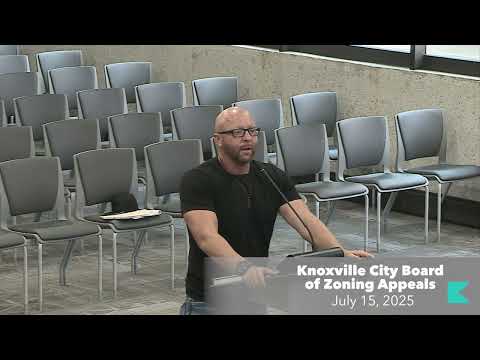
Michael Madrone told the board he and his surveyor followed the plat that was recorded in 2020 and that two houses already built on adjoining lots were located where approved at that time. “I thought everything was fine,” he said. Madrone said the remaining two houses are compact — “only 1,200 square feet” — and that moving them forward on the lots is not physically possible given the lot widths. He argued the houses would be “unbuildable” if the board denied the variances.
Board members who spoke in favor said the unusual recorded lot geometry created a practical hardship and that approving a limited variance would not cause a detrimental effect to surrounding properties. One member described the situation as a recorded mistake that had already been acted on and said the board was reluctant to “pull back” from the status created by the recorded plat.
The board made and seconded motions to approve both docket items and called for the vote; the chair announced the motions carried. The board’s decisions allow front setbacks of 121.9 feet and 115.5 feet, respectively, where the R‑M‑1 block face average would normally require roughly 27.1–37.1 feet in the district.
The approvals explicitly rest on the board’s finding of hardship tied to the recorded shape and size of the lots and the limits that geometry places on building placement. The board did not direct additional staff follow‑up beyond the standard conditions attached to variances.