Get Full Government Meeting Transcripts, Videos, & Alerts Forever!
Get email alerts on the Campaign Ethics topic
No spam. Unsubscribe anytime.
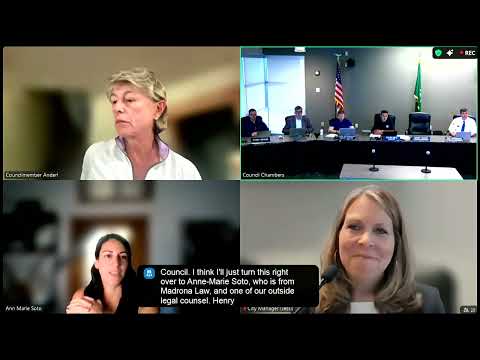
Outside counsel briefs Mercer Island council on campaign use of public resources and social media rules
Summary
City council received a legal briefing on state restrictions for elected officials’ use of public office, facilities and resources during campaigns, including guidance on social media, public comment and exceptions for ballot measures.
Ann Marie Soto, outside counsel from Madrona Law, told Mercer Island City Council on July 15 that state law generally bars elected officials and employees from using public office, facilities or resources to assist election campaigns, but outlined narrow exceptions and practical steps elected officials should follow.
Soto said the primary statutory authority for the rules is RCW 42.17A.555 and that additional guidance comes from the Washington Administrative Code and the Public Disclosure Commission. “Anything that essentially the city pays for — agency letterhead, postage, computers, office space, meeting space — those are things that are not allowed to be used for campaign purposes,” Soto said.
The briefing explained why public comment at a council meeting is not an appropriate forum for campaign advocacy: using city hall or council meetings to promote or oppose candidates or ballot measures would constitute use of a public facility for campaign purposes and is therefore prohibited. Soto described limited exceptions: the elected legislative body may take a formal position on a ballot measure if done in open meeting with notice that includes the proposition title and number, and the council must afford equal opportunity for supporters and opponents to speak.
Soto also reviewed permitted personal activities by elected officials. “You can use your personal social media accounts to post information about a campaign,” she said, “but so long as you are making it clear that these are your personal views and that you are not speaking on behalf of the city.” She said officials may identify their office when endorsing a candidate or ballot measure but should make clear the statement reflects their personal view.
Council members asked several practical questions. Councilmember Craig Reynolds asked how to distinguish a personal account from an official account; Soto replied it is fact-specific and recommended clearly stating on the profile that the account expresses personal views. Reynolds also asked about replying from a personal email to a message that was originally sent to a city (.gov) account; Soto said she had not seen a controlling PDC interpretation and that the safest practice is to start a new thread from a personal account rather than reply directly to the .gov message.
Soto warned council members not to use city resources — including agency-wide calendars — to promote campaigns or to post signs advocating for or against candidates on city property. She reminded members that press conferences or responses to specific inquiries are among limited channels where an official may state support or opposition to a ballot proposition, and that any informational materials produced by the city must be factual, neutral and part of the agency’s routine, lawful practice.
Deputy Mayor Rosenbaum and Councilmember Weicker thanked Soto for the presentation. The briefing was given as part of a study session; council did not take any legislative action on the presentation itself.
The presentation materials referenced RCW 42.17A.555, WAC guidance, and a Public Disclosure Commission interpretation used in the briefing; Soto encouraged council members to contact staff or the PDC for further clarifications during the election season.