
Kane County treasurer, assessor warn late tax bills would cost local governments millions
Get AI-powered insights, summaries, and transcripts
Subscribe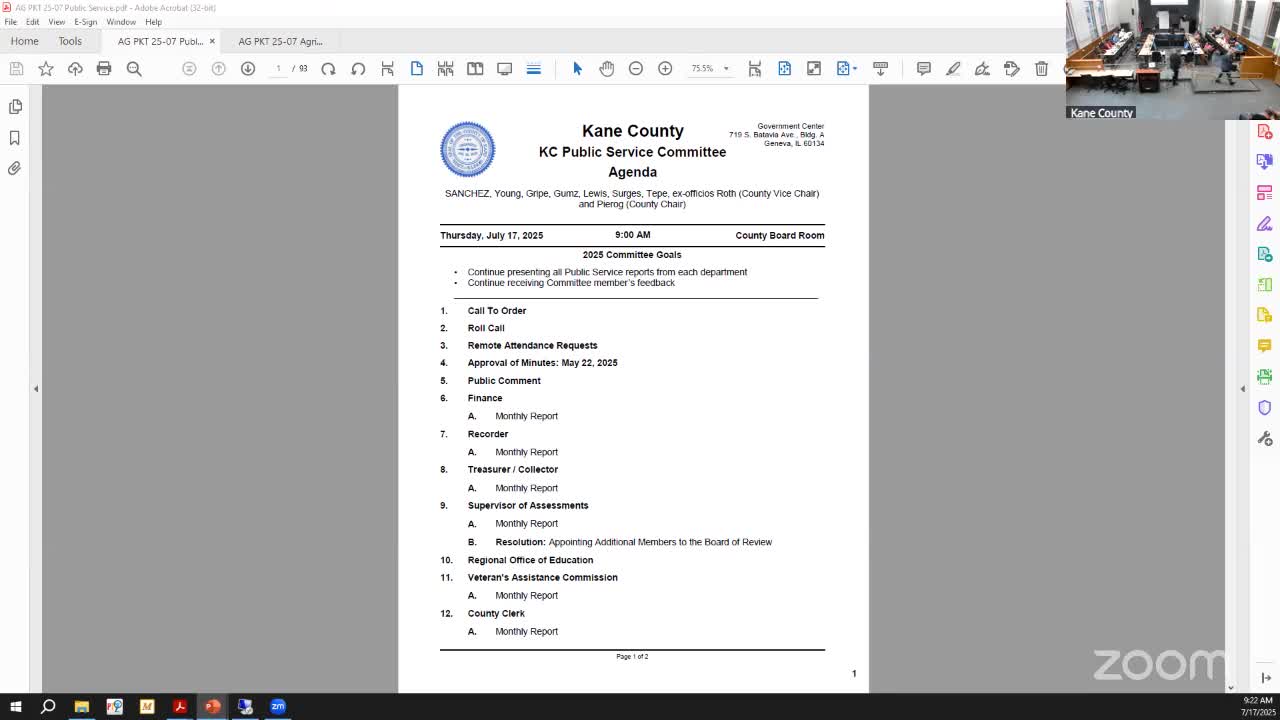
Summary
Treasurer and assessor briefed Kane County’s Public Service Committee on July 17 that delays in mailing property tax bills could cost the county hundreds of thousands and other taxing bodies millions, and the committee approved a routine resolution to authorize additional board-of-review members when complaint volumes spike.
Kane County officials told the Public Service Committee on July 17 that late property tax bills would produce measurable losses to county and local taxing bodies, and requested routine authority to appoint extra board-of-review members to handle assessment complaints.
Treasurer/Collector Lawson and Supervisor of Assessments Mark Armstrong explained the county’s 22-month tax cycle and the timing links among the board of review, the county clerk and treasurer. Armstrong said the county’s 2024 extension (payable 2025) totaled about $1,665,000,000 and that Kane County’s share was about $61,000,000 (roughly 3.7% of the total distribution). He warned that a 90-day delay in tax-bill mailing could cost Kane County about $544,006 in lost interest and cost all taxing districts combined nearly $15 million, using the interest-rate assumptions the treasurer provided during the presentation.
Armstrong described operational deadlines: board-of-review hearings must complete by Jan. 15 so the board can certify by Feb. 1; the clerk needs the extension by April 1 to allow the treasurer 30 days for bill mailings with a typical due date near June 1. Armstrong said his office has historically kept the cycle on time.
Treasurer Lawson described a recent instance in which counterfeit cash entered the payment stream and said county staff are seeking procedures and law-enforcement assistance to prevent pass-along of counterfeit bills. Lawson also raised an unresolved statewide policy issue: the disposition of residual equity when tax lien buyers acquire a property. Armstrong said 49 other states have legislative solutions; in Illinois the issue requires state law changes to preserve any surplus equity for property owners.
The committee approved Armstrong’s annual resolution authorizing the chairman to appoint additional board-of-review members as needed when assessment complaint volumes exceed the capacity of the three-member board; the clerk called the roll and the committee voted in favor on the record.
Discussion versus decision: The presentation and debate were substantive administrative discussion and did include one formal, routine resolution authorizing emergency appointments to the board of review; the committee voted to approve that resolution. No new county policy or appropriations were adopted at the meeting. Officials recommended continuing attention to legislative fixes for tax-sale equity and to county processes for counterfeit-cash handling.
Ending: Officials said they will return with a short presentation on assessment accuracy in a future meeting and encouraged county taxing bodies to budget conservatively for possible shifts in interest income.