
Hillsborough commissioners approve $709 million HUD disaster-recovery action plan amid public calls for clearer storm-resilience projects
Get AI-powered insights, summaries, and transcripts
Subscribe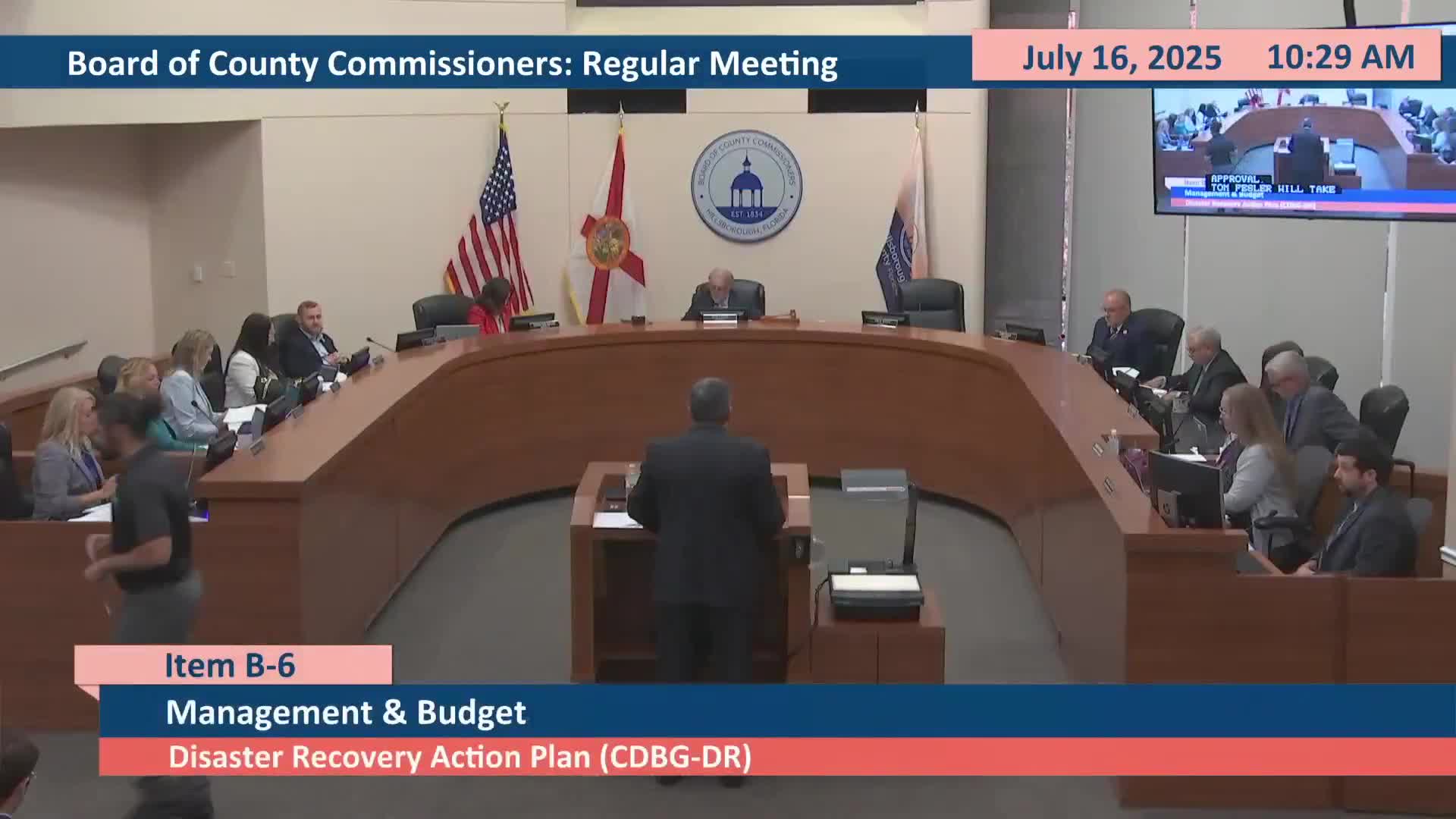
Summary
County commissioners on July 16 approved a final Community Development Block Grant–Disaster Recovery action plan and authorized staff to submit it to HUD for a $709,324,000 allocation.
County commissioners on July 16 approved a final Community Development Block Grant–Disaster Recovery action plan and authorized the chair and county administrator to execute and certify documents needed to access the $709,324,000 allocation from the U.S. Department of Housing and Urban Development. Tom Fessler, the county’s chief financial administrator, told the board, "it was January 21 when the county received notification of an allocation from HUD of $709,324,000."
The board’s approval sends the plan to HUD for review; HUD will have a 45‑day window to approve or comment on the submission, and staff said the county will use that window to issue requests for proposals to hire consultants for implementation. The action matters because at least 70% of the funds must be used for low‑ and moderate‑income residents and projects generally must demonstrate a direct tie to the storms Helene and Milton.
Advocates and residents used the public‑comment period to press for more detailed mitigation and resilience measures in the plan. Isabella Moeller, a member of the Hillsborough Affordable Energy Coalition and a University of South Florida student, said, "this plan does not adequate adequately address these issues," urging the commission to prioritize energy efficiency and storm‑resilient upgrades for multifamily housing. Alyssa White, climate justice organizer with Florida Student Power, told the board, "This plan must be built for the long haul, not just recovery, but also resilience." Several speakers asked for clear project lists, timelines and accountability metrics before the plan is finalized.
County staff said the plan is intentionally broad at this stage to preserve flexibility for drilling into project specifics during implementation. Fessler said the draft began a 30‑day public‑comment period after it was presented to the board in June and that the county will coordinate with municipalities to allocate funds inside city boundaries. He told the board the county plans to hire consultants during HUD’s review period and will return to the commission with detailed program design for housing, infrastructure and economic revitalization projects.
Commissioners stressed two practical priorities in discussion: protecting as much of the allocation as possible for direct project work rather than administrative fees, and structuring consultant and construction contracts to avoid duplicated overhead. Commissioner Christian Willstell proposed and the board agreed to direct staff to separate the housing implementation role (a construction manager/general contractor responsible for construction oversight) from grant administration services, a change staff said is used in other jurisdictions and would help limit unnecessary administrative layers.
The board voted unanimously to approve the action plan and a separate motion to direct staff on procurement structure; the record shows the board authorized the chair to execute the final agreement after HUD approval and the county administrator to sign required certifications. The plan will now be transmitted to HUD for review; staff will return with vendor recommendations and project‑level details once the federal review and initial RFP process are complete.
What the county approved today sets required federal rules and a funding envelope; it does not yet specify exact project addresses or construction contracts. Residents and coalitions who addressed the board requested that subsequent implementation documents include enforceable metrics for energy resilience, affordable housing prioritization, and clearer timelines for stormwater and infrastructure work.