
Edmonds School District board adopts 2025‑26 budget; fund balance projected at about 7.18%
Get AI-powered insights, summaries, and transcripts
Subscribe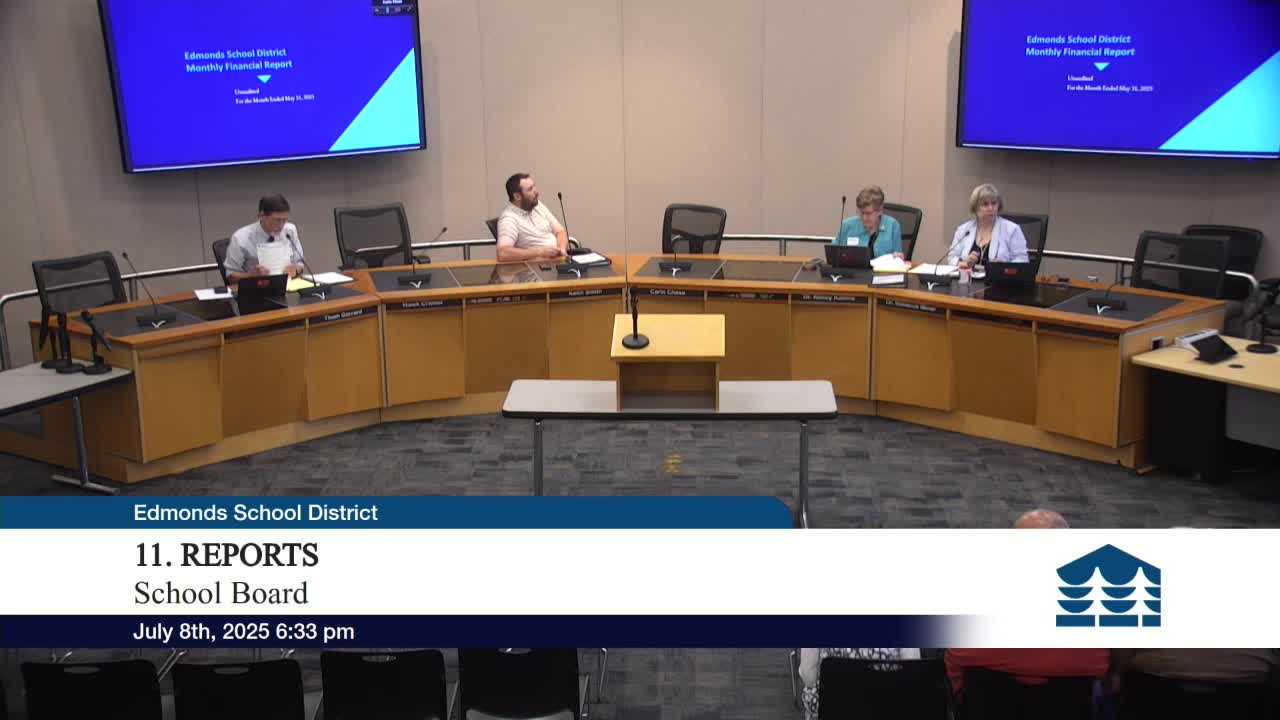
Summary
The Edmonds School District board approved Resolution 25‑16 to adopt the 2025‑26 annual budget by roll call vote, with staff projecting a total fund balance of about 7.18%.
The Edmonds School District board adopted Resolution 25‑16 on July 16, approving the district’s 2025‑26 annual budget by roll call vote.
Executive Director Lydia Celli presented the May financial report and told the board that, even though the report covers May, the district is roughly three‑quarters through the fiscal year and both revenues and expenditures are tracking close to last year. “Fund balance, currently the total is projected at 7.18%,” Celli said, noting that figure includes inventory, prepaid expenditures and other fund balance elements; district policy targets an unassigned minimum fund balance of 4%.
Board members discussed cash‑flow timing and recent state‑level adjustments. Celli and staff said the Office of Superintendent of Public Instruction (OSPI) short‑paid certain funds in June because of state budget actions and expects make‑up payments in July when the new state fiscal year begins. Board members and Superintendent Dr. Chris Minor said the district is already engaged in advocacy with state legislators about funding gaps.
Directors also addressed federal allocations the district expected this year — titles cited in the meeting included Title I, Part C (migrant education), Title II, Part A (professional learning), Title III, Part A (English language learners) and Title IV (before‑ and after‑school programs). A district speaker said some Congress‑approved funding has been suspended at the federal level; board members said maintaining reserves provides flexibility if those federal payments do not arrive.
The board voted on Resolution 25‑16 by roll call; Directors Gerard, Smith, Chase and President Cadems voted yes. Kramer was absent. The resolution passed and will govern the district’s spending plan for the 2025‑26 fiscal year.
Why it matters: the adopted budget sets program funding levels and preserves reserves the board said could be critical if expected federal or state funding is delayed or reduced.
What the transcript shows and does not show: the board approved the budget after prior study sessions and presentations; the transcript includes summary numbers and policy discussion but does not provide line‑by‑line appropriation details in the public comment segment.