Get Full Government Meeting Transcripts, Videos, & Alerts Forever!
Get email alerts on the Land Use Renewables topic
No spam. Unsubscribe anytime.
Richland County commissioners approve resolution restricting large wind and solar in 11 unincorporated townships
Summary
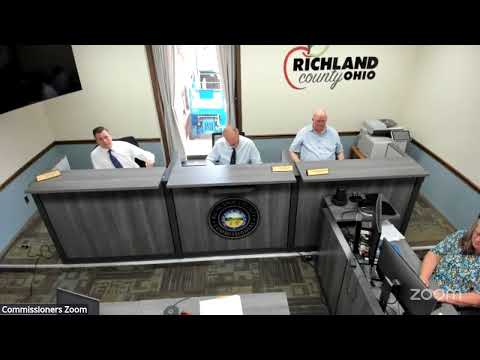
The Richland County Board of Commissioners voted July 17 to adopt a resolution declaring portions of unincorporated Richland County restricted areas that prohibit construction of “economically significant” wind farms, large wind farms and large solar facilities in townships that requested the prohibition.
The Richland County Board of Commissioners voted July 17 to adopt a resolution declaring portions of unincorporated Richland County restricted areas that prohibit construction of “economically significant” wind farms, large wind farms and large solar facilities in the townships that requested the prohibition. The board said it acted after township trustees in a majority of the county’s townships formally requested commissioners take that step.
Commissioner Tony Vero introduced the background for the board, saying the county asked its 18 township trustees to respond after Senate Bill 52 became state law and gave local governments authorities and options. "In February, our office had sent a letter to the 18 townships, requesting guidance from our townships on, the commissioner's ability to prohibit large wind and solar within the county," Vero said. He told trustees the county provided a sample resolution if they wished to take formal action.
The vote followed an extended public-comment period in which residents, township trustees and labor representatives spoke for and against the restrictions. Jeff Strang, who identified himself as a local resident and retired teacher, urged the board to keep options open for renewable manufacturing and jobs and said Richland County had advantages for wind and solar: "We have the manufacturing space. We have the know how, and we have an exit waiting to happen," Strang said. Others, including township trustees and residents, raised concerns about farmland loss, property values and local notice for township-level deliberations.
Why it matters: the resolution concentrates authority at the county level only for those townships that asked for the restriction. Commissioners framed the vote as deferring to local township trustees who formally asked county hall to act. The result will change where large-scale renewable-energy projects can be sited in unincorporated parts of the county unless townships later rescind their resolutions.
Key facts and what the vote does: the board said 11 townships asked the county to prohibit large wind and solar and that seven townships either declined to take formal action or explicitly declined to request a prohibition. Commissioners read the list on the record: townships included in the prohibition were listed as Plymouth, Blooming Grove, Sharon, Jackson, Franklin, Weller, Mifflin, Troy, Monroe, Perry and Jefferson. Townships that declined were Worthington, Washington, Addison, Springfield, Sandusky, Butler and Cass. The county reported there are 18 townships in total.
Scope and definitions cited at the meeting: county counsel and staff said the statutory thresholds define "large" projects; the board and county attorney said that, under state statute, a large solar facility is generally the 50-megawatt threshold and that "economically significant" wind and large wind have separate statutory thresholds (commission staff cited wind thresholds in the 5–50 megawatt and 50+ megawatt ranges while explaining the difference). Andrew, county counsel, summarized: "For solar, it's only 50 and above. Now wind is different ... economically significant wind is between 5 and 50 megawatts, and large wind is 50 megawatts or bigger."
Discussion versus decision: commissioners explicitly separated public comment and trustee requests from formal action. Commissioner Vero said the board would follow the stated wishes of townships that asked for prohibition and would not act where trustees did not ask for it. He also told the public the county could revisit any prohibition: "If we go out and fill up these townships with amazing solar projects that bring clean energy, labor, and we can do more, I am 100% willing to revisit and rescind a prohibition in the township," Vero said. Several speakers urged a case-by-case approach and said a prohibition could deter future investment; others argued the restriction protects farmland and property values.
Implementation and next steps: commissioners recorded the vote to adopt the resolution and asked county staff to record which townships were included. Commissioners and county counsel noted that a township may later amend or rescind its own resolution and that the commissioners’ action could be revisited if trustees request a change and follow the statutory process.
Who spoke about this at the meeting: residents including Jeff Strang, Annette McCormick and Crystal Davis Weese; township trustees including Adam Schrader (Sharon Township), Mike Keith (Franklin Township) and Dan Gorbert (Sandusky Township); representatives of labor including an IBW Local 688 speaker; county staff including Daryl (county staff) and Andrew (county attorney); and Commissioner Tony Vero. Many other residents and trustees offered public comments during the hearing.
What the resolution does not do: commissioners and staff repeatedly clarified the action does not affect municipal (city or village) limits within townships. The county said the prohibition applies only to unincorporated areas; municipalities remain able to regulate projects within their corporate limits. County speakers also emphasized the resolution does not affect small residential solar installations or other non-utility residential uses.
Outlook and caveats: commissioners said the ban only applies in specified unincorporated township areas and that the county had not yet seen any large wind or solar projects proposed since the statute changed in 2021. Several trustees and residents asked for clearer notice and greater outreach in townships before such actions are taken; some trustees said they had held public hearings or received constituent input before acting. The board recorded the resolution as approved and recessed after the vote.