Get Full Government Meeting Transcripts, Videos, & Alerts Forever!
Get email alerts on the Peak Innovation Park topic
No spam. Unsubscribe anytime.
Council discusses utilities executive agreement to make Peak Innovation Park "shovel ready" amid $165–168M utility proposal
Summary
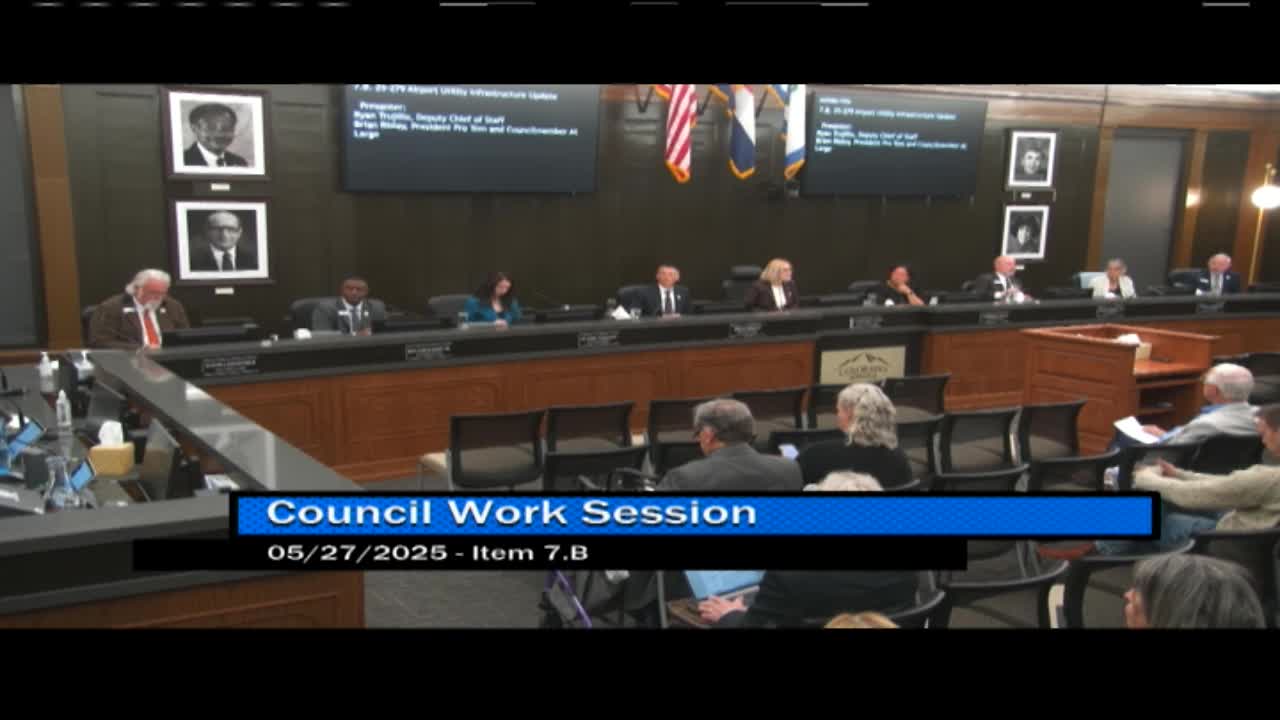
Colorado Springs City Council members and city staff heard detailed briefings on a proposed executive agreement with Colorado Springs Utilities that officials say would make Peak Innovation Park ‘‘shovel ready’’ by funding major electrical infrastructure, including a substation the airport would finance.
Colorado Springs City Council members and city staff heard detailed briefings on a proposed executive agreement with Colorado Springs Utilities that officials say would make Peak Innovation Park ‘‘shovel ready’’ by funding major electrical infrastructure, including a substation the airport would finance.
The discussion matters because city and utilities officials said the utilities investment, together with an airport-financed substation, would remove a major obstacle for large industrial and aerospace employers to locate in the city and could accelerate projects that otherwise face multi‑year lead times.
Mike Frankel, Colorado Springs Utilities chief customer officer, described the utilities’ role and timeline. “Essentially, what it does is it allows the site to be shovel ready,” he said, adding that utilities has proposed about $168,000,000 to provide needed transmission and that the airport’s substation would be about $58,000,000. Frankel said long lead times for substation transformers are typically “about 4 and a half to 5 year lead time,” and that prebuilding infrastructure reduces that delay.
Johnna Reeder Klamire, president and CEO of the Colorado Springs Chamber and EDC, urged urgency, saying site readiness is a decisive factor for location consultants. She told council that in 2024 the chamber had 13 projects looking at the region and lost 10; for 2025 she reported nine requests for proposals and had already lost one. “If they don't know that they're gonna be able to get in in 24 to 36 months, we're likely gonna get cut out,” she said.
City staff and the chief of staff described financing considerations and limits under local rules. Staff said the airport — an enterprise fund separate from general city revenues under local governance rules and ballot measure constraints — is being considered to finance the initial substation investment. The chief of staff said the $58,000,000 substation figure is the initial airport-side estimate, and that the utilities’ investment has been discussed at roughly $165,000,000 to $168,000,000 in the meeting.
During the discussion Councilman Risley asked whether public comment would be allowed; the council allowed a short presentation from the chamber. Council members also asked about the number of prospects reliant on the project; staff and the chamber said there were multiple prospects in the pipeline (staff said “5 that we're considering in the queue” and the chamber said a larger funnel of active leads). Officials described benchmarks — examples included a prospect that could bring about 400 jobs at an average salary the presenter said was “about 89 k a year,” and a past example, Entegris, that created hundreds of jobs on an infill site.
City staff outlined preliminary financing mechanics discussed for the executive agreement. Staff said an initial deposit was proposed to secure transformer deposits and to cash flow early costs; staff stated, “we proposed was a deposit of 2,800,000.” Staff also said that total airport capital for the substation was expected to be about $58,000,000 and that utilities’ capital contribution was being discussed in the mid‑hundreds of millions. Council members repeatedly pressed for clarity on risk to the airport and the city, and staff emphasized due diligence and structuring to protect the airport’s financial health.
Council members voiced the tradeoffs between speed and fiscal caution. Some emphasized that delays could cause prospective employers to locate elsewhere; staff and utilities noted supply‑chain and skilled‑labor constraints that tend to increase costs over time. No formal vote or ordinance was taken during the work session; the item was discussed at length and staff said they would continue due diligence and negotiations.
Copies of comments and financial figures provided at the session showed the project’s history (staff said Peak Innovation Park was created in 02/2009), the airport’s separate enterprise status, and the council’s role in any future approvals. Council members asked staff to return with clearer financing terms and implementation milestones.
The session concluded with no formal council action recorded on the executive agreement; staff and utilities indicated they were continuing negotiations and expected additional briefings and potential action in coming weeks.