Get Full Government Meeting Transcripts, Videos, & Alerts Forever!
Get email alerts on the Police Accountability topic
No spam. Unsubscribe anytime.
Council hearing examines Baltimore police accountability process, highlights data gaps and staffing shortfalls
Summary
A City Council Public Safety Committee hearing on LO25-0005 focused on how complaints of police misconduct move through Baltimore’s new accountability framework, with officials and civilian board chairs citing inconsistent data, lengthy case timelines and insufficient staffing for the Administrative Charging Committee.
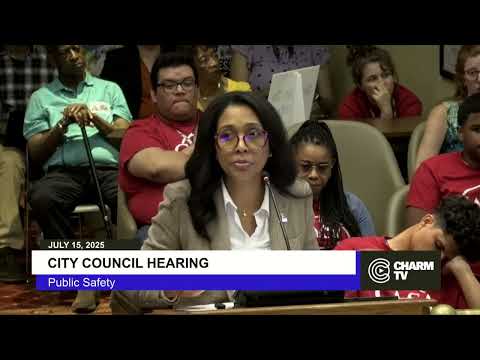
Baltimore — The Baltimore City Council’s Public Safety Committee convened a hearing on LO25-0005 to review how the city handles complaints of police misconduct and whether existing systems are delivering timely, transparent accountability.
Councilman Mark Conway, chair of the committee, said the hearing was designed to “understand whether or not these processes are living up to the promise that we've made to residents to investigate complaints in a timely manner and to hold officers accountable when they engage in misconduct.” He opened the session noting recent, high-profile police-involved incidents that have increased public scrutiny of investigatory timelines and outcomes.
The city’s Office of Equity and Civil Rights (OECR) described the framework set by the Maryland Police Accountability Act of 2021, which established a Police Accountability Board (PAB) and an Administrative Charging Committee (ACC). Director Amber Green said the city accepts complaints online, by mail and in person and that the OECR and BPD are collaborating to standardize key dates and definitions so case-tracking is consistent across agencies. “We are committed to upholding the civil and human rights for all Baltimore residents to ensure constitutional policing and equitable public safety,” Green said.
Baltimore Police Department (BPD) Deputy Commissioner Brian Dedo said the department receives about 1,500 complaints a year and that classification and assignment workflows create unavoidable backlogs when investigators are undersized. “We each year, we have about 1,500 complaints. We do not have, of course, enough folks to get to those complaints all immediately,” he told the committee, describing how cases are routed to either the ACC (when a member of the public is involved) or a Disciplinary Review Committee (DRC) for internal matters.
PAB Chair Jamal Turner and ACC Chair Sierra Hawkes told the committee they are reviewing high caseloads and data inconsistencies. Turner’s 2024 PAB report identified the most frequent allegations as neglect of duty, body-worn camera failures and use-of-force outside policy; the board recommended giving the PAB independent investigatory and subpoena authority and clarified OECR’s supportive role. “The most frequent allegations were neglect of duty followed closely by body worn camera failures and use of force out of policy,” Turner said.
Hawkes said the ACC meets weekly and typically reviews 20–30 cases per meeting; she told the committee that timeliness is a major concern. “I think a year and a a day is far away from the 90 days, and I think that's something that we need to address,” Hawkes said, referring to the 90-day investigatory target in the city’s consent-decree-era guidance.
The committee and witnesses discussed recent data provided to council staff. Conway summarized the administration’s dataset, noting that calendar year 2024 showed 2,269 complaints (1,380 labeled external, 787 internal and 102 ethics complaints) encompassed in 1,485 cases, with roughly 30% open when the dataset was transmitted. He said about 46% of adjudicated complaints had been sustained, but the spreadsheet from the administration did not enumerate disciplinary outcomes. OECR and BPD officials acknowledged differences between datasets (OECR tracks ACC-eligible cases; BPD’s raw iPro system includes broader intake and internal audits) and promised follow-up data clarifications.
The committee pressed for more complete outcome data: how often ACC recommendations were accepted, what suspensions or terminations followed sustained findings, and how frequently accused officers chose trial boards. Director Green said the administration had received supplemental information indicating 1,196 cases had reached final disposition and 1,098 of those were sustained, and she pledged to provide a year-by-year breakdown as requested.
Members of the committee and civilian board chairs urged clearer, standardized public reporting. Conway proposed working with CityStat and OPI to develop a consistent reporting format and suggested a short-term data fellowship to standardize and present accountability metrics. PAB and ACC leaders also asked for expanded staffing and independent legal support; Turner asked that the PAB be empowered to investigate and issue subpoenas, which would require state authorization and local enabling legislation.
State timeline changes were discussed. OECR staff briefed the committee on Senate Bill 533, which the state passed to adjust investigatory timelines: the law enforcement agency will have roughly 11 months to complete its investigation and the ACC up to 60 days if it exercises subpoena powers, creating a combined statutory window of roughly 395 days to finalize a review.
Where the process falls short, witnesses said, is not only in legal authority but in personnel and data systems. Hawkes and Turner described heavy volunteer and staff workloads at the ACC and PAB. Deputies and OECR staff described process improvements — weekly notifications of complaints, standardized definitions, and the use of a statewide disciplinary matrix — but acknowledged implementation will take time and resources.
The committee made several follow-up requests and informal directions: clearer datasets with standardized date fields and outcome categories; a breakdown of disciplinary outcomes for sustained allegations; an administration response on whether the ACC and PAB can be provided third‑party legal counsel without a city-law conflict; and a joint CityStat/OECR project to produce a consistent public-facing accountability dashboard. Conway asked for these items to be advanced as near-term deliverables and recommended staff return with proposals for city or state legislative changes within roughly 60 days ahead of the next legislative cycle.
The hearing closed with a commitment to continued oversight and additional briefings. No formal votes were taken at this meeting.