Get Full Government Meeting Transcripts, Videos, & Alerts Forever!
Get email alerts on the Polystyrene Ban topic
No spam. Unsubscribe anytime.
Boston committee holds fact‑finding hearing on phasing out polystyrene food packaging
Summary
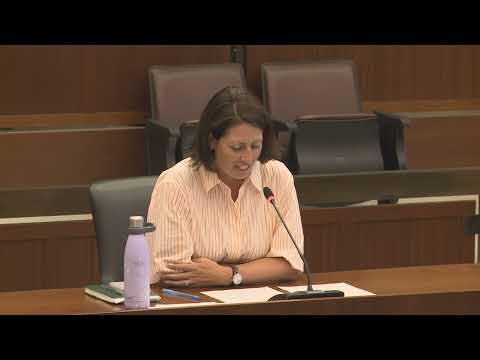
Councilor Gabriela Colette Zapata, District 1 city councilor and chair of the Boston City Council Committee on Environmental Justice, Resiliency and Parks, convened a July 16 hearing to assess a proposed ban on polystyrene food packaging in the city of Boston.
Councilor Gabriela Colette Zapata, District 1 city councilor and chair of the Boston City Council Committee on Environmental Justice, Resiliency and Parks, convened a July 16 hearing to assess a proposed ban on polystyrene food packaging in the city of Boston. The session, docket 0315, gathered testimony from the city’s Environment Department and Office of Economic Opportunity and Inclusion, members of the public and youth advocates, and local stakeholders to weigh environmental, health and small‑business impacts.
The hearing’s central question was whether and how Boston should phase out polystyrene — the lightweight foam used for many takeout containers, cups and food trays. Councilor Wu Chen, a co‑sponsor of the matter, cited public‑health concerns and existing municipal precedent: “The CDC has identified [styrene] as, quote, ‘reasonably anticipated to be a human carcinogen,’” she said, and noted roughly two dozen U.S. cities and about 66 Massachusetts municipalities already restrict polystyrene in some form.
Why this matters: polystyrene is not curbside recyclable in Boston and is persistent in the environment; city staff described how it often enters waterways or is incinerated rather than landfilled or recycled. Committee members emphasized environmental‑justice concerns after witnesses said lower‑income neighborhoods and communities of color see disproportionate exposure to single‑use plastic pollution.
Administration testimony and technical options
Alice Brown, director of environmental quality in the Environment Department, told the committee polystyrene “leads to littering, perpetuates the use of non‑recyclable single‑use products and may pose health risks to humans and the environment.” Brown outlined alternatives and implementation tools the city could use if it pursued a ban: bulk purchasing of non‑polystyrene containers for small businesses, grant or subsidy programs to offset transition costs, pilot reuse programs that rely on on‑site dishwashing or networked reusable container schemes, and modifying health‑code permitting to enable refill and reuse models.
Brown cautioned that many commonly suggested alternatives have limits: some paper containers contain plastic liners and are not truly recyclable, compostable items typically require industrial composting infrastructure, and black plastic is often invisible to automated recycling sorters. “Reusing materials is more environmentally sustainable than recycling them,” she said, and recommended the committee center reuse in any policy design.
Donald Wright, deputy chief for economic opportunity and inclusion, focused on impacts to small businesses. Wright said many restaurants — particularly Black, Brown and immigrant‑owned establishments — rely on existing suppliers and low‑cost polystyrene to maintain thin margins, and that a transition would require technical assistance and financial support. He recommended partnering with Main Street districts, regional entities such as MAPC, and foundations or state programs to provide grants, bulk procurement or targeted outreach. Wright said capacity for a citywide transition is limited today: “We don’t have a full‑time staff person who is thinking specifically about reuse,” he told the committee.
Councilor concerns and committee scope
Councilor Flynn repeatedly raised the potential financial burden on small restaurants and pressed the administration for data on how many businesses currently use polystyrene and how transition costs would affect profit margins. Chair Zapata framed the hearing as the first step in a fact‑finding process and emphasized outreach to affected business owners and environmental‑justice communities before any ordinance is drafted. "This is a hearing, a fact‑finding mission, to simply understand what the feasibility is," Zapata said.
Public testimony and local advocacy
Members of Girl Scout Troop 68277 (Dorchester) — Eleanor Pelletier and Kalita Bellavo — told the committee the troop has run nine recycling drives that collected specialty items the city does not accept curbside and reported diverting more than 8,000 pounds of specialty waste, including nearly 800 pounds of polystyrene. "We get a lot of food packaging Styrofoam," Pelletier said, and argued a city policy would scale collection or eliminate the source rather than rely on volunteer efforts.
Local resident Christian (Christine/Kristen) Delorco described environmental and health concerns tied to polystyrene and referenced animal‑ and laboratory‑based studies on microplastics and styrene exposure. Delorco urged the council to move on the issue, saying alternatives are widely available in the market.
Next steps and limits
No ordinance or vote was taken. Committee members and staff described next steps limited to research and stakeholder engagement: possible assessments of enforcement pathways (health permitting, weights and measures or other enforcement channels), outreach with restaurant associations and Main Streets, an evaluation of grant and bulk‑purchase models, and exploration of pilot reuse programs. The administration noted it has not completed a comprehensive feasibility study and that enforcement would likely fall to other agencies if a ban were enacted.
The hearing closed with committee members committing to continue outreach and to gather more data on small‑business impacts, litter patterns by neighborhood, and the costs and infrastructure needs for alternatives. Chair Zapata said her office intends to draft policy options only after further engagement with restaurants, community groups and city departments. The committee did not set a timeline for any ordinance or a subsequent vote.