Get Full Government Meeting Transcripts, Videos, & Alerts Forever!
Get email alerts on the Fairgrounds Purchase topic
No spam. Unsubscribe anytime.
Williams County agrees to negotiate terms for purchase of Upper Missouri Valley Fairgrounds; staff directed to return with agreement
Summary
The Williams County Commission voted to support in principle a staff proposal to pursue purchase of the Upper Missouri Valley Fairgrounds and directed staff to negotiate specific terms with the Upper Missouri Valley Fair Association and return to the commission for final approval.
The Williams County Board of County Commissioners on July 15 authorized county staff to continue negotiating terms to purchase the Upper Missouri Valley Fairgrounds and to return to the commission with a written agreement for formal approval. The board’s action was a vote of support for the staff report and direction to finalize details with the fair association. The motion passed on a roll call vote with all commissioners present voting yes.
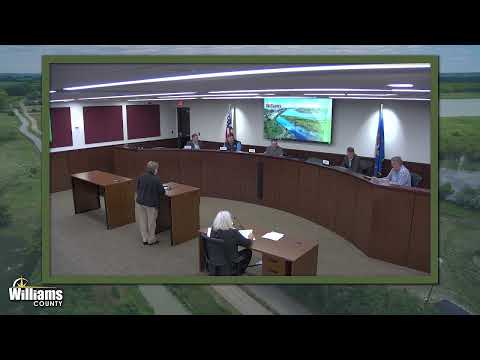
The vote came after a lengthy staff presentation by Helen (county staff) and discussion with Shane Cymbalek, president of the Upper Missouri Valley Fair Association, who attended the meeting. The county’s original written offer — provided to commissioners in advance — proposed a $300,000 purchase to retire the fair association’s outstanding loan and creation of a grant funding mechanism for future projects. The fair association’s counterproposal requested a different funding structure, including a request for $200,000 annually for 15 years and other conditions the county described as not acceptable in their current form.
County staff said the counteroffer raised legal and fiscal concerns. Helen told the commission that because the county intends to use 1% sales tax quality-of-life funds that are scheduled to sunset in 10 years, the county could not commit taxpayer funds beyond that term. She also said the county could not give the fair association a contractual “first right of refusal” to repurchase the property at the original purchase price once county investments were made, because government asset sales require a fair market process and because county-funded improvements would increase asset value.
Commissioners and staff discussed how any financial support would be administered. Commissioners stated they wanted the fair association to apply for grants under the county’s existing 1% grant process rather than receive an unrestricted annual payment. Helen said that, by policy, recipients of county grant funding provide financial statements and other accountability materials; she reviewed the fair association’s recent audits and profit-and-loss statements and said the county already requires that documentation for grant recipients.
Other points in the staff report and in discussion included: the county would purchase building accessories normally attached to the property; existing fairboard-held liquor licenses would continue to be held by the association (so long as they remain in compliance with City of Williston regulations); the county would inventory site-owned and tenant-owned equipment and work out shared-use or tenancy agreements; current scheduled events through 2026 would be honored but longer-term event commitments could be reassessed as site improvements proceed; and the county intends to improve and maintain the property to support fair operations rather than restrict them.
Rather than accepting the fair association’s 15-year, $200,000-per-year proposal as written, the board voted to move forward on the staff recommendation and asked Helen and county staff to work with the fair association to produce a written agreement spelling out the grant process, accountability requirements and other details, and to return to the commission for final approval. Helen said staff would provide a written summary of the commission’s direction to the fair association’s board members so they all have the same information for their next meeting.
The county and the fair association still need to finalize the purchase contract and the grant/advisory processes. Commissioners emphasized the goal of improving facilities for quality-of-life and economic development, and of preserving the fair association’s ability to stage the annual fair. The commission’s procedural vote is not a final purchase contract; staff will return with a proposed agreement and formal motion for signature and funding authorization at a subsequent meeting.