Get Full Government Meeting Transcripts, Videos, & Alerts Forever!
Get email alerts on the Property Assessments topic
No spam. Unsubscribe anytime.
Williams County releases 2025 assessment report; officials cite 10% baseline increase
Summary
The Williams County Tax Equalization Office presented the county'wide 2025 assessment report June 3, explaining a 10% baseline increase applied to many property classes and outlining sales-ratio results that keep the county within the state'required 90'to'100 percent range; residents raised concerns about rising valuations and tax impacts.
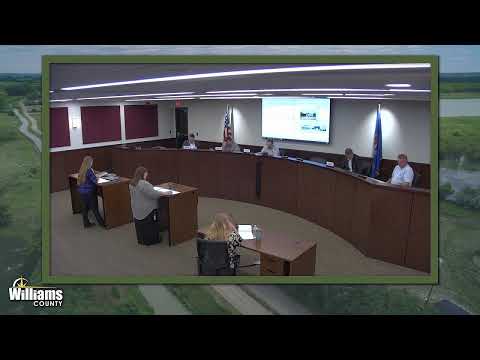
Leah, Williams County tax equalization director, told the Board of Equalization on June 3 that the county'wide 2025 property assessments were set using a February 1 valuation date and market information from Jan. 1 to Dec. 31, 2024. "The specific requirements for property assessment are established in the North Dakota Century Code," she said, and the office followed that law in producing the report.
The assessment staff applied a 10 percent "across-the-board" base increase to many property classes after observing higher replacement costs and sales data, but Leah emphasized the 10% was a starting point: "Just because we did a 10% across the board does not mean that everybody received a 10% increase." She said individual classifications were adjusted up or down where sales indicated a different change.
Why it matters: the state requires local assessors to keep sales-ratio studies between 90 and 100 percent; Williams County's residential sales ratio averaged about 93.34%, and assessors sent 1,033 notices of value increases to owners whose assessed value rose at least 10% and $3,000. Leah noted residential true-and-full value increased $60,873,588 for 2025, with over $22,000,000 attributed to new construction.
Assessors explained methods and results. Leah described the assessor's role as historical and data-driven: "Assessors do not create value or predict what the market will do. Rather, the assessor's job is to follow that pattern set by the real estate market." The office reported an overall commercial sales ratio near 95% and said commercial true-and-full value increased $4,675,865 in 2024, including about $14,000,000 in new construction.
Staff detailed classification-specific practices: manufactured homes that are not on owner-owned land are assessed via a permit system and are taxed on a calendar-year basis rather than the December statement for real property. Agricultural land is valued using soil-productivity models and an "Eggland" capitalization formula based on cap rates, production averages and a production-cost index.
Residents asked questions during the public comment and hearing periods. Resident Rory Barbault said he could not reconcile his assessment with recent nearby sales: "They just sold another house for $410. ... This is a comparable house. I would say square footage everything. You guys have assessed it at $525." Leah and staff explained mass appraisal and sales-study methods, including use of median ratios to limit outlier effects.
Resident Kelly Harrelson told the board her property rose 14% this year and warned that continued increases would price some homeowners out: "If this increases at the current rate it is, we're all gonna lose our homes." Leah and board members responded that mill-levy adjustments and broader budget decisions can offset some valuation-driven tax pressure and that state rules bound assessors to stay within the 90'to'100 percent window.
Leah and staff offered property owners an appeal path and local review: "If somebody does question the value, you'll offer to go in and review the property," said Christy Gutierrez, an assessor who handles specific classifications, and she invited residents to contact the assessor's office for inspections or record reviews.
Ending: The presentation and public discussion preceded a series of board motions formalizing corrections and exemptions (see separate article). The tax equalization office said it will continue to accept inquiries and is prepared to make site visits and, when warranted, adjust assessments through the formal protest and abatement processes.