Get Full Government Meeting Transcripts, Videos, & Alerts Forever!
Get email alerts on the Compensation And Benefits topic
No spam. Unsubscribe anytime.
Council weighs 2.4% cost-of-living increase, pay-equity moves and benefit changes
Summary
County staff presented compensation scenarios showing the fiscal impact of a 2.4% COLA and options to fund positions at minimums and midpoints; council members also discussed benefits changes and overtime accounting.
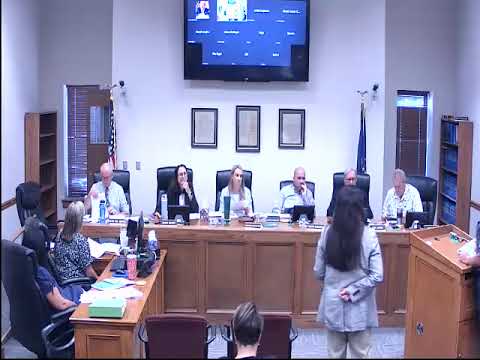
County staff presented detailed compensation scenarios and the Boone County Council discussed how to balance a proposed 2.4% cost-of-living adjustment (COLA), internal pay equity (minimum and midpoint funding), and benefit changes including HSA and long-term disability coverage.
Amber, a county staff member, walked the council through a spreadsheet that showed three nested scenarios: (1) a 2.4% across-the-board COLA applied to presently funded salaries; (2) adding funds to bring positions now funded below the job minimum up to the minimum and then applying the 2.4% COLA; and (3) bringing positions to midpoint plus applying the 2.4% COLA. "If you look at the spreadsheet...there is the column that's just the 2.4% COLA," Amber said; the spreadsheet showed that a 2.4% increase alone would cost roughly $528,500 (staff’s figure). Bringing everyone currently below minimum up to minimum, and then giving the 2.4% COLA, added roughly $43,007 to that total; moving all positions to midpoint plus 2.4% was a larger jump (Amber’s sheet showed an approximately $711,000 total scenario for midpoint plus COLA).
Council members discussed priorities. Several members and the compensation committee indicated a preference for continuing previous years’ emphasis on moving positions toward midpoint when justified by experience or market data. "Last year...we discussed that we really wanted to get people to midpoint if in fact they had the experience," one council member said. Elected officials and department heads in the room asked for clarity about which specific positions were funded below minimum or midpoint; staff agreed to provide a department-level breakdown so elected officials and department heads can identify specific employees or lines.
Job classification and salary-ordinance consistency was a recurring issue. Several department leaders and elected officials said some budget forms and the printed salary ordinance list generic titles (for example, "litigation paralegal") even though individual staff perform distinct duties (victim advocate, child-support caseworker, court support). Amber and Debbie (staff) said they are working to reconcile job descriptions and form-1 entries and will break out mixed lines so department-specific roles are visible in the salary ordinance and budgets.
On benefits, staff summarized recent and proposed changes: - Health savings account (HSA)/Wellbridge: staff proposed replacing the prior wellness-credit structure with a tiered HSA funding approach (employee and employee-plus tiers), with 50% of the annual award credited early in the year and the remainder across subsequent pay periods. Staff also proposed revising the Wellbridge incentive so that fully covered procedures or items that meet a plan’s deductible threshold would generate a $500 HSA credit and procedures requiring out-of-pocket expense would generate $1,000, and to reimburse male sterilization procedures that the Affordable Care Act requires plans to cover for females. - Long-term disability: the county began covering long-term disability for full-time, non-elected employees starting January; staff estimated annual costs are in the low hundreds of thousands of dollars (budget staff to confirm exact 2025 figure). - PERF contributions: the county currently covers employee PERF contributions (three percent employee share plus employer portion); staff estimated total combined PERF-related costs at about $2,000,000 annually (staff to confirm exact split).
Overtime and timekeeping were flagged for policy clarification. Several department heads said they would prefer a clear rule: allocate overtime budget lines to track true overtime (pay at time-and-a-half for hours over 40) and keep straight-time work in regular salary lines, to improve payroll reporting and insurance audit transparency. Staff said they would work with the auditor and commissioners on a consistent approach to timekeeping and budget-line structure.
No final compensation votes were taken. Council members instructed staff to return with a departmental breakdown showing which positions are below minimum/midpoint, to finalize job-title alignments on the salary ordinance, and to provide confirmed cost numbers for PERF and long-term-disability coverage ahead of the August workshops.