Get Full Government Meeting Transcripts, Videos, & Alerts Forever!
Get email alerts on the Student Loan Repayment topic
No spam. Unsubscribe anytime.
HCAI opens Medi‑Cal Behavioral Health Student Loan Repayment program; applications due Aug. 15
Summary
The Department of Health Care Access and Information launched the BH Connect Medi‑Cal Behavioral Health Student Loan Repayment Program, offering up to $90 million in this cycle and awards of as much as $240,000 for certain behavioral‑health professions. Applications opened July 1 and close Aug. 15 at 3 p.m.
The Department of Health Care Access and Information on July 1 launched the BH Connect Medi‑Cal Behavioral Health Student Loan Repayment Program, a federally authorized effort to expand California’s behavioral‑health workforce by reducing student‑loan burdens for clinicians who commit to serve Medi‑Cal members and uninsured patients.
Kim Ramson, Grants Management Section Chief for Health Workforce Development at HCAI, said the program is part of a broader state effort. “California is facing a significant behavioral health workforce shortage, and the BH Connect workforce initiative is one way we're working to address it,” Ramson said.
The program is funded through the BH Connect initiative, which HCAI and the Department of Health Care Services developed after Centers for Medicare & Medicaid Services approvals tied to a Section 1115 demonstration and state plan amendments. Christian Jones, the program’s HCAI policy lead, said the agency has allocated “up to $90,000,000 in total for this year’s MBH SLRP cycle.” Awards vary by profession; Jones said some licensed prescribers and advanced practitioners are eligible for awards up to $240,000, while other eligible professions have lower maximums.
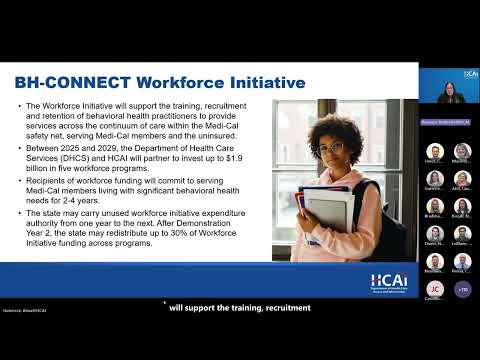
Why it matters: California officials say the awards are intended to recruit and retain clinicians in Medi‑Cal safety‑net settings where shortages are greatest. HCAI and DHCS plan to invest up to $1.9 billion across five workforce programs over five years, and recipients of this loan‑repayment funding must commit to serve Medi‑Cal members for multi‑year service obligations.
Who can apply and award levels - Eligible professions listed by HCAI include psychiatrists (including addiction and child/adolescent psychiatrists), physician assistants, nurse practitioners, licensed clinical psychologists, clinical social workers, marriage and family therapists, professional clinical counselors, certified peer support specialists, community health workers and others. Exact lists are in the grant guide. - Christian Jones said certain professions (for example, addiction medicine physicians, nurse practitioners, physician assistants and psychiatrists) may be eligible for awards of up to $240,000 and that those categories carry a four‑year service obligation. Other licensed clinical professions were described as eligible for maximum awards up to $180,000; AOD counselors, peer specialists and several paraprofessional roles were described as eligible for awards up to $120,000. Jones noted service‑obligation length is tied to award amounts; the webinar transcript contains uneven phrasing of the award‑to‑service breakdown, and applicants should consult the grant guide for the definitive schedule and examples.
Service obligations and work requirements - All service obligations must be served full time in an eligible Medi‑Cal safety‑net setting. HCAI defines full time as a minimum of 32 hours per week of direct client care (30 hours for school‑based behavioral‑health settings). - Direct client care includes prevention, assessment, treatment, counseling, documentation of patient encounters, face‑to‑face and telehealth services, and first‑line supervision where that supervision is required for the supervisee to deliver direct care. - Eligible sites include federally qualified health centers, community mental health centers, rural health clinics and hospitals or behavioral‑health sites with specified Medicaid/uninsured payer mixes. HCAI explained typical thresholds as 40% Medicaid/uninsured payer mix for many settings and 30% for certain rural hospitals; exact site categories and payer thresholds are listed in the grant guide.
Application process, deadlines and verification - The application opened July 1; Jessica McIntyre, program officer for grants management at HCAI, said: “The application is currently open. It opened on July 1. And the deadline to apply is August 15 at 3PM.” HCAI anticipates award notices in November and a proposed grant agreement start date in December. - Applicants must upload identifying and supporting documents (NPI if applicable, licensure/credential, unofficial transcripts, loan statements for each loan, employer contact for an employer verification form, emergency contacts, and any required conflict‑of‑interest letter). McIntyre said an application is not complete until the employer returns the electronic employer verification form and that awardees will submit employer verification every six months. - Payments will be sent directly to loan servicers. McIntyre said award payments will be issued to servicers and that grantees remain responsible for making required loan payments until servicers receive the award funds.
Breach, suspensions and leave - HCAI’s grant guide and grant agreement set conditions for recoupment and for suspension or modification of service obligations. McIntyre said HCAI will recoup payments if a grantee fails to perform their service obligation and that waivers after payment are generally limited. The grant guide lists suspension and leave policies; Christian Jones said the program allows up to four weeks of leave per year without extending the service obligation and that HCAI can grant suspensions for specified circumstances (for example, longer parental leave or loss of program funding) and will extend the service end date for suspended periods.
Scoring, conflicts and exclusions - The application evaluation awards points for factors such as participation in publicly funded programs, languages spoken, prior Medi‑Cal safety‑net experience and work at county specialty behavioral‑health sites. HCAI said it intends to support geographic and market‑type distribution; higher scoring applicants are more likely to receive funding, but score is not currently used to calculate award amount. - Nathaniel, a program manager on MBH SLRP, stated that current California state employees paid through CalHR are ineligible because state employment presents a conflict of interest for this state‑administered program: “anyone collecting a paycheck from the state of California… is not eligible for the program because it is considered a conflict of interest.” Former state employees may be eligible with a required conflict‑of‑interest attestation.
Common applicant questions raised in the webinar - Private practice: permitted if the practice serves the required Medi‑Cal/uninsured payer mix; HCAI evaluates sites at the practice level, not by an individual clinician’s caseload. - Independent contractors (1099): not categorically rejected; eligibility depends on who pays and the site and service criteria and may require a conflict‑of‑interest letter. - Parent PLUS and loans held in another person’s name: HCAI said loans must be in the applicant’s name; parent loans generally do not qualify. - Consolidated or refinanced loans: may be eligible if documentation clearly ties loans to the degrees listed and they are not consolidated with another person’s loans or non‑educational debt. - Telehealth and out‑of‑state clinicians: HCAI referred to DHCS telehealth policies; generally, clinicians must be licensed in California and reside in California except in limited, published circumstances referenced in the grant guide.
Where to get details and help - HCAI posted a grant guide, technical assistance guide and application materials on its website; an FAQ and webinar recording were to be posted within five business days. Applicants with situation‑specific questions were asked to email MBHSLRP@hcai.ca.gov. Christian Jones and Jessica McIntyre repeatedly urged applicants to consult the grant guide for definitions and examples.
Ending HCAI and DHCS said the award pool this cycle is large and encouraged eligible behavioral‑health practitioners to apply by Aug. 15 at 3 p.m. Applicants should read the grant guide carefully for the definitive definitions, award schedules, and waiver and suspension rules and should email MBHSLRP@hcai.ca.gov with application or verification problems.