Get Full Government Meeting Transcripts, Videos, & Alerts Forever!
Get email alerts on the Business And Occupation Tax topic
No spam. Unsubscribe anytime.
Council reviews 'Shield Seattle' B&O tax restructure as advocates and businesses clash
Summary
The Select Budget Committee heard hours of testimony and a staff briefing July 16 on council member Mercedes Rink’s Seattle Shield proposal, a ballot referral that would restructure the city’s business-and-occupation tax and, if approved by voters, is projected to raise about $90,000,000 a year while exempting most very small businesses.
The Select Budget Committee heard hours of testimony and a staff briefing July 16 on council member Mercedes Rink’s Seattle Shield proposal, a ballot referral that would restructure the city’s business-and-occupation (B&O) tax and, if approved by voters, is projected to raise about $90,000,000 a year while exempting most very small businesses.
The proposal would boost the small‑business exemption from $100,000 to $2,000,000; create a $2,000,000 standard deduction; and raise tax rates on larger taxpayers so the package nets about $90 million a year for a set of human‑services and public‑safety priorities. It would include a six‑to‑eight year sunset structure and go to Seattle voters on Nov. 4 if the council sends it to the ballot.
Why it matters: City and nonprofit leaders told the committee the revenue could shore up shelters, housing and emergency food programs that they say face cuts from federal actions, while many business owners warned it will discourage job creation and put fragile small and midsize firms at risk. Council members and the executive said the measure is one part of a broader strategy that will not by itself close a roughly $235–$240 million combined general‑fund and payroll‑expense tax gap identified in the April forecast.
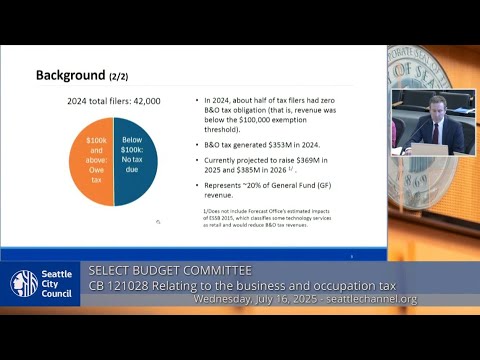
Central facts - The city’s forecast office estimates the restructure would generate a net $90,000,000 annually after raising the exemption and applying a new standard deduction. - Council central staff summarized the mechanics: the exemption rise to $2,000,000 would exempt an estimated additional 15,906 filers; a $2,000,000 standard deduction would remove roughly $10.8 billion of gross receipts from the tax base; and rate increases (to 0.342% for retail/wholesale/manufacturing and 0.658% for services/other categories) would be required to fund the changes. - Central staff and the executive emphasized revenue risks: the bill would narrow the taxable base from roughly 21,000 taxpayers to about 5,000, concentrating revenue risk; the April forecast saw slower growth and a 40–50% probability of recession in the next 12 months; state law changes (cited in the presentation as “state law 35 2 1 7 11” and the 2015 change classifying some tech services as retail) also affect definitions used in city collections.
What proponents said Several human‑service providers and hunger‑relief organizations urged the council to send the proposal to the ballot. Hallie Willis, introduced as policy manager for the Seattle/King County Coalition on Homelessness, said a restructuring would “help protect essential services like housing and shelter from local and federal budget cuts” and that “the $90,000,000 this tax will raise every year is essential.” Dennis Sills of Plymouth Housing and others said the measure is a “crucial first step” but not sufficient on its own to close the city’s structural shortfall.
Small business views and concerns Small business owners and business groups urged caution. Blake Garfield, who described himself as owner of a Wallingford retail store, said the cumulative cost of city and state taxes plus downtown vacancy and other pressures makes operating in Seattle difficult and asked that the council consider alternative ways to target revenue. Lily Hayward, speaking for the Seattle Metro Chamber of Commerce, said the chamber supports raising the standard exemption and creating a standard deduction but “we oppose doing so, however, by raising the B&O tax on other businesses” and urged using fund balance and underspend where possible.
Council and executive framing Council member Mercedes Rink, the bill sponsor, framed the measure as “giving Seattle voters the choice they deserve” and said it protects small businesses while asking larger firms to “step up” to preserve services. Deputy Mayor Greg Wong said the proposal “strikes the right balance” by reducing costs for many small businesses while raising revenue to offset federal and state headwinds; he noted the measure contains a four‑year sunset that could be extended if council approves a later ordinance.
Limits and next steps Central staff and the executive repeatedly warned of forecast risk and operational cost and timeline risks if the city must implement a new tax structure by Jan. 1: system changes to tax administration could cost an estimated $2.3 million (plus possibly $2.7 million more for legacy system updates) and about $1.5 million a year in ongoing administrative costs. Staff also flagged that roughly one‑third of the anticipated additional B&O receipts would be generated by a very small number of large taxpayers, increasing volatility.
The committee did not vote. Staff and the sponsor noted that amendments to the proposal or related budget items are due July 22 and that the council is scheduled to consider final action in August; if the council forwards the measure, voters would see it on Nov. 4.
Ending note Speakers on both sides urged the council to weigh both local budget needs and long‑term business climate concerns. Central staff and the executive said the restructure is only one lever among efficiencies and reductions the city will need to use to respond to the multi‑year budget shortfall.