Get Full Government Meeting Transcripts, Videos, & Alerts Forever!
Get email alerts on the Water Quality Incident topic
No spam. Unsubscribe anytime.
Utility district: nitrification, missed preventive maintenance led to week-long boil-water advisory; residents fault communication
Summary
At its July 16 Utility Special District meeting, Executive Director Joshua Neiman told the board that a precautionary boil-water notice affecting west-side neighborhoods was issued after staff found chlorine residuals below the level required by Florida health rules.
At its July 16 Utility Special District meeting, Executive Director Joshua Neiman told the board that a precautionary boil-water notice affecting west-side neighborhoods was issued after staff found chlorine residuals below the level required by Florida health rules.
Neiman said the state requires a 0.6 parts-per-million chlorine residual in the distribution system and that “once I was notified, we immediately issued a precautionary boil water notice.” He told the board staff traced the low residuals to nitrification—a biological process that can consume chlorine—and to missed preventive maintenance on prechlorination equipment.
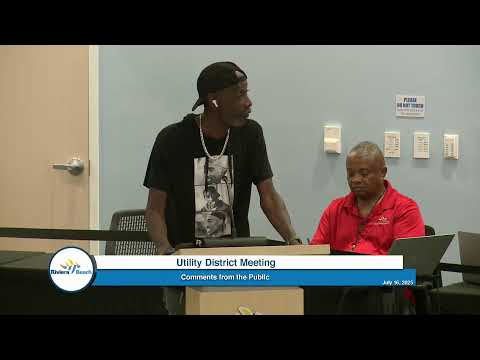
The board and residents pressed staff for details and faster communications. Resident Rochelle Baker Hughes said the district’s hydrant flushing and notice schedule was not consistently communicated and asked for broader outreach: “We need better communication from the utility district to the residents.” Annette Dragon, another resident, said flushing activities were handled poorly and reported yellow water and sediment in household plumbing.
Why it matters: the precautionary boil notice required residents in affected areas to treat or boil tap water for safety; the episode highlighted operational and communication failures that officials said they will address.
What the district said it will do: Neiman said the district is conducting a chlorine burn with Department of Health approval and expects that measure to help. “We are currently in a chlorine burn right now,” he told the board, and said the burn was scheduled for around July 21. He added that the burn would address part of the problem but not all of it.
Neiman described a two-part follow-up: 1) restore and sustain chlorine residuals by reducing the ‘‘water age’’ in the distribution system so treated water is consumed faster, and 2) develop a hydraulic master plan to model distribution velocities and identify pipe- or system-level work needed to reduce storage-stagnation and improve delivery to the west side. He said the district has about 4,000,000 gallons of storage and his short-term goal is to get treated water consumed within 48 hours; the master-plan target would be to keep maximum water age at 72 hours.
On preventive maintenance and staffing, Neiman told the board his review found prechlorination maintenance had not been done for about three years and that state guidance recommends annual prechlorination. He said he has personally begun reviewing daily plant data and has recommended staffing changes; he told the board he would ensure the district has personnel with the needed skills.
Board members pressed City Manager Jonathan Evans and Neiman about prior communications and operations oversight. A board member said residents ‘‘paid the cost’’ of missed maintenance after having to boil water for a week and urged clearer, more direct public notice. Evans described the district’s usual notification methods: door-hanger notices, signage in impacted streets, a crawl on Channel 18 and social-media posts. He said the district also reached out to local press for this unusually large precautionary notice.
Residents said that these measures were insufficient for some populations. Hughes noted that many residents lack internet access and asked the district to add robocalls, text alerts or other direct outreach. Neiman and Evans said staff would review expanded notification methods and were exploring text- and email-alert systems.
Public comment also included requests that the district address not only the plant but the older pipe network that delivers water from the new treatment facility to customers; Neiman said upgrades to distribution piping and targeted hydraulic work would be part of future infrastructure projects and budget discussions.
What was not decided: the board did not vote on a specific project or budget item during this discussion. Neiman said some distribution upgrades would be considered as separate projects and likely addressed during the city’s budget process.
Context and next steps: Neiman said corrective steps include completing the chlorine burn with Department of Health authorization, accelerating preventive maintenance, completing the hydraulic master plan and expanding communications. He told the board he ‘‘promised you all when I started this position that I was gonna tell you the good, bad, and the ugly,’’ and said staff would continue to report progress back to the board.
Speakers quoted in this story are Executive Director Joshua Neiman and public commenters Rochelle Baker Hughes and Annette Dragon, all of whom spoke at the July 16 meeting.
Ending: The board directed staff to return with follow-up information; staff said they would report on the chlorine burn results and on communications and planning for hydraulic improvements at future meetings.