
Polk County plans Level 2 charging rollout, targets 20% electric fleet by 2030
Get AI-powered insights, summaries, and transcripts
Subscribe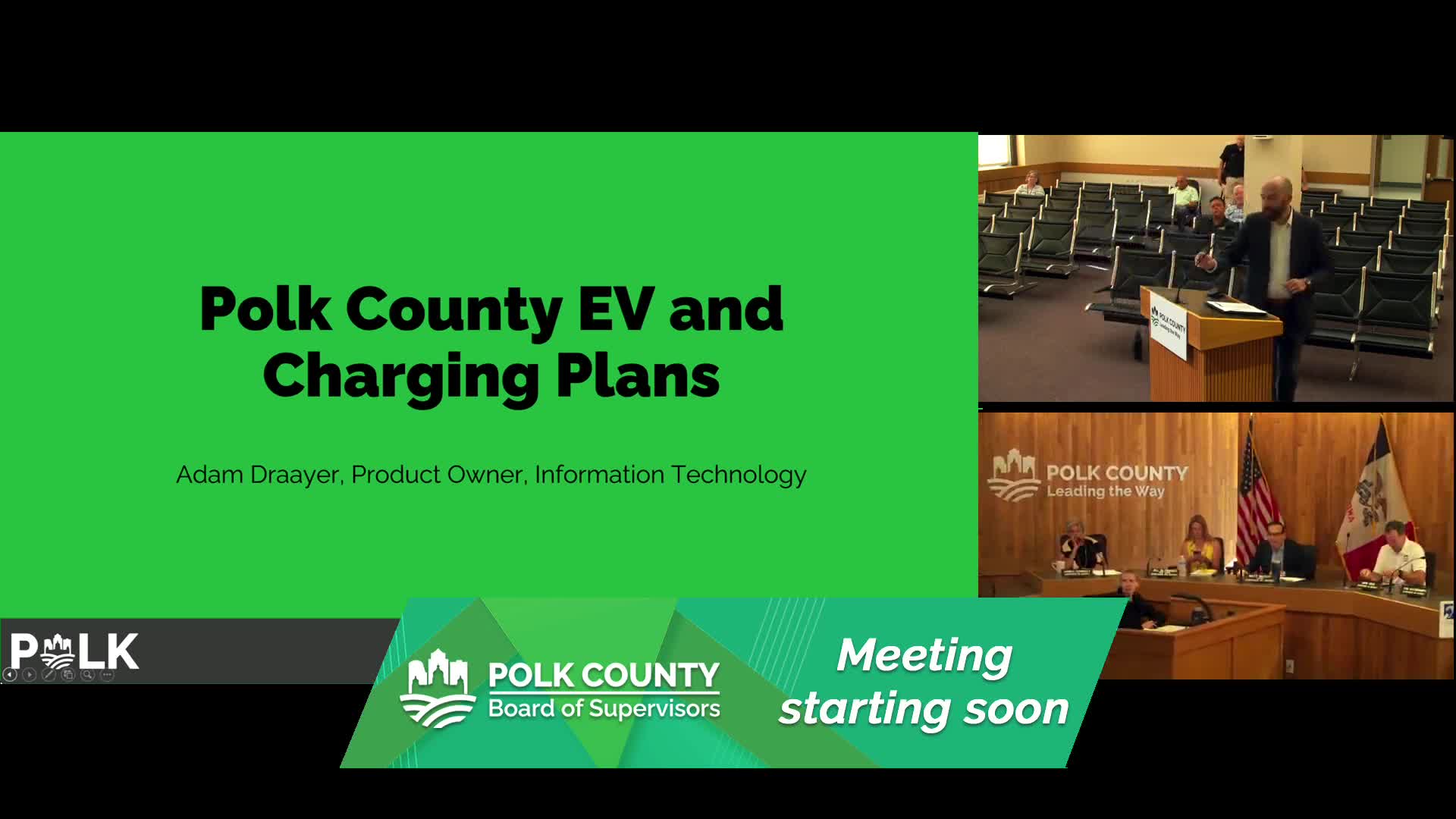
Summary
Polk County IT presented a plan to prioritize Level 2 EV chargers at three county sites, pair purchases with fleet replacement, and begin with fleet-only access while staff evaluate additional fleet needs including juvenile detention vehicles.
Avinger, Polk County IT and chair of the climate action team's fleet and fuel subcommittee, told the Polk County Board of Supervisors that the county plans to install Level 2 electric-vehicle charging stations at three county properties and pursue gradual fleet electrification to meet the county's climate targets. "Level 3 is the big boys. This is off the side of the interstates, super fast charging," Avinger said, explaining why Polk County will focus on Level 2 chargers for regular fleet and local use.
The presentation said Polk County's climate action mandate aims to reduce the county's greenhouse-gas emissions 90% by 2040 and reach roughly a 20% EV share in the county's light-duty fleet by 2030. Avinger said the county currently has six general-services EVs at the 70 College location and a separate set of 12 vehicles at Conservation. He proposed three initial charger locations: the Health Department site at 1900 Carpenter, the Admin Building, and the general-services garage at 70 College.
The plan prioritizes Level 2 chargers because they can go from near zero to a full charge in under six hours, suitable for overnight fleet charging. Avinger gave specific cost figures from vendor quotes: about $7,200 for a dual-head ChargePoint Level 2 unit procured through a state contract with Carbon Day, and said Level 3 sites typically require a large DC converter or generator that can cost on the order of $100,000. He recommended starting with fleet-only access and said the newer ChargePoint units have dual heads so Teslas and non-Tesla vehicles can charge without an adapter.
Avinger warned of changing incentives and grant availability. He said the 2025 reconciliation bill phases out a $7,500 federal electric-vehicle tax credit effective Sept. 30, and that a previously active federal charging-infrastructure grant program has been paused. "I don't anticipate further support in getting these level 2 chargers installed across Polk County at this point," he said. He also noted potential tariff and supply-chain risks because many vehicle components are sourced internationally.
County staff discussed implementation and tracking: the vendor would provide training for the county's master electricians, and the county's crews would handle installation and maintenance to limit long-term costs. Avinger noted that fleet vehicles are tracked in the county's standard fleet-maintenance system and said EVs would be graded the same as other vehicles for replacement timing; he estimated battery life is still uncertain but that EVs may have longer service lives than internal-combustion vehicles, closer to 10 years rather than 5—6'.
Public comment raised additional fleet needs. Don (resident and longtime juvenile-detention employee) described daily high-mileage use in juvenile-detention transport and supervision vehicles and urged the county to evaluate those vehicles for electrification, noting some vehicles run multiple times per day across the county. In response, a supervisory member asked staff to evaluate the juvenile-detention fleet as a potential candidate for electrification and report back.
Avinger said he would prepare preliminary investment numbers for the three initial locations and circulate them to county leadership within one to two weeks to support a near-term decision on a phased rollout. He recommended beginning with fleet-only chargers and considering opening them to the public later if usage patterns allow and the county can account for state taxation on public energy sales.
Implementation considerations raised during discussion included: choosing fleet-only vs. public access (the ChargePoint units can be switched between modes), the tax treatment under Iowa law when energy is provided to the public, panel capacity at each building (initial assessments indicated adequate capacity), and the county's ability to track energy consumption per vehicle if fleet chargers are installed.
Direction, next steps and limitations: staff were asked to (1) provide preliminary cost estimates for dual-head Level 2 installations at 70 College, the Admin Building, and 1900 Carpenter; (2) confirm electrical-capacity assessments and a staged installation plan; and (3) evaluate juvenile-detention fleet suitability for EV replacement and return findings to the board. No formal vote was taken at the meeting.
Polk County officials said the plan intentionally excludes pursuit and other sheriff's office vehicles for now because Level 3 infrastructure and different vehicle performance requirements will be needed for those uses. "If we ever get to the point or when we get to the point of talking to the sheriff about pursuit vehicles and EVs, that's what we may need to think about," Avinger said.