Get Full Government Meeting Transcripts, Videos, & Alerts Forever!
Get email alerts on the Downtown Business Improvement District topic
No spam. Unsubscribe anytime.
Council approves downtown business improvement district expansion to include The Gulch after lengthy public hearing
Summary
The Metro Council on July 15 adopted an ordinance creating an expanded Downtown Central Business Improvement District (CBID) that merges the existing Gulch Business Improvement District (GBID) into the CBID with new reporting, grievance and confirmation requirements after public hearings and four amendments. The ordinance passed 29-6-1.
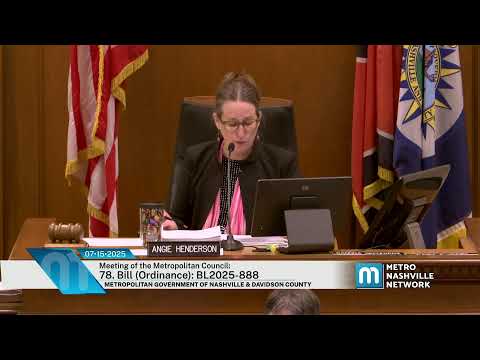
The Metropolitan Council voted 29-6-1 on July 15 to adopt BL2025-846, expanding the downtown Central Business Improvement District to include The Gulch and appointing a district management corporation to administer the combined district. The council added four amendments that require greater reporting, a public grievance process, annual metrics on interactions with the public and council confirmation of some district management corporation (DMC) board members.
Why it matters: downtown property owners collect assessments and some sales-tax revenues to pay for supplemental “clean and safe” services, outreach, landscaping and other functions that central business districts nationwide use to manage high‑traffic commercial cores. Supporters said the merger creates operational efficiencies and preserves services in The Gulch; opponents warned the expansion increases private influence over public space and called for stronger oversight.
Councilman Jacob Coopin, the bill sponsor, said the amended ordinance aligns with his district’s interests and the neighborhood’s request to combine the districts. “This is about the GBID and CBID board who, as you heard, deliberated and voted to combine these districts,” Coopin said during debate.
Supporters at the public hearing described services they say the downtown partnership already provides. Malik Gay, identified as vice president of livability at the Chamber and a Gulch resident, urged the council to “vote yes to unify The Gulch with the downtown district and strengthen what already works.” Developers, property owners and hoteliers — including Market Street Enterprises president Dirk Maltson and several downtown hotel general managers — testified that the partnership’s cleanup, maintenance and outreach work supports residents, businesses and visitors.
Opponents — including advocacy groups and residents — focused their public testimony on oversight, policing and transparency. Spencer Sharp told the council the Nashville Downtown Partnership “have failed to submit annual financial reports for 21 years” and urged the body not to expand the partnership’s authority until oversight gaps are fixed. OpenTable Nashville and other service providers and advocates questioned the partnership’s use of private security and off‑duty law enforcement for enforcement activities downtown.
Amendments adopted during committee and floor debate narrowed some concerns by adding explicit oversight and reporting requirements. Amendment 1 requires that certain DMC board nominations be subject to council confirmation. Amendment 2 sets a date and cadence for the DMC’s line‑item budget and reporting. Amendment 3 requires annual public reporting of program metrics including interactions with unhoused people and any use‑of‑force incidents. Amendment 4 creates a publicly accessible grievance process for complaints about DMC operations. Council members described those changes as a way to increase transparency while preserving the district’s services.
Councilmember Evan Siegel (speaking in committee) noted that prior city actions had imposed sales‑tax assessments that fund downtown initiatives, and she told colleagues that earlier ordinances added a quarter‑percent sales tax in 2013 and another quarter‑percent in 2021; she warned the council to recognize the fiscal impact of expanding the district to The Gulch.
The council’s final vote — 29 in favor, 6 opposed and 1 abstention — approved the ordinance as amended. Supporters said the amendments create the oversight tools the council sought; critics said concerns remain and pledged continued monitoring.
What happens next: the ordinance takes effect under the schedule in the text. The council will receive the DMC’s budget and the new reports established by the amendments on the timeline the ordinance requires. The council also agreed at multiple points to convene working groups and follow‑up meetings with stakeholders to track implementation.