Get Full Government Meeting Transcripts, Videos, & Alerts Forever!
Get email alerts on the School Finance topic
No spam. Unsubscribe anytime.
Silver Creek board hears second-quarter finances; education fund holds just under $6 million
Summary
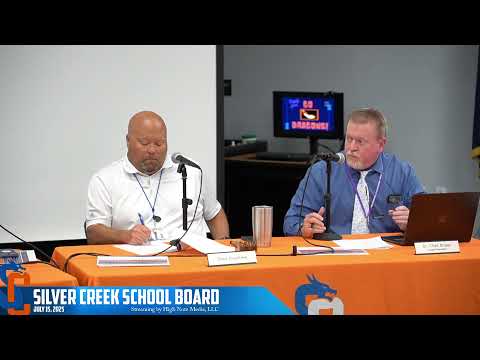
At its July 15 meeting at Silver Creek Elementary, district finance presenter Doctor Balmer reviewed second-quarter results, explained appropriations and warned of state-driven revenue changes tied to Senate Bill 1 and enrollment counts.
At the July 15 Silver Creek School Corporation board meeting at Silver Creek Elementary School, Doctor Balmer, a district staff member who presented the finance update, told the board the district entered the 2025 budget year with an education fund beginning balance of about $6.3 million and that education fund revenues through the second quarter totaled about $12.8 million while expenditures were about $13.1 million. "An investment in knowledge pays the best interest, and we believe that here," Balmer said as he summarized the district's position.
Balmer said the education fund ending cash balance after the second quarter was “just shy of $6,000,000” and that one-time payments — chiefly about $300,000 for a math textbook adoption moved into the education fund under a state mandate — inflated second-quarter expenditures. He said about 98% of education-fund expenditures are for salaries and benefits and that the state will provide a 2% increase for the 2025–26 school year, which will raise tuition support amounts.
The presentation also reviewed the operation fund and rainy day fund. Balmer said the operation fund began the year with a balance a little over $3.5 million, had roughly $4.3 million in revenue through the second quarter and about $3.8 million in expenditures, leaving an ending cash balance a little over $4.1 million. He reported the June tax settlement included roughly $1.8 million in property tax receipts, about $130,000 in excise taxes, and smaller amounts from commercial vehicle and financial-institution taxes, together “just shy of $2,000,000” for that settlement. The rainy day fund began the year at about $1.7 million; Balmer noted a June payment of $577,500 for a Hensley obligation and said the district wants to build the rainy day to roughly 15% of the budget, which he estimated near $5,000,000.
Balmer emphasized appropriation mechanics and limits. He explained an appropriation is the total dollar amount a district is authorized to spend in a fund and said the Department of Local Government Finance (DLGF) reviews and approves appropriation requests based on available revenue. He described the district’s process for setting and reviewing appropriation lines monthly and said the district may file for an additional appropriation if expenditures exceed an approved amount; such filings require public hearings and DLGF approval.
On state policy impacts, Balmer warned the board that Senate Bill 1 is expected to reduce operation-fund revenue in coming years — with more decline projected in fiscal 2027 and recovery beginning in 2029 — and that the district is planning and monitoring expenditures accordingly. He also noted the district uses the spring and fall ADM counts to calculate state tuition support and that fall enrollment will determine final revenue adjustments.
No formal budget motions or additional appropriations were taken at the meeting; the finance update was informational and concluded with Balmer answering board questions.
Board members present for the discussion were Mr. Basham, Miss McDaniel, Mr. Groen, Miss Franklin and one member who identified themselves during roll call. Superintendent-level agenda matters and other staff comments were led by Doctor Briggs earlier in the meeting.
Looking ahead, Balmer said the district will track expenditure trends after July payments (for 403(b) and other obligations) and will consider an additional appropriation if the fall count or other developments make it necessary.