Get Full Government Meeting Transcripts, Videos, & Alerts Forever!
Get email alerts on the Open Records Fees topic
No spam. Unsubscribe anytime.
Trustees declare emergency clause for town records ordinance after debate over open‑records fees
Summary
The Board of Trustees voted to declare the emergency clause on Ordinance 2025‑O4, adopting town records rules and a fee schedule that includes a 25¢ per‑page copy fee and proposed hourly search/redaction charges; residents urged review and asked for comparison to state open‑records fee rules.
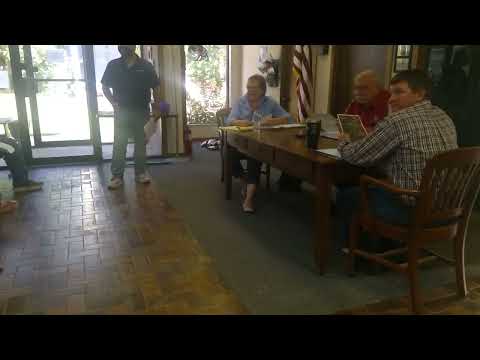
The Board of Trustees of the Town of Boyle, Oklahoma, voted to declare the emergency clause on Ordinance 2025‑O4, which adopts chapter 1, article 8 on town records and sets standards for open records and a fee schedule. The motion to declare the emergency clause was moved and carried by voice vote; the transcript records multiple “Aye” responses but does not list a roll‑call by name.
The ordinance adopts a 25¢ per‑page copy fee and treats other work — such as searches and redaction — as recoverable costs billed at an hourly rate, according to town staff. A town staff member said, “25¢ per page,” and explained that the town will recoup overtime and related burden costs when employees must perform manual searches or redactions. The staff member added that flash drives pose an IT security risk: “I would be fired if I stuck somebody’s flash drive in my computer.”
The issue drew public comment. A resident urged the trustees “to take another look at it,” saying the proposed code and fee schedule needed further review. Other residents and trustees pressed the staff to show how the proposed local fees align with the state open‑records statute before final adoption. One resident asked the board to provide the state fee schedule “prior to the adoption of this ordinance so the community can fully understand what the fees are that’s in the act as opposed to what you’re asking.”
Town staff told the trustees the ordinance language mirrors state law on allowable costs and certification fees and described the 25¢ per‑page charge as the prescribed copy fee. Staff also said most town records are already electronic, except accounts payable files, and that some manual work (for example, redacting social‑security or bank numbers or searching historical paper invoices) may require staff overtime because the town is understaffed.
Trustees and members of the public repeatedly asked for clarity on what would be charged for flash drives, electronic delivery, and manual redaction. Staff said prepared copies can be viewed at no charge on site, but electronic distribution and other special formats may trigger the proposed fees. The recorded discussion emphasized the town’s staffing limits and IT security concerns as drivers for the proposed hourly charges.
The ordinance discussion was followed by the motion to declare the emergency clause, which passed by voice vote during the meeting. Trustees said the fee schedule will be separated as a schedule so that the board will not have to adopt the entire ordinance each time a small fee change is proposed.
Trustees did not in the transcript provide a roll‑call vote or names for each “Aye,” and several speakers asked that the town circulate the state open‑records fee guidance before the ordinance takes final codification.