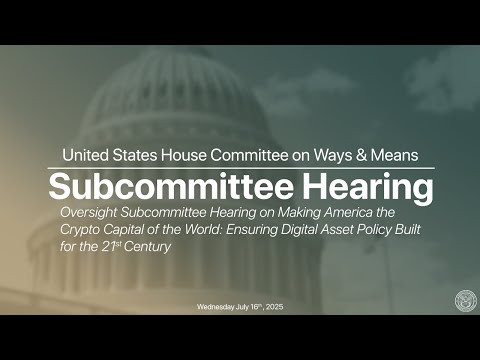
House Ways and Means hearing pushes for modernized tax rules for digital assets

5407301 · July 15, 2025

Get AI-powered insights, summaries, and transcripts

Subscribe
AI-Generated Content: All content on this page was generated by AI to highlight key points from the meeting. For complete details and context, we recommend watching the full video. so we can fix them.

Summary

Witnesses at a House Ways and Means hearing urged Congress to modernize the tax code for digital assets, calling for a de minimis exception, clearer rules for staking and mining rewards, and relief from an estimated flood of IRS reporting. Lawmakers discussed job creation and enforcement gaps but took no formal votes.

WASHINGTON — Lawmakers on the House Ways and Means Committee heard bipartisan testimony Thursday urging Congress to overhaul tax rules for cryptocurrencies and other digital assets to reduce compliance burdens, protect retail users and keep industry jobs in the United States.

Witnesses representing industry groups, financial firms and consumer advocates told the committee that current tax treatment is unclear and administratively onerous. "Right now, every digital asset transaction, no matter how small, is a taxable event," Summer Mersinger, chief executive officer of the Blockchain Association, told the panel. She warned that reporting requirements could overwhelm taxpayers and the Internal Revenue Service.

The panel heard repeated proposals aimed at three problem areas: a de minimis exclusion for small personal transactions; clearer guidance on when rewards from staking or mining count as income; and changes to reporting rules that officials say could produce billions of additional information returns.

Why it matters: More than 50 million Americans hold some form of cryptocurrency, witnesses and members said, and companies tied to digital assets have generated jobs and investment. Without clearer tax rules, supporters argued, activity could move offshore and small investors could face onerous paperwork or overtaxation.

Key testimony and recommendations

Industry and financial witnesses described concrete, overlapping fixes they want Congress to adopt. Mersinger said the tax code should exempt de minimis gains and losses, provide nonrecognition treatment for certain internal token movements, and clarify the character and sourcing of staking and mining rewards.

"The IRS itself has said it expects up to 8,000,000,000 new 1099‑DA forms annually," Mersinger said; she added an industry estimate that compliance could cost U.S. taxpayers roughly $250 billion and demand about 4,000,000,000 hours of paperwork per year.

Jason Samansato, director of policy at Coin Center, urged Congress to treat newly created block rewards more like newly produced property and not as immediate ordinary income. "These tokens are not received from another party. They are created by the validator, like a farmer grows a crop or an author writes a novel," he said, arguing rewards should be taxable when the holder disposes of them, not upon creation.

Fidelity senior tax counsel Sarah Riley told the committee that tax certainty is also essential for products that let ordinary investors access crypto — such as exchange‑traded products (ETPs) — and for keeping staking activity onshore. She said sourcing rules for staking income are unclear and that ambiguity has already prompted some staking activity to move outside the United States.

Lisonbee Manjuri of the Crypto Council for Innovation emphasized staking’s scale, saying global value staked across proof‑of‑stake networks has grown from roughly $50 million in 2019 to about $660 billion today, and argued that burdensome tax rules could discourage the infrastructure that secures many modern blockchains.

Consumer protection and enforcement concerns

Consumer advocates and some members pressed witnesses about investor protections and enforcement. Corey Frayer of the Consumer Federation of America said regulatory parity is important: digital assets should not receive weaker investor safeguards than traditional financial products.

Several lawmakers raised conflicts of interest tied to a high‑profile presidential token and asked whether weaker enforcement resources at agencies such as the SEC or Justice Department risked undermining market integrity. Witnesses stressed that better resourcing and technology‑neutral rules are needed so regulators do not "pick winners and losers."

No formal actions

The hearing produced no committee votes or binding decisions. Members discussed legislative options and tradeoffs, and committee leaders said they will continue drafting tax proposals. One committee member said in remarks that draft legislative text would be circulated in the coming weeks, though the hearing itself did not produce an enacted bill.

Context and next steps

Witnesses and members repeatedly urged that tax reform move in parallel with regulatory work such as stablecoin and market‑structure bills now being considered in Congress. Proposals discussed at the hearing included a de minimis personal‑use exclusion (analogous to a currency de minimis enacted in 1997), clearer sourcing rules for staking income, mark‑to‑market options for certain traders, and narrowly tailored safe harbors for foreign persons.

Lawmakers also noted practical administration questions: how to define personal use versus investment, whether pooled staking arrangements mimic traditional fund structures, and how to prevent misuse of any new exemptions. Committee staff will use witness testimony as lawmakers draft tax language intended to ease reporting burdens, clarify timing and character of income, and encourage domestic investment in digital asset infrastructure.

Ending

Lawmakers left the hearing with broad agreement that some form of tax modernization is needed but without consensus on specific legislative language. The committee indicated it will continue fact‑finding and solicit additional technical input from Treasury, the IRS and industry stakeholders as it prepares draft legislation.