Get Full Government Meeting Transcripts, Videos, & Alerts Forever!
Get email alerts on the City Hall Redevelopment topic
No spam. Unsubscribe anytime.
Commission asks for public workshops on future of City Hall site as leases and tenant moves create a window for change
Summary
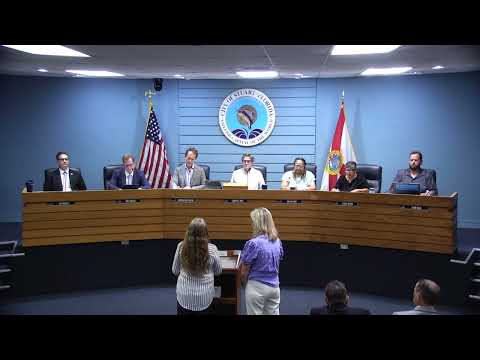
City Manager Mortel told the commission July 14 that shifting tenant leases at the Wells Fargo and adjacent cancer-center complex create a near-term chance to move commission chambers and staff and to develop options for the City Hall waterfront parcel.
City Manager Mortel briefed the commission on July 14 about the long-running question of using the City Hall waterfront site for redevelopment or public space and about an emerging window of opportunity resulting from current tenant timelines at the Wells Fargo/cancer-center complex.
History and legal constraint: the commission’s use and disposal of waterfront parcels in places that front the Saint Lucie River or tidal creeks is governed by an ordinance that requires a public referendum before conveying or leasing related real property longer than 10 years. The commission has considered multiple concepts and held public workshops over the last two decades — proposals have ranged from hotel-and-parking concepts to mixed-use buildings and expanded downtown green space — but the body never submitted a concrete plan to a referendum.
Where the opportunity lies now: staff told commissioners that recent lease dynamics at the Wells Fargo property and the cancer center may create an opportunity to relocate staff and commission chambers into the Wells Fargo building while freeing the current City Hall site for design and possible redevelopment. “The cancer center has outgrown it. They need to go somewhere. They’re willing to leave in ’28,” City Manager Mortel said, explaining that a move could allow the city to reconfigure the current City Hall parcel for public use, a mixed-use project or another use the commission approves.
What the commission asked for: commissioners asked staff to gather prior plans and run a public, facilitated workshop process to gather resident input and compare trade-offs. Commissioner Clark asked for a facilitator and for the session to be designed as a true public charette rather than a series of short presentations. Commissioners discussed project elements the public previously identified — public waterfront access, green space, structured parking and a downtown extension — and asked staff to list options and timelines that would allow a potential referendum in a future election cycle if the board chose that route.
Practical next steps and timing: staff said it will present the leases that make the near-term relocation possible on the July 28 regular meeting agenda. If the commission directs it, staff will convene facilitated workshops this fall, pulling prior concept plans and public‑workshop materials together as a starting point. Staff cautioned that a finished design and a clearly costed project would be required before a precise referendum question could be drafted. Commissioners asked staff to prepare a reverse timeline (backward schedule) showing the actions and milestones required to reach a referendum and, separately, to show the minimal set of improvements needed to open a portion of the waterfront parcel as passive parkland if the commission prefers that outcome.
What is not decided: no redevelopment deal has been negotiated and no final decision on leasing, sale or park designation was made; the commission’s referral of the question to a public workshop process is intended to gather community input and prepare options with cost estimates and draft referendum language for later consideration.