Get Full Government Meeting Transcripts, Videos, & Alerts Forever!
Get email alerts on the Cra Properties Downtown Stuart topic
No spam. Unsubscribe anytime.
Stuart CRA board reviews five downtown parcels; leases, litigation and commission policy limit redevelopment options
Summary
At a City of Stuart Community Redevelopment Board meeting, members reviewed five CRA-owned parcels in and around downtown and discussed constraints — long-term leases, prior lawsuits and a city commission stance against multifamily — that currently limit redevelopment options.
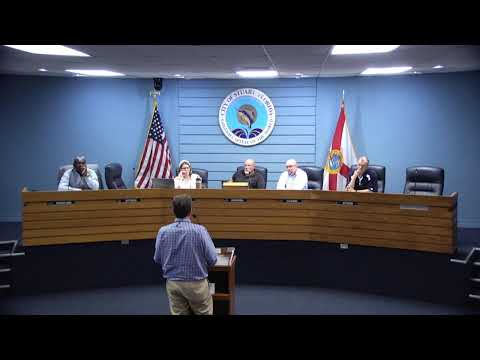
Members of the City of Stuart Community Redevelopment Board on Monday reviewed an inventory of five CRA-owned parcels downtown and discussed how long-term leases, litigation and the City Commission’s current policy stance are constraining redevelopment options.
Board members debated whether to push for redevelopment, retain sites as public green space or sell parcels, while staff described existing legal, financial and contractual limitations that would affect any project.
Staff identified five parcels in the CRA inventory: the Northpointe parcel north of the old drawbridge; a triangular site that includes the land beneath the Azul apartments; two adjacent parcels along East Ocean Boulevard and Osceola Street next to the Wells Fargo building (listed in materials as 325 Ocean and 330 Osceola); and the Willie Gary parcel where a separate project is underway. Sandy Sabda, the board scribe, presented the map and the list of parcels to the board.
The meeting highlighted three practical constraints on redevelopment. First, the Northpointe site has been slowed by litigation. "Northpointe was involved in two lawsuits; the last one just recently ended," said Lee Baggett, the city attorney, who noted the property had been tied up in legal proceedings for years. Second, some parcels are effectively unavailable because of long-term leases: staff and board members described the land underlying the Azul apartments as encumbered by a long-term lease (speakers referred to figures in the range of multiple decades). Third, board and commission policy choices matter: several speakers said the City Commission has signaled opposition to multifamily development, which would reduce private interest in proposals that counted on residential density to make projects financially viable.
Board members and staff discussed the history of the Wells Fargo block in detail. According to staff comments at the meeting, the city used General Fund borrowing to purchase the Wells Fargo building and the CRA contributed funds to acquire an adjacent vacant parcel; the CRA contribution was described in the meeting as roughly $1,000,000 while the city borrowing for the building was described as roughly $6,000,000. Those figures were presented by city staff during the discussion about how prior transactions and developer proposals shaped present options.
The board reviewed prior solicitations and submissions. One developer, Stuart Muse (identified in the meeting as the team led by Tim Hernandez), had previously been selected under an RFP to develop a mixed project on the Wells Fargo/adjacent-parcel site; the development concept shown earlier included a parking garage timed to public investment and phased residential units. Staff and board members said that original proposal relied on a multi-step implementation that assumed the parking garage would be completed before developer obligations kicked in. At the meeting staff explained that under current conditions — notably higher construction costs and a commission preference against multifamily — that proposal is effectively in limbo and would require the termination or renegotiation of the existing agreement before it could move forward.
Staff also described an alternative concept discussed previously with developers: building fee-simple two- and three-story single-family homes on the Wells Fargo-adjacent parcels, with deed restrictions to limit short-term rentals. Staff projected, on the record, a hypothetical comparison where a fee-simple single-family approach could create substantially higher assessed value in the long term compared with a 94-unit multifamily lease model; those back-of-envelope comparisons were presented by staff as part of the discussion about tax base and CRA revenue, not as adopted policy. The board discussed possible deed restrictions to limit short-term rental use of future residences.
Board members asked for clarity about which approvals would be required for any proposal. Staff explained that CRA-owned property transactions and lease terms frequently require multiple approvals: an RFP review process, CRA/CRB action, local planning approvals and, in some cases, city commission action. Staff also noted a state-law requirement discussed at the meeting: long-term leases or sales of waterfront city property commonly require a public referendum, which can affect how waterfront parcels are packaged for development.
Several members urged using the CRA inventory to prioritize smaller, near-term projects the board called "no-brainers" — streetscaping, trees, pedestrian improvements — while continuing to prepare for larger proposals that would likely need coordination with the commission and private investors. Board members also expressed concern that downtown success and tourist demand have increased pressure on housing affordability and on long-term businesses that may be priced out by rising rents.
The board asked staff for follow-up materials. Staff agreed to circulate the CRA plan and the parcel maps included in the meeting packet, and to provide a written recap of the Wells Fargo / adjacent-parcel history and any outstanding contractual entanglements. One staff member noted that there were currently no active marching orders to pursue a specific redevelopment on the Wells Fargo site.
Votes at a glance - Motion to approve agenda: moved and seconded; outcome: approved (voice vote). - Motion to approve May 6 minutes: moved and seconded; outcome: approved (voice vote). - Motion to adjourn: moved and seconded; outcome: approved (voice vote).
Why it matters: The CRA’s land inventory includes parcels that could support significant downtown projects or be preserved for public uses. Long-term leases, past litigation and the City Commission’s stance on multifamily development limit near-term options and make negotiation and legal review essential before the CRA or the board can move properties toward redevelopment or sale.
What’s next: Staff will circulate the parcel maps, the CRA plan and a written summary of past actions and outstanding agreements for the board’s review; any future project will require additional coordination with the CRA board and likely the City Commission and planning bodies before approvals or transactions proceed.