Get Full Government Meeting Transcripts, Videos, & Alerts Forever!
Get email alerts on the Infrastructure Sewer Standards topic
No spam. Unsubscribe anytime.
Kitsap Public Works outlines comprehensive update to sanitary sewer construction standards
Summary
Public Works staff presented a two-part update to Kitsap County's sanitary sewer construction standards, proposing technical "priority 1" operational rules and a set of discretionary "priority 2" development policies; staff proposed a draft/workshop schedule and invited developer feedback.
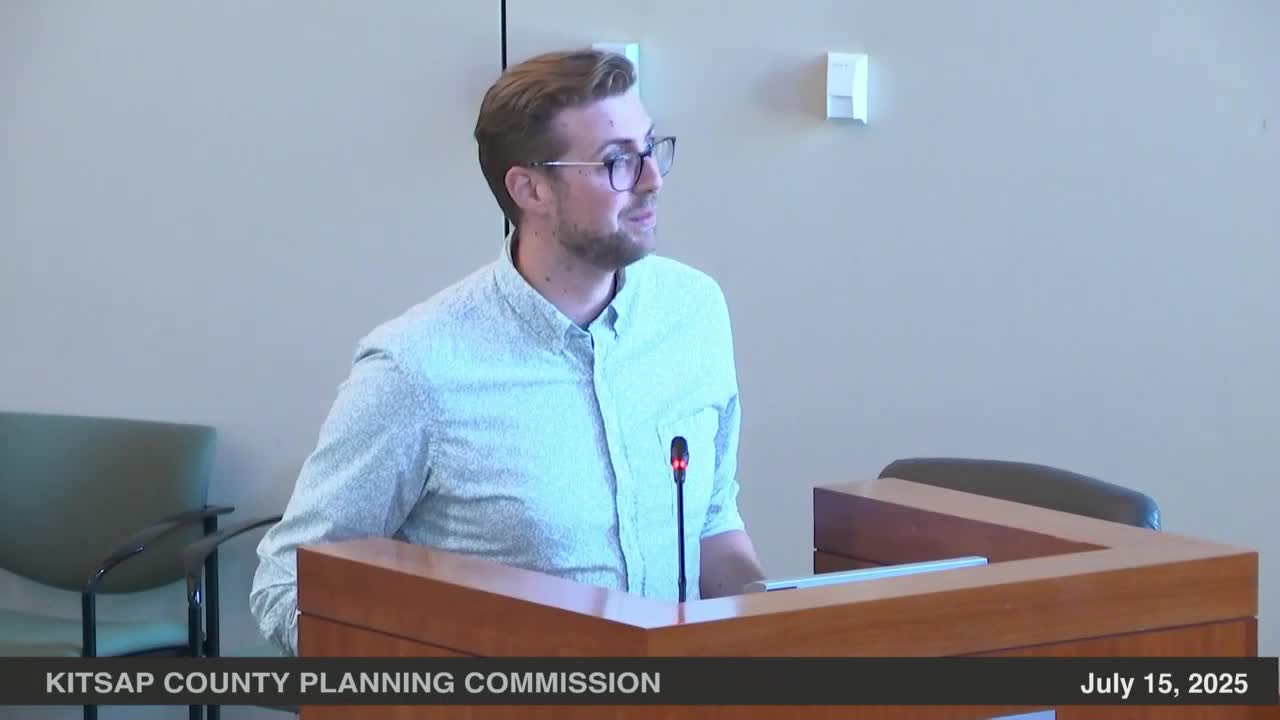
Anthony Burgess, capital projects manager for the Kitsap County Public Works Sewer Utility Division, briefed the Kitsap County Planning Commission on July 15 about a comprehensive update to the county's 2025 sanitary sewer construction standards. The presentation described two workstreams for the update, explained why an update is needed and outlined a proposed schedule of workshops and hearings.
Burgess said the standards "build on other established requirements from agencies like the Washington State Department of Transportation and Department of Ecology" and are intended to establish consistent expectations for developers and design professionals across the county's four sewer service areas: Manchester, Central Kitsap, Kingston and Suquamish. He told the commission the standards will cover gravity mains and structures, pressurized lines, developer-installed lift stations, easement and dedication policies and the public/private delineation of infrastructure.
Burgess told commissioners the update is long overdue and that the existing documentation is "not easily understood and difficult to locate." He said some older requirements are out of step with current construction practice and, in some cases, have been perceived as barriers to development. As an example, he said the current standards allow use of pea gravel for backfill, which he called "not appropriate for sewer main installation" because it creates long-term maintenance issues. He described the project as two priorities: Priority 1 will set jurisdictional means-and-methods tied to safety, operation and maintenance; Priority 2 will address discretionary development issues that differ by jurisdiction.
Commissioners asked about the project schedule, outreach to the Kitsap Builders Association and specifics that will be clarified in future work studies. Burgess said he had already briefed the Kitsap Builders Association and expected feedback to be included in the public record. He proposed either one extended work study or two work studies before public hearing and subsequent deliberations and Board of County Commissioners consideration. He also provided technical examples for Priority 1 items, such as the need to increase easement widths when sewer mains exceed typical depths: "This easement width has never changed in our standards, which creates issues for us when sewer is 20 feet deep," he said.
Commissioners also asked about recycled water ("purple pipe") standards; Burgess said Silverdale Water District would be the purveyor and that the county's document would not set distribution standards. He said the county would be the producer at the Central Kitsap treatment plant in Brownsville and that recycled-water planning is addressed in the county comprehensive plan and general sewer plan, but that distribution and purveyor standards would be Silverdale Water District responsibilities.
No formal action was taken by the commission on July 15. Staff seeks commission feedback at upcoming work studies before publishing drafts for public comment and moving to public hearing and deliberation stages.
The county plans to proceed with staff-led work studies and workshops and intends to present findings and a drafted standards document to the commission and then to the Board of County Commissioners for formal adoption at a later date.