Get Full Government Meeting Transcripts, Videos, & Alerts Forever!
Get email alerts on the Public Comment Critical Areas topic
No spam. Unsubscribe anytime.
Public commenters, WSDOT and rural groups urge revisions to critical‑area mapping, septic rules and mitigation options
Summary
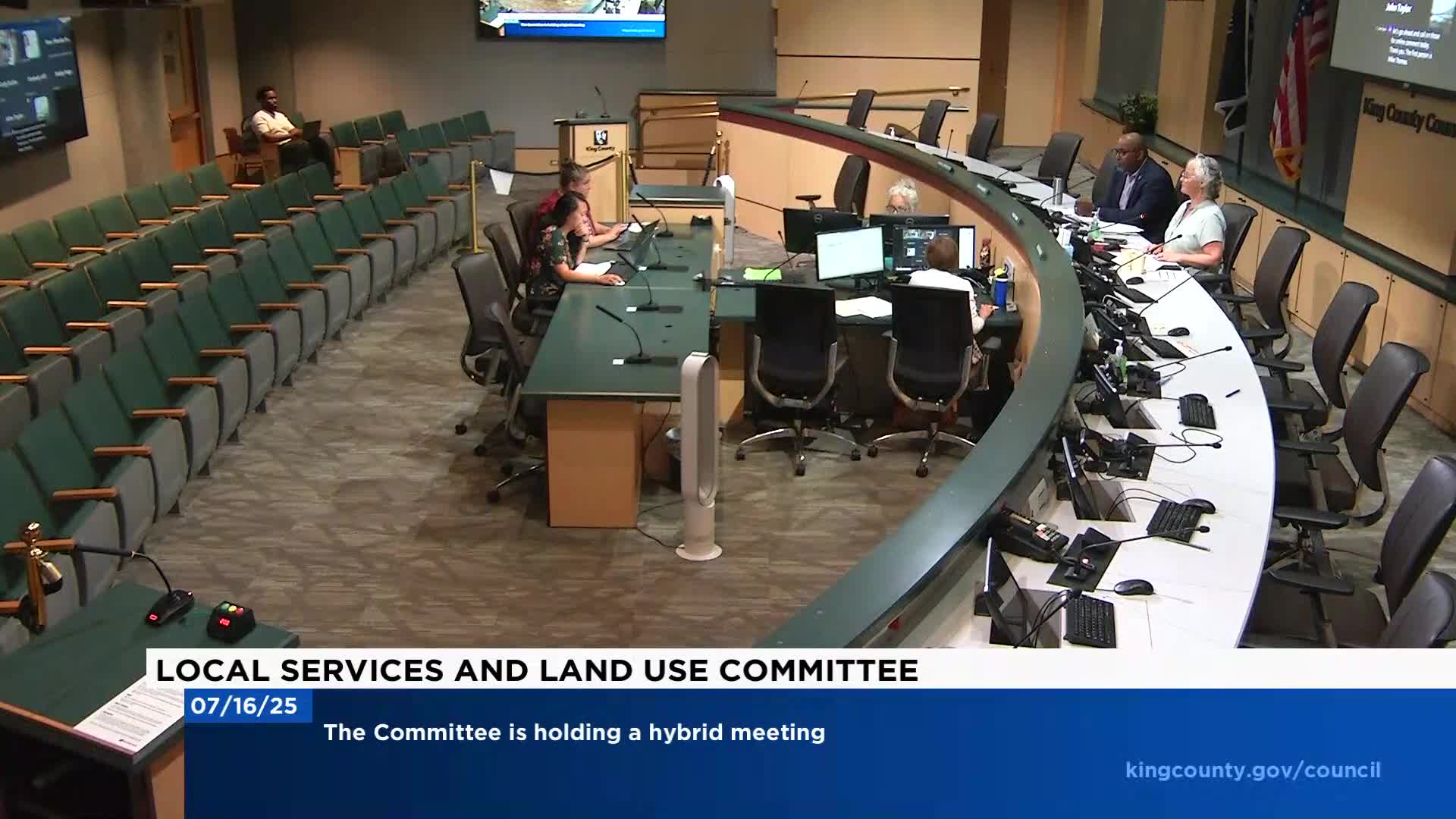
The committee took public comment at the start of its July 16 meeting on items appearing later on the agenda, principally the proposed critical areas ordinance updates and their mapping and permitting effects.
The committee took public comment at the start of its July 16 meeting on items appearing later on the agenda, principally the proposed critical areas ordinance updates and their mapping and permitting effects.
Mike Thomas of North Bend told the committee he was “greatly concerned about the intersection of critical aquifer recharge areas mapping … and onerous requirements on septic replacements.” He said more than 2,000 septic systems in North Bend could face elevated replacement costs if mapped in a critical aquifer recharge area and said “there is no evidence that these septic systems are contributing to drinking water quality issues” in his area. Thomas argued the county should “revisit the mapping and its science and its methods” and noted local geology and rainfall patterns as factors that, in his view, were not sufficiently accounted for in mapping.
Terry Lavender, representing the Joint Rural Team (a coalition of urban unincorporated area organizations and rural groups), said the proposed update to the critical areas ordinance “is very good and offers a greater level of protection to critical areas in the county,” but warned that without “major reform in the Department of Local Services permitting division, we're very concerned the promise of this update will fall short.” Lavender urged clearer materials, adequate staffing and effective code enforcement to make the rules usable for landowners.
Evan Doolin, mitigation lead for the Washington State Department of Transportation Environmental Services Office, said WSDOT “agrees with many of the proposed changes” but asked the county to explicitly include advanced mitigation sites in the code alongside mitigation banking. Doolin said advanced mitigation “provides very similar ecological benefits” and shortens the time between restoration benefits and project impacts. He also requested that the county allow similar mitigation‑ratio reductions for off‑site riparian mitigation using primary and secondary restoration actions, saying narrow rights‑of‑way often make on‑site riparian mitigation infeasible for transportation projects.
Committee members acknowledged the comments. Chair Sarah Perry thanked commenters and said the committee and staff would continue to work on mapping issues and the broader ordinance review. The committee did not take action on the comments; public remarks were recorded as input to the ongoing process.