Get Full Government Meeting Transcripts, Videos, & Alerts Forever!
Get email alerts on the Animal Control Spay Neuter topic
No spam. Unsubscribe anytime.
Bedford County committee delays vote on targeted spay-and-neuter rules after wide public debate
Summary
The county’s Rules and Legislative Committee heard hours of public comment and staff testimony on a proposed animal-control resolution that would require altered animals seized as running at large to be sterilized or owners to pay fines; members agreed to form a study group and return the draft next month.
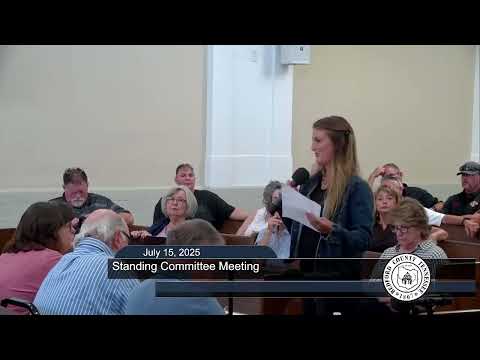
The Bedford County Rules and Legislative Committee on Tuesday heard widespread public comment and staff testimony about a proposed animal-control resolution that would require animals picked up for running at large or chronically tethered to be spayed or neutered or face fines; the committee voted to delay final action for one month and asked Commissioner Epperson to return with a revised draft and a process for public input.
Supporters said targeted sterilization and fines could reduce shelter intake and save taxpayer money. Donna Clanton of New Destiny Dog Rescue urged the committee to “have spay and neuter requirements or pay a yearly fee” and suggested a $100 annual fee per unaltered dog as an example. Savannah, representing Better Days Dog Rescue, said more than 60% of shelter intake are pit bull–type dogs and estimated each dog costs the county “$400 to $600 to trap, house, feed, vet, and sometimes euthanize,” arguing that targeted enforcement would reduce intake and spending. An unnamed cat-rescue representative said cats should be included and quoted national estimates for stray animals, which she gave as about 5,000,000 dogs and 33,000,000 cats in the United States.
The proposal discussed by the committee is a targeted spay-and-neuter approach tied to existing running-at-large citations rather than a blanket mandatory sterilization rule for all dogs. Under the draft described to the committee, an owner whose animal is picked up running at large would receive a citation and be given 90 days to have the animal altered; if the owner does not comply the DA’s office could pursue the citation. The draft sets a jurisdictional penalty provision that the presenter said should read “no more than $500” (the draft currently referenced $50 and used wording that the presenter said should be fixed). Presenters also said the ordinance would not take effect for one year so residents would have time to prepare.
Animal-control staff and other county officials cautioned that the county currently lacks facility space and staff capacity to implement the resolution as written. Josie, identified in the meeting as Bedford County Animal Control director, told the committee the shelter’s operation is already at maximum capacity, that the facility was not designed for current needs and that staff are stretched thin. Josie said the shelter currently houses 61 animals and calculated a shortfall of roughly 181.5 staff hours per week relative to a common industry benchmark of 15 minutes of direct care per animal per day. She warned that adding enforcement or surgical programs without additional personnel and facility upgrades would risk overloading the department.
Officials and commissioners also raised procedural and fairness concerns for rural residents. Several commissioners asked how the proposed ordinance would affect residents with large or remote properties and described scenarios—dogs running on large parcels or following owners in fields—where a neighbor might report a dog as running at large even though the animal was on the owner’s property. Commissioners recommended exemptions commonly included in other counties’ rules, such as veterinary medical exemptions and exemptions for working/hunting dogs, and discussed possible step-up enforcement (warning first, citation second).
There was debate about enforcement workload. The presenter said Blount County passed a targeted spay-and-neuter ordinance and Williamson County enforces a spay-and-neuter requirement through its running-at-large law; she said Blount County did not have to add staff. Animal-control staff disputed that comparison, noting that neighboring counties benefit from volunteer groups, nonprofit partners, and different facility capacity, and that Bedford County’s current shelter lacks both space and veterinary staff to absorb additional surgical work. The animal-control director highlighted that daily duties already include calls, intake processing, kennel care, transport, and community outreach; during multi-day spay clinics staff act as intake and veterinary technicians, limiting the ability to respond to emergencies.
After extended public comment and discussion, commissioners agreed not to adopt the resolution at this meeting. Commissioner Bowman moved to defer the matter for one month and requested that Commissioner Epperson prepare a draft process and stakeholder plan; the motion passed. Committee members asked that the follow-up include a proposed study group or task force with rescue organizations, animal-control staff, a veterinarian, municipal representatives, the county attorney’s office, and other stakeholders to produce a recommended structure for any ordinance and associated budget implications.
The committee’s action was procedural: it postponed the resolution to allow additional review, stakeholder meetings, and a transparent process for drafting a final ordinance and any resource requests. The committee directed Commissioner Epperson to return next month with a plan for public engagement and a revised draft. The county did not adopt any new ordinance or fines at the meeting.