
Residents, commissioners press to weave climate resilience, active transportation and sewer fixes into Island County 2025 comprehensive plan
Get AI-powered insights, summaries, and transcripts
Subscribe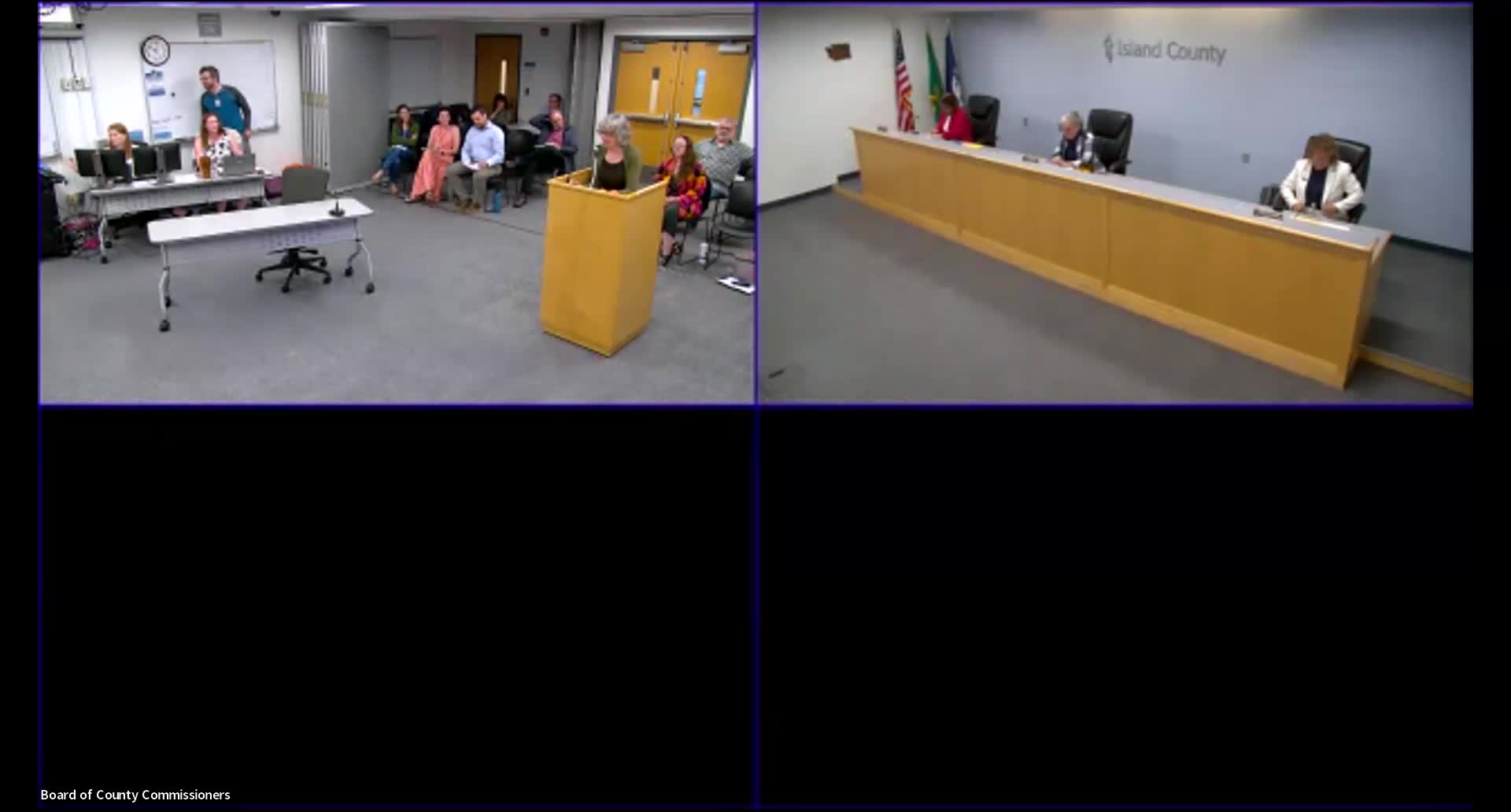
Summary
Public commenters and commissioners on July 1 urged Island County to ensure the 2025 comprehensive plan ties climate resilience across elements, prioritize active transportation and resolve sewer infrastructure limits that constrain Freeland’s urban growth area. The board scheduled a 1 p.m. workshop to review revised goals and policies.
Island County commissioners on July 1 heard public comments urging that the county’s 2025 comprehensive plan more fully integrate climate resilience, active transportation and a clear sewer strategy for Freeland, and set a 1 p.m. workshop to review revised goals and policies.
Supporters of stronger climate policy praised staff work on the draft plan but asked the board to ensure the climate element is woven through transportation, housing and utilities sections so policies align across the document.
"I want to commend you and members of the planning department staff for putting in such sustained work on the 2025 comprehensive plan," said Linda Irvine, representing Whitby Climate Action. She highlighted the plan’s climate-resilience goals and praised a change in the transportation element that replaces the term "alternative" with "active" and adds "multimodal." Irvine singled out transportation policy 6.5, which promotes a multiuse pathway alongside the highway, saying such paths "will encourage active transportation and reduce vehicle traffic on roads and ferries, reduce pollution, improve air quality, promote tourism, and keep those of us who already cycle a lot safer."
Dean Nannell, who said he is a member of the same climate organization, framed the plan in the context of sprawl and infrastructure limits. He criticized historic growth patterns that have placed new development in rural areas and said a 1998 approach to downzoning and creating an urban growth area (UGA) in Freeland relied on a sewer that was never delivered. "Today, Freeland could best be described as a non functional NMUGA," Nannell said, and he asserted that "85% of the new growth in 3 of the 4 planning areas of Island County occurs in the rural area." He urged the county to pursue smaller-scale sewer solutions and to ensure the plan supports affordable multifamily housing where sewer capacity exists.
Amanda Bullis of the Environmental Action Network asked the board to prioritize ecosystem functioning in the natural-resources element and invited the county to cosponsor a roundtable and cohost a town-hall discussion linking agriculture, housing, environment and public health before draft materials are released later this year. "We wholeheartedly accept that challenge and ask that the county cosponsor a roundtable for community groups," Bullis said.
Commissioners responded with a mix of acknowledgement and procedural reminders. They thanked speakers for their participation and emphasized constraints the county faces in delivering infrastructure: permitting and discharge options limit where a sewer can drain, soil conditions complicate on-site disposal, and the county must work with municipal partners to absorb growth within designated UGAs. The board said it is reviewing alternatives, including smaller neighborhood sewer systems, and is working to leverage existing UGAs and municipal cooperation to limit sprawl.
Steve Myers of Langley asked about a public-facing emergency-preparedness flip chart he previously shared; commissioners said a prototype has been produced and will be reviewed by the county in early August. "I'm still getting a couple of phone calls a week asking for these flip charts," Myers said.
The board approved the meeting agenda — which added two executive sessions — and the consent agenda by voice vote. It announced a planning workshop at 1 p.m. to discuss revised goals and policies, including the capital facilities and utilities element and the parks, recreation and open-space element. The board said no public announcements were expected after the scheduled executive sessions covering real estate and the performance of a public employee.
What happens next: county staff and the board will review the draft comprehensive-plan materials during the afternoon workshop and continue work on infrastructure alternatives for Freeland. Community groups seeking focused discussion were advised to use existing planning-commission and public-review opportunities to avoid violating the Open Public Meetings Act, though several speakers asked the county to cohost targeted roundtables or town-hall events before final drafts are released.